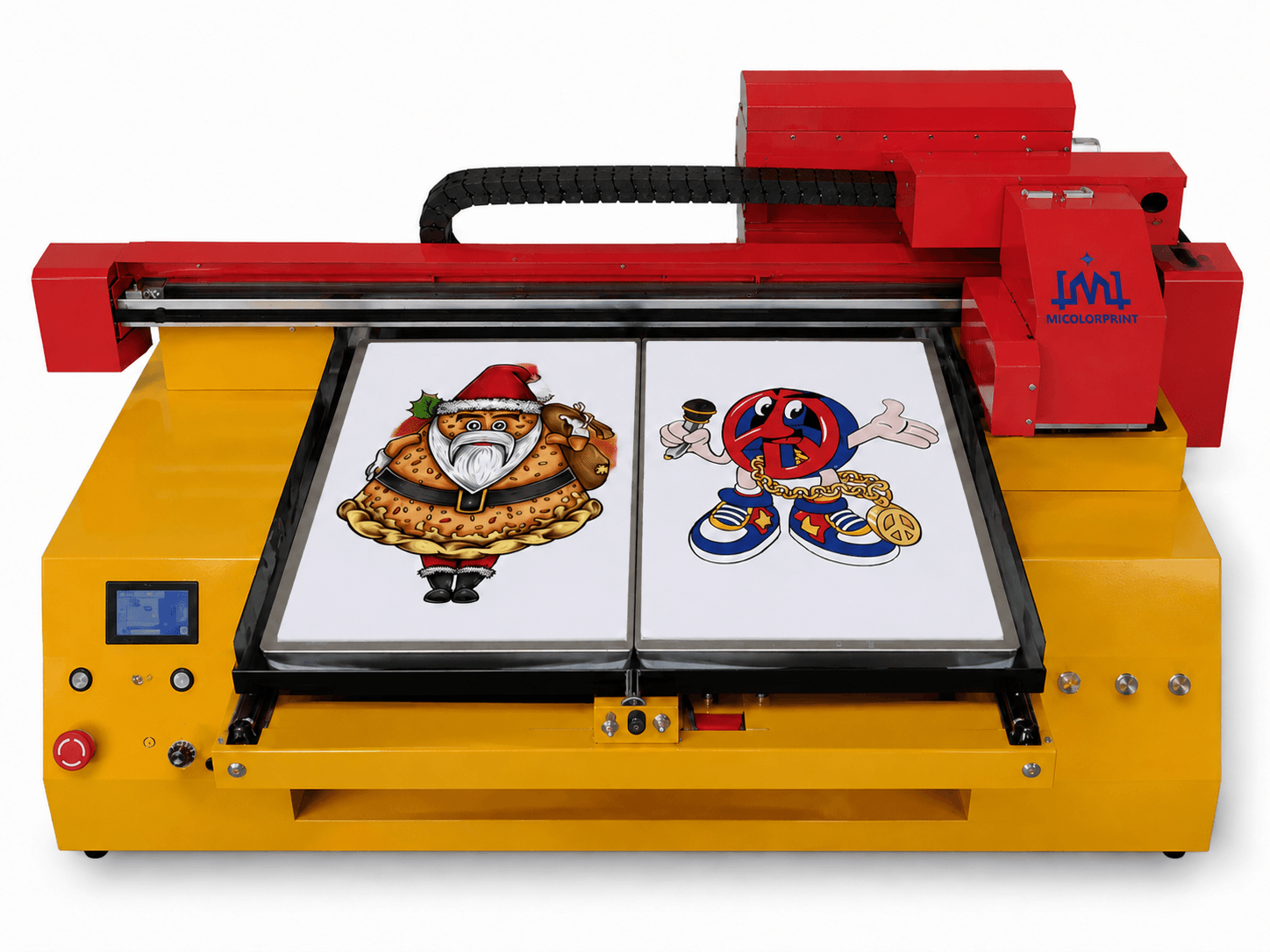
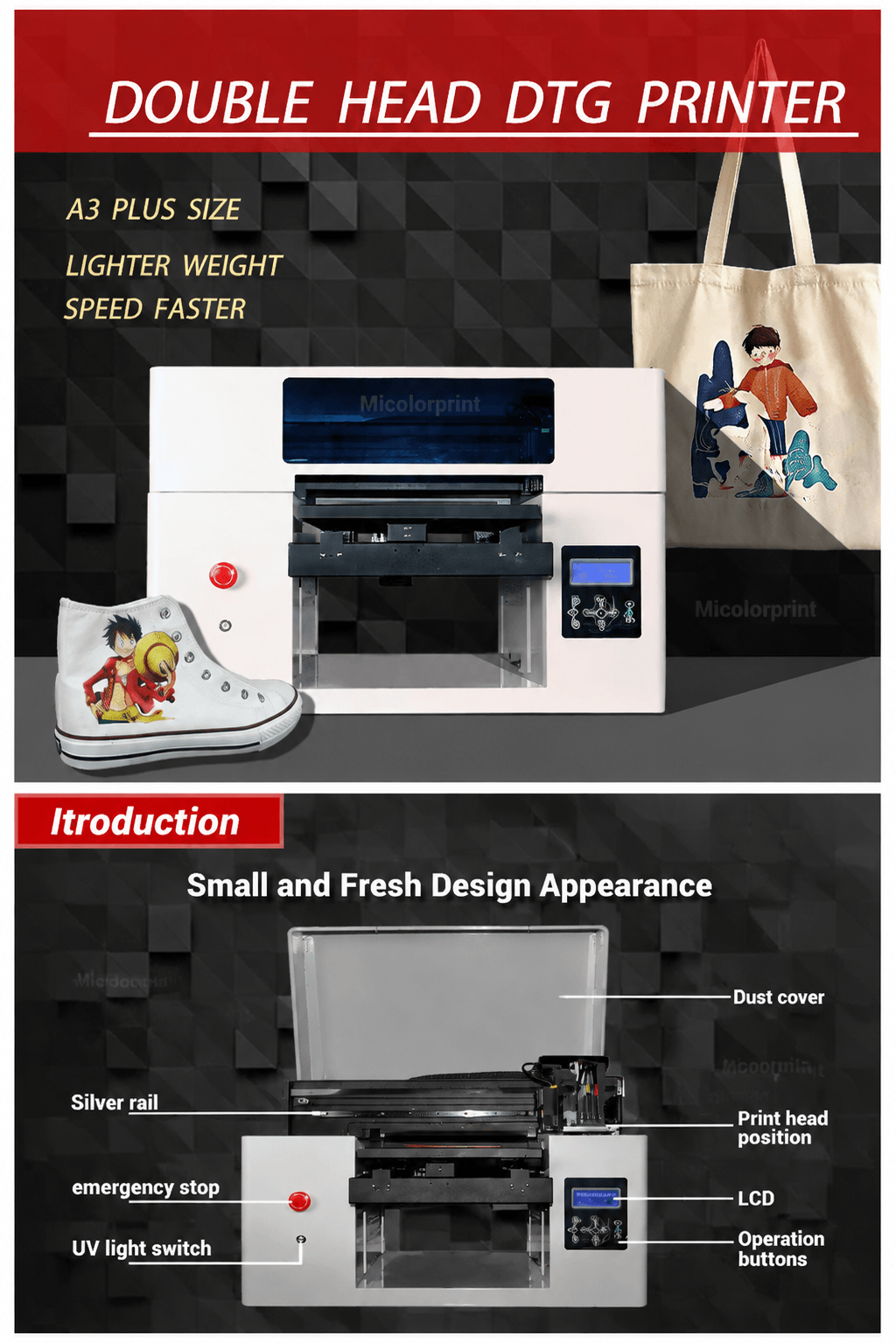
Now the DIY is coming, t shirt printer is more and more popular. Our printers have many new technologies that are different from others. We adopt digital programming, precision infrared scanning, multi-position sensors, and high precision parts, to ensure that the printer’s performance is more stable and more precise positioning. The Dtg Printer T-Shirt just works with one computer, T Shirt Printer Price is competitive.
Factory Direct · Stable Performance · Commercial Print Quality
Start or scale your custom T-shirt business with DTG printers designed for small-batch, on-demand garment printing. Our DTG printers deliver photo-level color accuracy, strong white ink coverage, and stable daily performance—helping you build a profitable and sustainable apparel business.
✔ No MOQ · ✔ Photo-Quality Output · ✔ Manufacturer Direct Supply
Many customers come to us with the same question: “Is DTG really the right solution for my business?”
Our t shirt printer direct to garment is designed for businesses that need flexibility without high risk:
One-piece printing, no minimum order quantity
Ideal for custom and print-on-demand T-shirt business
Suitable for start-ups and small print shops
Easy operation, even for beginners
Fast design switching without setup cost
If these points match your needs, DTG printing is likely the right path for you.
What Is a DTG Printer?
A DTG (Direct to Garment) printer is a digital printing machine that prints water-based ink directly onto garments, mainly cotton T-shirts. It is widely used for custom apparel, small-batch production, and print-on-demand businesses where flexibility and image quality matter.
DTG printing allows you to accept orders without worrying about quantity, setup time, or complex workflows.
Textile printers are a type of flatbed printer, which can be used to print on cotton and linen, and other fabrics when replaced with special textile inks. Commonly used to print clothes, canvas bags, socks, and more. Compared with the uv printer, it just lacks the uv system, and the other parts are the same. If you only print white or light-colored clothes, you can use white ink, or even change all the nozzles in the printer to colour channels. If you install two Epson printheads in your machine, you can make them fully print CMYK four-color or CMYKLcLm six-color, and the corresponding efficiency will be improved a lot. If you want to print dark clothing, you must use white ink. If the machine still has two Epson nozzles, one nozzle tube is white, and the other nozzle tube is CMYK four-colour or CMYKLcLm six-colour. In addition, because textile white inks are generally much more expensive than colour inks on the market, printing dark clothes often costs twice as much as light-colored clothes.
How to print clothing by the textile printer?
When printing light-colored clothes, simply treat the place where the clothes are to be printed with the pretreatment liquid, and then put them on the heat press machine for about 20 seconds. If you print dark clothes, you need to use a fixing agent to deal with them before ironing. Although the use cases of the two are different, the core function is to fix the color and increase the saturation of the color. So why ironing before printing? That’s because there will be a lot of fine plush on the surface of the clothes. If it is not pressed down by ironing, it will easily affect the accuracy of the ink droplets. Moreover, if it gets on the print head, it may also affect the service life of the print head.
After ironing, lay it on the machine for printing, and ensure that the surface of the clothes is as flat as possible. Adjust the height of the print head and print directly. During the printing period, keep the room as clean and free of dust as possible; otherwise, it will definitely not get off the pattern of the clothes.
Due to the use of textile ink, it cannot be dried immediately. After the printing is completed, it needs to be placed on the heat press machine again for about 30 seconds. This pressing will cause the ink to penetrate directly into the fabric of the garment and solidify. If it is done well, it will not fade if it is washed directly in water after ironing. Of course, whether the color of clothes printed on a textile machine will fade is related to two factors: one is the quality of the ink, and the other is the fabric. Normally, cotton or fabrics with a high cotton content will not fade.
Printer Details
DTG Printing vs Other T-Shirt Printing Methods
Many customers worry about choosing the wrong technology.
Printing Method
Best Use
MOQ
Print Quality
Flexibility
DTG Printing
Custom & on-demand
1 piece
★★★★★
High
Screen Printing
Mass production
High
★★★
Low
DTF Printing
Transfer workflow
1 piece
★★★★
Medium
Before: “What if I choose the wrong technology and regret it later?”
After: DTG printing is the best choice for businesses focused on custom designs, small orders, and premium visual quality—while other methods are better suited for mass production or transfer-based workflows.
Our DTG Printer Product Series
Different businesses need different solutions. That’s why we offer multiple DTG printer configurations.
Compact DTG Printer
Designed for start-ups and small custom T-shirt businesses. Low learning curve, easy maintenance, and ideal for first-time DTG users.
A DTG (Direct to Garment) printer is a digital printing machine that prints water-based ink directly onto garments/t shirts, mainly cotton T-shirts. It is widely used for custom, small-batch, and print-on-demand apparel production.
2. What is a DTG printer mainly used for?
DTG printers are commonly used for:
Custom T-shirt printing
Print-on-demand businesses
Small batch apparel production
Start-up clothing brands
Personalized promotional garments
3. What is the difference between a DTG printer and a T-shirt printer?
“DTG printer” is a technical term describing the printing method (Direct to Garment), while “T-shirt printer” is a general term customers use when searching for machines that print directly on T-shirts. In most cases, they refer to the same type of machine.
Printing Quality & Results
4. How is the print quality of DTG printing?
DTG printing offers photo-level image quality with smooth gradients, fine details, and accurate colors. It is ideal for complex designs, photos, and multi-color artwork.
5. Can DTG printers print on dark T-shirts?
Yes. DTG printers use white ink as a base layer, allowing vivid colors to be printed on dark garments. Proper white ink circulation and pretreatment are key to stable dark-shirt printing.
6. Will the print fade or crack after washing?
When printed correctly and washed according to garment care instructions, DTG prints are durable and suitable for commercial sale. The ink penetrates the fabric rather than sitting on top like a sticker.
7. Is DTG printing suitable for selling premium T-shirts?
Yes. DTG printing is widely used for premium custom apparel because of its soft hand feel, detailed image quality, and professional appearance.
Fabric & Material Compatibility
8. What fabrics can DTG printers print on?
DTG printers work best on:
100% cotton garments
High cotton-content blends
They are generally not recommended for 100% polyester fabrics.
9. Can DTG printers print on different T-shirt colors?
Yes. DTG printers can print on white, light-colored, and dark-colored T-shirts. Print results may vary depending on fabric type, color, and thickness.
Cost & Business Considerations
10. What is the printing cost per T-shirt with a DTG printer?
The cost per T-shirt mainly includes:
Ink consumption
Pretreatment liquid (for dark garments)
Labor and utilities
DTG printing is cost-effective for small orders and customized designs. (Labor and rent costs vary from country to country, so specific figures cannot be provided.)
11. Is DTG printing profitable for small businesses?
Yes. DTG printing is popular among start-ups because it requires low setup cost, allows one-piece printing, and enables higher selling prices for customized products.
12. Is DTG suitable for mass production?
DTG printing is best suited for small to medium batch production. For very large-scale mass production, screen printing may be more cost-efficient.
Operation & Maintenance
13. Is a DTG printer difficult to operate?
No. Modern DTG printers are designed to be user-friendly. With basic training, beginners can start printing in a short time.
14. Do you provide training for DTG printers?
Yes. Training is usually provided through operation manuals, videos, and remote technical support to help users get started smoothly.
15. Is maintenance complicated?
Daily maintenance is simple but important, especially for white ink systems. Regular cleaning and proper operation help ensure long-term stable performance.
Does white ink clog easily?
White ink requires proper circulation and maintenance. A well-designed white ink system greatly reduces clogging issues.
DTG vs Other Printing Methods
16. What is the difference between DTG and DTF printing?
DTG prints ink directly onto garments, ideal for premium quality and cotton fabrics.
DTF prints designs onto transfer film and then heat-presses them onto garments, suitable for a wider range of fabrics.
The best choice depends on your business model.
17. DTG or screen printing – which is better?
DTG is better for small orders, custom designs, and fast turnaround. Screen printing is more suitable for large-volume production with simple designs.
Buying & Support
18. How do I choose the right DTG printer model?
The right model depends on:
Your production volume
Available workspace
Budget
Business stage
It’s recommended to consult the manufacturer for a suitable model suggestion.
19. Do you provide after-sales support?
Yes. Technical support, spare parts supply, and maintenance guidance are typically provided to ensure smooth long-term operation.
20. Can DTG printers be customized or OEM-branded?
Yes. Many manufacturers offer OEM and customization options for branding and specific business requirements.