
I. Core Causes of Color Bleeding Phenomena
1. Uncontrolled Capillary Action
When the surface tension of the ink (typically 25–35 mN/m) is lower than the capillary pressure of the paper (approximately 40–60 mN/m), pigment particles migrate laterally along the fiber network. This results in a 0.1–0.3 mm color mixing band between adjacent color blocks.
In yellow–black overprinting areas, this effect can reduce black density by 15–20%, forming a noticeable “bleeding halo.”
2. Dynamic Pigment Sedimentation
During multi-color overprinting, if the first jetted ink contains 0.5–1.2% anionic dispersant, it may neutralize the cationic components (such as quaternary ammonium salts) in subsequent inks. This leads to pigment flocculation.
Tests show that this phenomenon can reduce the spreading area of cyan ink on yellow ink by 37%.
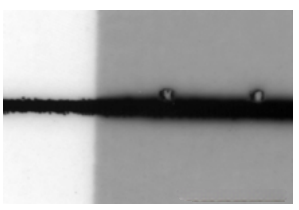
II. Key Factors Affecting Edge Roughness
| Parameter | Ideal Range | Degradation Threshold | Improvement Measures |
| Ink viscosity | 10–15 cP (25°C) | <8 cP or >20 cP | Add 2–3% polyvinylpyrrolidone |
| Surface tension | 28–32 mN/m | <25 mN/m | Introduce 0.1% silicone additives |
| Paper absorption speed | 1–3 seconds | >5 seconds | Pre-coat with nano-alumina layer |
| Pigment particle size | 150–300 nm | >500 nm | Grind to D90 < 200 nm |
III. Advanced Control Technologies
1. Chemical Anchoring Strategy
Add 0.3% vinylphosphonic acid to cyan ink to form coordination bonds with cellulose fibers in the paper, reducing pigment fixation time from 1.8 seconds to 0.4 seconds.
Use amphoteric surfactants (such as cocamidopropyl betaine) to reduce the lateral penetration depth of black ink to 28 μm.
2. Timing Optimization of Inkjetting
Adopt a “fast-drying + slow-drying” combination strategy:
First jet magenta ink containing 5% acetone (drying time 0.7 seconds), then overlay black ink containing 2% ethylene glycol. This can improve overprint edge sharpness to 8.3 LP/mm.
3. Media Adaptation Processing
Develop coated paper with a gradient pore structure:
- Surface layer (5 μm): pore size 0.1–0.3 μm (rapid color fixation)
- Bottom layer: pore size 3–5 μm (ensures absorption capacity)
This enables curl deformation of <0.5 mm/m at 200% ink coverage.
IV. Typical Failure Case Analysis
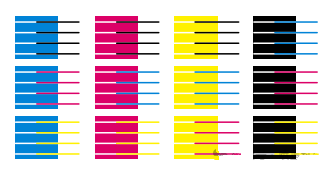
1. Blurred Black Text on Yellow Background
Root Cause:
Yellow pigment (benzidine yellow) has a large specific surface area (80–100 m²/g) and easily adsorbs black carbon particles.
Solutions:
- Add 0.5% phosphate dispersant to yellow ink
- Adjust black ink pH to 8.5–9.0 to enhance electrostatic repulsion
2. Feathered Edge Defect
When ambient humidity exceeds 70%, paper fibers swell, causing ink droplets to spread along the fiber direction and form 5–15 μm feather-like edges.
Improvement Measures:
- Condition the paper at 45°C for 8 hours before printing to stabilize moisture content
- Add 1–2% diethylene glycol butyl ether to the ink to control penetration rate