I. Comparison of Ricoh G5 and G6 Printhead Parameters
Ricoh Gen 5 and Gen 6: Parameter Comparison
| General Properties | GEN 6 | GEN 5 |
|---|---|---|
| Print Width | 54.1 mm (2.1″) | 54.1 mm (2.1″) |
| Number of Nozzles | 1,280 (4 × 320 channels) | 1,280 (4 × 320 channels) |
| DPI | 600 | 600 |
| Compatible Ink | UV, Solvent, Aqueous | UV, Solvent |
| Max. Number of Colors | 4 | 4 |
| Max. Jetting Frequency | 50 kHz | 30 kHz |
| Drop Volume | 5–15 pL | 7–21 pL |
| Viscosity Range | 10–12 mPa·s | 10–12 mPa·s |
| Cable Type | Detachable cable | Integrated cable |
1. Printhead Structure
There are structural differences between the Ricoh Gen 5 and Gen 6 printheads.
The G5 adopts an integrated structure in which the printhead and data cable are connected together and cannot be separated.
The G6 adopts a modular structure in which the printhead and data cable can be separated.
Generally speaking, the maintenance cost of the G6 is significantly lower.
2. Printing Resolution
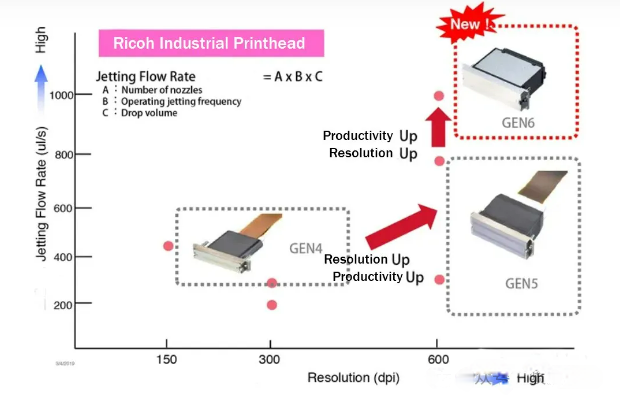
The printing resolution of the Ricoh Gen 6 is higher than that of the Gen 5.
The G6 features smaller droplet sizes, enabling higher resolution and finer patterns, making it suitable for more demanding printing applications.
3. Inkjet Control
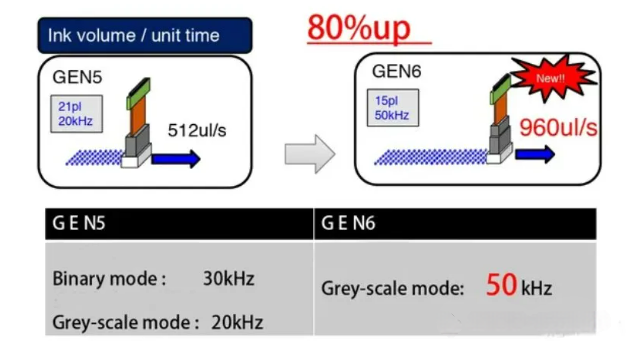
The G6 achieves more precise droplet control, upgrading from 7 pL to 5 pL.
This allows better control over droplet landing position and diameter, resulting in more accurate printing results.
4. Printing Speed
The G6 offers higher printing speed.
The firing frequency has increased from 30 kHz to 50 kHz, enabling faster printing speeds.
This is highly beneficial for high-volume printing and efficient production.
5. Ink Compatibility
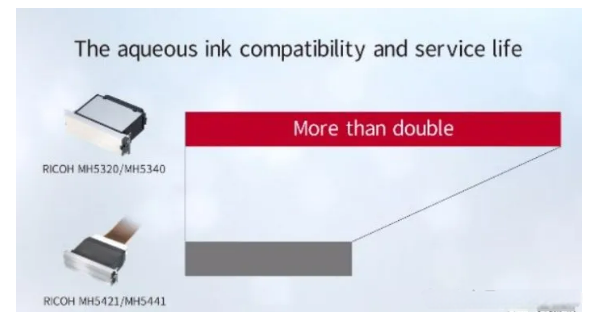
The Ricoh G6 is compatible with UV, solvent, and water-based inks, making it more versatile.
In general, the G6 printhead performs better than the G5 in terms of printing accuracy, inkjet control precision, and printing speed. However, this also means the G6 printhead is relatively more expensive and is more suitable for professional fields requiring higher print quality.
The choice of printhead should be determined based on specific printing requirements and budget.
The GEN5 has been tested in the market for 11 years since 2014 and has gained widespread customer recognition and high praise. With continuous market development and cultivation, it has now been widely applied, and production capacity requirements have continued to increase.
From the above parameter comparison, it is clear that the introduction of GEN6 precisely meets this market demand. This explains why GEN6 has rapidly gained widespread adoption.
It can increase production capacity by 50% while maintaining or even improving precision.
II. Technical Performance Comparison Between Ricoh Gen 6 and Gen 5 Printheads
▲ Color Channels
The Ricoh G6 printhead is designated as MH5320 (referred to as G6).
The droplet size has been reduced from 7 pL (G5) to 5 pL.
Smaller droplets enable finer transitional patterns, which is an important improvement for enhancing pattern detail.
Since the base droplet size becomes smaller, larger droplets are also reduced proportionally (from 21 pL to 15 pL). This introduces new challenges for large color block printing.
Under the same pass conditions, compared to the G5 printhead, its coverage depth and uniformity are slightly inferior.
In practical applications, it has been found that for uneven color blocks on certain machines, the multi-pass method is not linearly effective. Therefore, simply increasing the number of passes is not a very effective solution for improving large color block uniformity.
▲ Printhead Heat Dissipation
As the firing frequency of the piezo chip increases, the heat generated by the printhead itself becomes more significant.
An increase in internal temperature will affect normal print quality. At the same time, heat dissipation around the printhead must also be considered.
▲ Small Droplets
Compared to larger droplets, smaller droplets lose more velocity while flying in the air.
When printing at the same spacing, the G5 printhead achieves better fine droplet positioning than the G6 printhead.
In terms of image three-dimensional effect, G5 may outperform G6.
Therefore, when using the G6 printhead to achieve refined patterns, the distance between the printhead and the substrate must be smaller.
When small droplet mode is enabled, airflow around the printhead has a greater impact on droplet placement.
Due to the smaller droplet volume, G6 is more prone to uneven printing when printing solid color blocks compared to G5.
This requires improvements and optimization in mechanical precision and control accuracy to match the characteristics of this printhead.
▲ Ink Supply
For the Ricoh G5, the maximum ink consumption per minute at the highest firing frequency is approximately 33 ml.
For the Ricoh G6, this value increases to 57 ml.
Therefore, it is essential to calculate and verify whether the original ink supply system can meet this flow requirement, and whether pressure loss remains within a reasonable range.
Otherwise, when firing frequency increases, ink breakage may easily occur due to poor coordination of the ink supply system.
▲ Ink Path System
The firing frequency of the G6 printhead has been significantly improved.
Attention must be paid to whether the shear rate at high frequency still maintains Newtonian fluid characteristics.
Currently, most ink manufacturers focus only on the static viscosity and surface tension of UV inks.
However, they have conducted limited research and testing on the fundamental physical and chemical properties of inks under dynamic and high-frequency conditions.
As a result, ink maturity differs significantly compared to that used for G5 printheads.
▲ Mechanical Precision
To achieve the 50 kHz firing frequency of the Ricoh G6 printhead, if the carriage movement resolution is 600 dpi, the carriage speed will reach 2.1 m/s.
At such high speed, higher mechanical performance requirements are imposed.
To meet general pattern quality requirements, the ratio between carriage movement speed and droplet falling speed should be at least 1:4.
However, the actual droplet falling speed of the G6 printhead is typically around 6–7 m/s at 1 mm from the nozzle.
To meet this requirement, horizontal movement speed must be adjusted to 720 dpi.
If 600 dpi is selected, the horizontal-to-vertical speed ratio will be less than 1:4, and print quality will significantly decline.
Of course, if customer requirements are not strict, 600 dpi can still be selected.
Additionally, the acceleration zone of the high-speed carriage should not be too large. In this case, acceleration must be increased.
When acceleration exceeds 1G, the stability of the ink supply system becomes a challenge.
Therefore, carriage speed must be increased without instability.
If pressure fluctuation in the ink supply path is too large, a pressure fluctuation absorption device should be added to reduce sudden pressure changes.
At the same time, the precision and anti-fluctuation capability of the negative pressure system must be further improved.
▲ Firing Frequency
If you want the Ricoh Gen 6 printhead to operate stably and efficiently, you must find a suitable firing frequency point.
After repeated testing, around 35 kHz has proven to be a stable printing frequency.
However, if the firing frequency is increased further, droplet velocity will oscillate and fluctuate.
This requires further adjustment and optimization of both the ink supply system and mechanical system.
▲ Ink Compatibility
Compared with the fifth-generation printhead, the sixth-generation printhead offers significantly improved compatibility.
It supports UV inks, reactive inks, coating inks, and disperse inks, thereby meeting the needs of a wider range of industry users.