
I. Core Technology and Material Differences
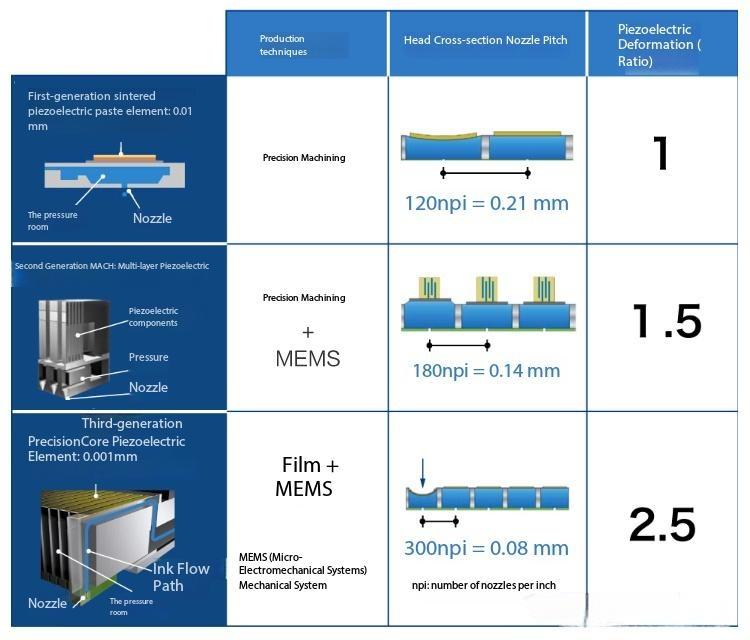
Both technologies are based on the inverse piezoelectric effect (electric-field-driven deformation), but they differ fundamentally in material form and fabrication processes:
- Thin-film piezoelectric:
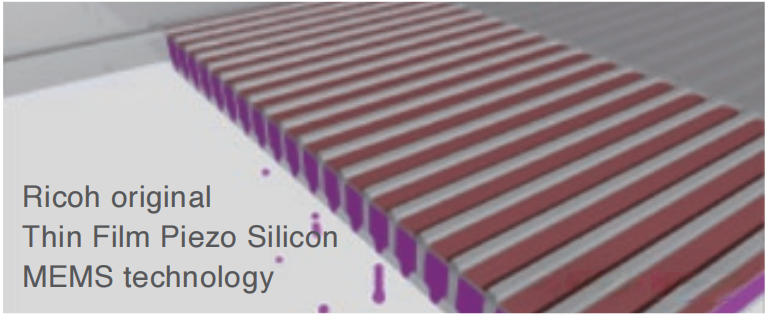
Uses MEMS processes to deposit an ultra-thin piezoelectric film (about 1 µm thick), such as the PZT thin film used in Epson’s PrecisionCore technology, onto a silicon wafer. The crystal orientation is uniform and consistent. Ink is ejected by bending deformation of the thin film to compress the ink chamber, and droplet control is achieved with sub-micron-level precision structures.
- Ceramic piezoelectric:
Uses bulk piezoelectric ceramics (e.g., PZT ceramic plates) as the core. Early designs assembled ink chambers and drive units by stacking multilayer metal plates, relying on the expansion/contraction or bending of ceramic blocks to generate driving force.
II. Comparison of Key Performance Advantages and Limitations
1. Printing Accuracy and Droplet Control
| Dimension | Thin-film Piezoelectric | Ceramic Piezoelectric |
| Advantages | 1. High film thickness uniformity; single-nozzle droplet volume deviation < 5%. 2. Supports intelligent variable droplet technology (VSDT), enabling variable droplets from 2–20 pL. 3. Sub-micron MEMS structures allow higher nozzle density (e.g., 7,680 nozzles on a single chip). | 1. High piezoelectric coefficient; stable displacement per actuation, suitable for large-volume droplet output. 2. Strong crystal structural stability; minimal long-term droplet positioning drift. |
| Limitations | Larger individual inkjet unit size; maximum nozzle density still lower than thermal inkjet technology. | Component size constraints make droplet miniaturization difficult at high resolution (typically ≥ 5 pL). |
2. Printing Speed and Response Efficiency
- Thin-film piezoelectric:
Fast response (microsecond level). With high-frequency drive circuits, jetting frequencies above 30 kHz are possible. However, due to the complexity of each unit, the number of nozzles in a head of the same size is harder to increase, and continuous printing speed is typically 10–20% lower than that of high-end ceramic piezoelectric heads. - Ceramic piezoelectric:
Traditional bulk structures have lower resonant frequencies (usually < 20 kHz), but some high-end models use multilayer designs to reach kHz-level operation. Their advantage lies in scalability: multi-head arrays can compensate for speed limitations, making them suitable for industrial large-format printing.
3. Durability and Environmental Adaptability
- Thin-film piezoelectric
✔️ Advantages: No heating elements; stable ink chemistry; compatible with a wide viscosity range (1–20 mPa·s) including aqueous and solvent inks. Silicon-based structures resist corrosion, with service life exceeding 100,000 pages.
❌ Limitations: Thin-film structures are less impact-resistant; severe vibration may cause interlayer delamination. Piezoelectric performance degrades noticeably at high temperatures (> 60 °C). - Ceramic piezoelectric
✔️ Advantages: High mechanical strength (compressive strength > 500 MPa); excellent resistance to high/low temperatures (-40 °C to 120 °C) and chemical corrosion. Absence of delicate thin-film layers results in low failure rates in industrial environments.
❌ Limitations: Brittle material prone to fracture under tensile stress, requiring preload mechanisms that increase structural complexity. Long-term high-frequency operation may lead to lattice fatigue and reduced droplet stability.
III. Application Scenario Suitability
| Technology | Advantageous Scenarios | Unsuitable Scenarios | Typical Applications |
| Thin-film piezoelectric | High-precision graphics and text printing, art reproduction, small desktop printers | Industrial continuous high-intensity printing, high-temperature environments | Epson SureColor P-series photo printers, small UV flatbed printers |
| Ceramic piezoelectric | Wide-format industrial printing, ceramic tile printing, 3D printing | Home/office high-precision printing, portable devices | Ricoh Gen5 industrial printheads, ceramic inkjet printers |
IV. Cost and Maintenance Comparison
- Initial Cost:
Thin-film piezoelectric printheads are typically 30–50% more expensive due to MEMS fabrication and material synthesis complexity (e.g., Epson’s in-house raw material synthesis equipment). Ceramic piezoelectric heads rely on traditional precision machining and have lower mass-production costs. - Maintenance Cost:
Thin-film piezoelectric heads require specialized equipment for clog removal, making single maintenance operations more expensive, but annual maintenance frequency is only about one-third that of ceramic piezoelectric heads. Ceramic piezoelectric structures are simpler and can often be unclogged via standard negative-pressure cleaning, but nozzle wear from ink residue leads to higher annual replacement costs. - Total Cost of Ownership (TCO):
- Home/office use (annual print volume < 10,000 pages): ceramic piezoelectric TCO is 15–20% lower.
- Professional graphics use (annual print volume > 50,000 pages): thin-film piezoelectric, benefiting from longer lifespan, has a TCO more than 25% lower.
V. Technology Development Trends
- Thin-film piezoelectric:
Moving toward ultra-thin and highly integrated designs, aiming to reduce film thickness below 0.5 µm and integrate temperature sensors for real-time closed-loop control. - Ceramic piezoelectric:
Advancing through multilayer stacking and dopant modification. For example, multilayer PZT ceramic stacks can reduce drive voltage to below 50 V, while manganese-doped materials can cut high-frequency losses by approximately 30%.