
Advantages of grayscale printing in digital inkjet printing
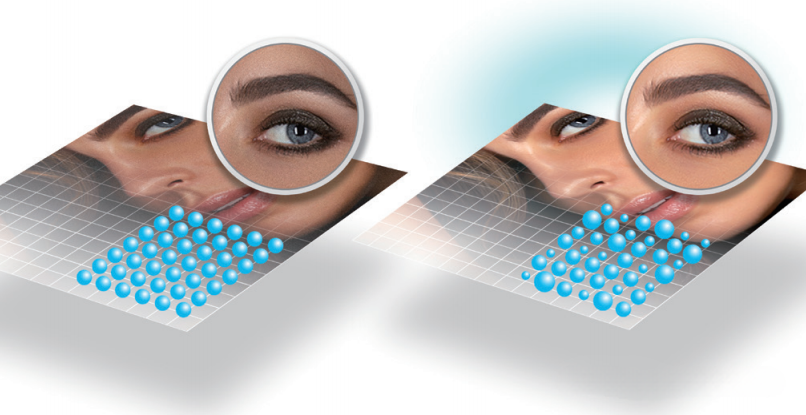
1. Technical Principles and Industry Positioning
Digital inkjet grayscale printing achieves 256-level grayscale transitions without changing dot spacing by precisely controlling ink drop size (as small as 3 pL) and firing frequency (up to 100 kHz). Compared to traditional binary printing, its core breakthroughs lie in:
- Fluid Control Algorithm: Utilizes PWM modulation technology, with ink drop volume coefficient of variation < 2%.
- Nozzle Dynamic Response: A single nozzle supports 8-level voltage adjustment (step precision of 0.1V).
- Color Mapping Engine: ICC profiles support 16-bit color depth conversion.
2. Core Advantage Analysis
2.1 Quality Improvement Dimensions
- Tonal Continuity: Smoothness index improved by 60% (colorimeter ΔE < 1.5).
- Detail Reproduction: Capable of 10μm-level line accuracy (ISO 13660 standard).
- Media Adaptability: Maintains over 90% dot reproduction rate even on uncoated paper.
2.2 Production Efficiency Optimization
| Comparison Item | Traditional Binary Printing | Grayscale Printing |
| Single-Pass Output | 35 m²/h | 52 m²/h |
| Ink Consumption | 100% (Baseline) | Reduced by 18% |
| Calibration Cycle | Every 8 hours | Every 24 hours |
2.3 Economic Performance
- Overall cost decreased by 23% (including energy, consumables, and maintenance).
- Defect rate reduced from 5.7% to 1.2% (HP Indigo measured data).
- Equipment lifespan extended by 30% (reduced mechanical shock wear).
3. Typical Application Scenarios
- Packaging Printing: Perfectly reproduces metallic luster gradients (Pantone gamut coverage reaches 98%).
- Textile Printing: Achieves 0.1mm-level precise registration (Kodak PROSPER system).
- 3D Printing Support: Grayscale control of support structure density (saves 40% post-processing time).
4. Technology Development Outlook
- Synergistic effects of nanoparticle inks and grayscale control.
- Machine learning-driven dynamic droplet optimization systems.
- Cross-platform color management protocols (expected to become an ISO standard by 2026).
5. Why Grayscale is Needed
The range of tones and colors the human eye can perceive is vast.
Almost all printing processes, including inkjet, can only print in a “binary” manner: print a dot or do not print.
Traditional printing uses halftone dots, varying their size according to the required tone.
At normal viewing distances, the eye cannot distinguish individual dots, only perceiving grayscale.
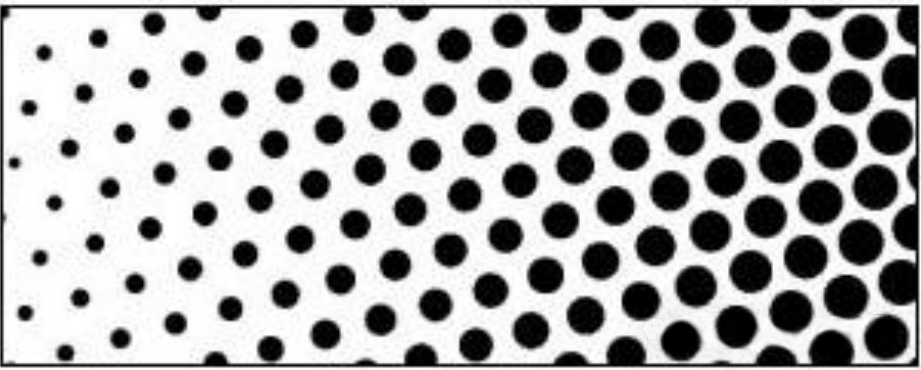
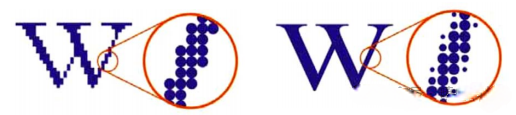
Halftone dot plot
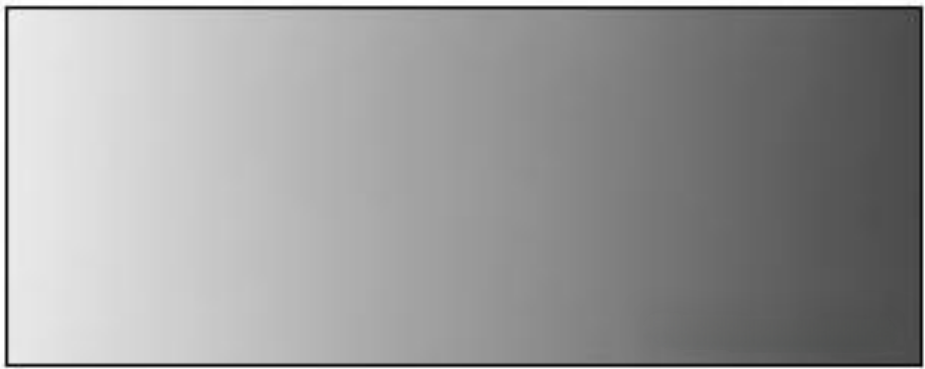
Halftone viewed from a distance
6. Methods for Achieving Grayscale Printing
Digital Halftoning Digital Micro-drops Inks of Different Concentrations Directly Changing Drop Volume
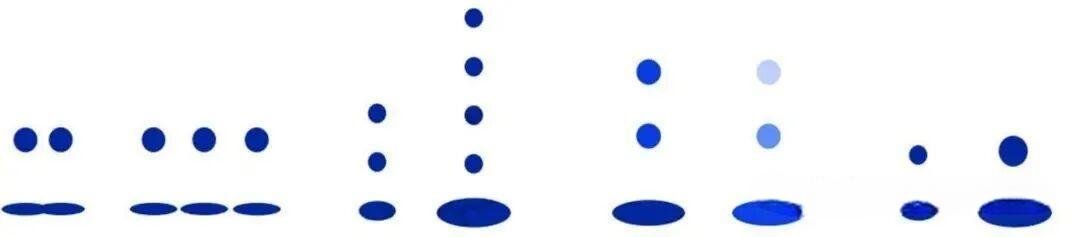
7. Advantages of Variable Dot Size
Single Dot (Fixed Size) Variable Dot Size

Selection of UV & EB Curing Technologies for Digital Inkjet
Core Consideration Dimensions for Technology Selection
1. Curing Efficiency vs. Production Throughput Matching
- UV Curing:
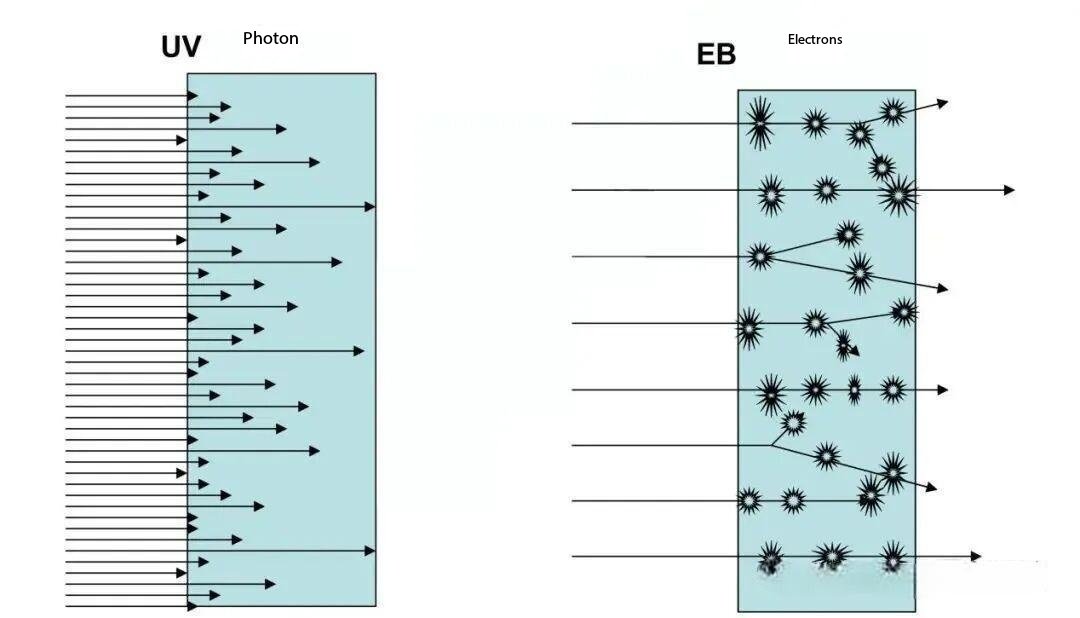
When using 365/395 nm LED light sources, the curing time for a single-color ink layer can be reduced to 0.15 s, supporting 30 m/min medium-speed production at 600 dpi resolution. However, multi-layer printing requires multiple curing units—for example, CMYK four-color printing needs four UV lamp arrays. - EB Curing:
Electron-beam penetration reaches up to 500 µm, enabling 40 m/min high-speed continuous curing, which is especially suitable for roll-to-roll production in the packaging industry. The drawback is the need for a 10–300 keV electron accelerator, increasing the equipment footprint by about 40%.

2. Key Indicators of Material Compatibility
| Substrate Type | UV Curing Compatibility | EB Curing Advantage Scenarios |
| Non-absorbent substrates (PET/PC) | Requires primer coating to enhance adhesion | Direct curing, peel strength ≥ 3 N/mm |
| Porous materials (paper/textiles) | Risk of uncured monomer migration | Electron beam penetrates fibers for bulk curing |
| Heat-sensitive materials (BOPP film) | Requires low-temperature photoinitiators (e.g., TPO-L) | No thermal accumulation, temperature rise < 5 °C |
3. Cost–Benefit Analysis Model
- Initial Investment:
Industrial UV curing system (including six LED lamp arrays): approx. RMB 250,000 (~USD 36,000).
EB system (150 keV): over RMB 800,000. - Operating Costs:
UV curing energy consumption: 0.8 kWh/m².
EB curing: 0.3 kWh/m², plus RMB 60,000 (~USD 8,000) per year for radiation protection and maintenance. - Cost Break-Even Point:
When monthly output exceeds 80,000 m², EB curing becomes more economical.
Typical Application Scenario Decision Tree
- Advertising & Large-Format Printing
- Choose UV curing: suitable for small-to-medium batch production on acrylic/metal boards up to 3 mm thick; configure 4–8 sets of 395 nm LED lamps (each watt cures approx. 1.2 m²).
- Food Packaging Printing
- EB curing is mandatory: compliant with FDA 21 CFR, eliminating photoinitiator migration risks.
- Example: Tetra Pak production lines use 300 keV electron beams to achieve 200 m/min sterilization-grade curing.
- Digital Textile Printing
- Hybrid UV/EB solution:
- EB curing for the base layer ensures color fastness (wash resistance ≥ Grade 4).
- UV curing for surface patterns preserves color saturation (ΔE < 1.5).
- Hybrid UV/EB solution:
Technology Development Trends
- UV Curing:
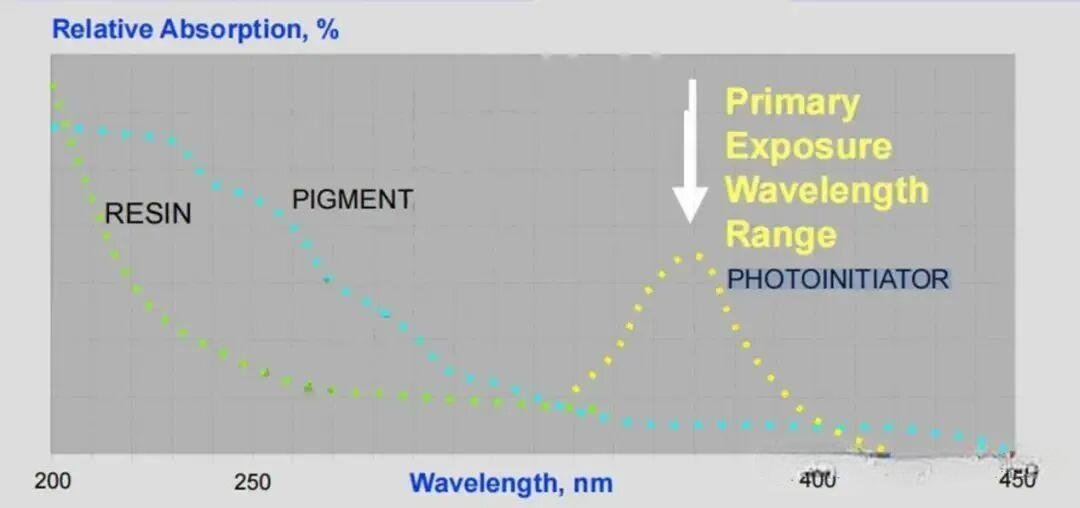
Quantum-dot photoinitiators extend curing wavelengths to 450 nm, reducing penetration limitations in dark inks. - EB Curing:
Modular electron-gun designs reduce equipment volume by 60%; domestic localization rates exceeded 35% in 2024.
Application Analysis of UV Ink Technology
Technical Application Analysis of UV Inks in the Digital Inkjet Printing Industry
I. Core Technical Characteristics and Process Breakthroughs
1. Photochemical Curing Mechanism
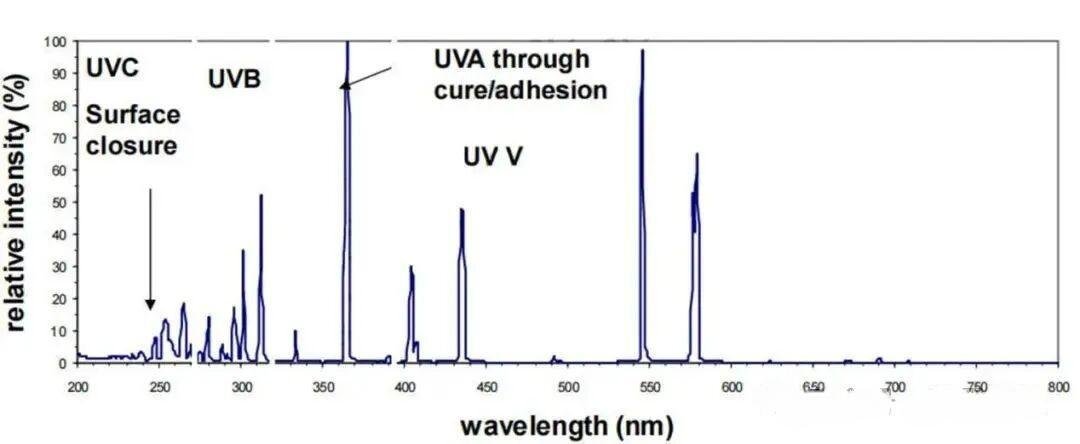
- UV light in the 365–395 nm wavelength range triggers free-radical polymerization, achieving curing times of 0.1–0.13 seconds, which is up to 300 times faster than traditional ink drying.
- Cationic UV inks feature post-curing capability, making them suitable for applications requiring deep curing, such as 3D relief printing.
- Typical spectral distribution of medium-pressure mercury discharge lamps.
2. Innovations in Material Compatibility
- By modifying acrylate resin formulations, strong adhesion on non-absorbent substrates such as glass and metal is achieved (adhesion ≥ 4B).
- Color–white–color double-sided printing solutions break the limitation of traditional single-sided printing, enabling visible patterns on both sides of textiles.
- UV absorption characteristics of component materials.
3. Upgrades in Environmental Performance
- Water-based UV inks contain VOC levels below 5 g/L, complying with the EU REACH regulations on hazardous substances.
- LED UV curing systems reduce energy consumption by up to 80% compared with mercury lamps and produce no ozone emissions.
Photoinitiators:
- Absorb ultraviolet light
- Decompose to form free radicals
- Initiate polymerization
- Common types include α-hydroxyketones, benzoin dimethyl ketones, and bis-acyl phosphine oxides
PhCOC(OMe)₂Ph —hv→ PhCO* + PhC(OMe)₂*
UV Curing Mechanism:
- Free radicals
- Initiation reaction
R–R → 2R*
- Propagation reaction
R· + CH₂=CHX → RCH₂CHX·
RCH₂CHX. + n CH₂=CHX → R(CH2CHX)nCH2CHX.
- Termination reaction
2 R(CH2CHX)nCH2CHX.→ R(CH2CHX) nCH2CHX-XHCCH2(XCHCH2) nR
II. Industry Application Scenarios and Value Creation
1. Advertising and Signage
- High-precision output: Resolutions up to 2800 DPI meet ultra-realistic advertising requirements, supporting 8-color configurations (CMYK + white + varnish + spot colors).
- Special effects: Ink-layer stacking enables localized 3D embossing (up to 1.2 mm), widely used in anti-counterfeiting labels for luxury packaging.
2. Textile Printing
- Flexible ink solutions: Polyurethane acrylate inks with elongation > 200% are suitable for digital direct-to-fabric printing on elastic textiles.
- Fast-response production: Combined with single-pass systems, printing speeds reach 150 m/min, supporting “small-order, fast-turnaround” supply chains.
3. Industrial Decorative Printing
- Enhanced weather resistance: UV inks containing nano-silica allow ceramic patterns to pass 1,000-hour QUV aging tests.
- Printing on irregular shapes: Five-axis UV flatbed printers enable precise printing on curved building materials such as cylindrical aluminum profiles.
III. Technology Development Trends and Challenges
1. Future Innovation Directions
- Smart materials: Development of thermochromic and photochromic UV inks to expand applications in anti-counterfeiting packaging and interactive printing.
- Ultra-fast curing: Development of 405 nm short-wavelength LED systems, targeting curing times below 0.05 seconds.
2. Existing Technical Bottlenecks
- Printing on dark substrates still relies on white undercoats, increasing production costs by 20–30%.
- The long-term reliability of piezoelectric printheads when using high-viscosity inks (>30 cPs) requires further optimization.
IV. Comparative Economic Efficiency Analysis
| Metric | UV Digital Inkjet Printing | Traditional Screen Printing |
| Minimum order quantity | 1 piece | 500 pieces |
| Unit cost | Medium–high (USD1–2) | Low (USD0.3–0.71) |
| Lead time | 2 hours | 3–5 days |
| Color limitation | None | ≤ 6 colors |
Data source: 2025 Digital Inkjet Printing Industry White Paper