
Analysis of Key Elements in Inkjet Printing Processes
1. Ink Management Through Printhead Engineering
Nozzle Design
Printheads must optimize nozzle geometry (such as cylindrical or funnel-shaped designs) to balance droplet formation and mechanical strength, preventing jet instability caused by structural defects.
Ink Recirculation Systems
Drop-on-Demand (DOD) printheads commonly use recirculating ink flow designs to prevent nozzle drying and clogging, while stabilizing ink temperature—particularly critical for thermal inkjet systems.
2. Microfluidic Characteristics Along Capillary Channels
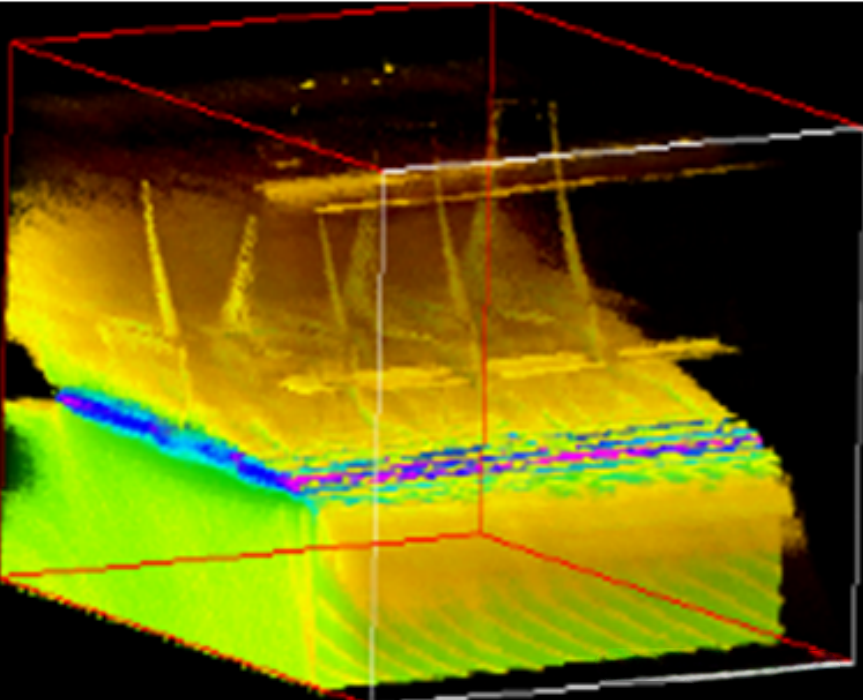
Microfluidic Droplet Generation
By combining thermal inkjet and microfluidic technologies, more than 30,000 picoliter-scale droplets per second can be generated. This performance relies on precise control of capillary channel dimensions (e.g., using transparent polycarbonate materials).
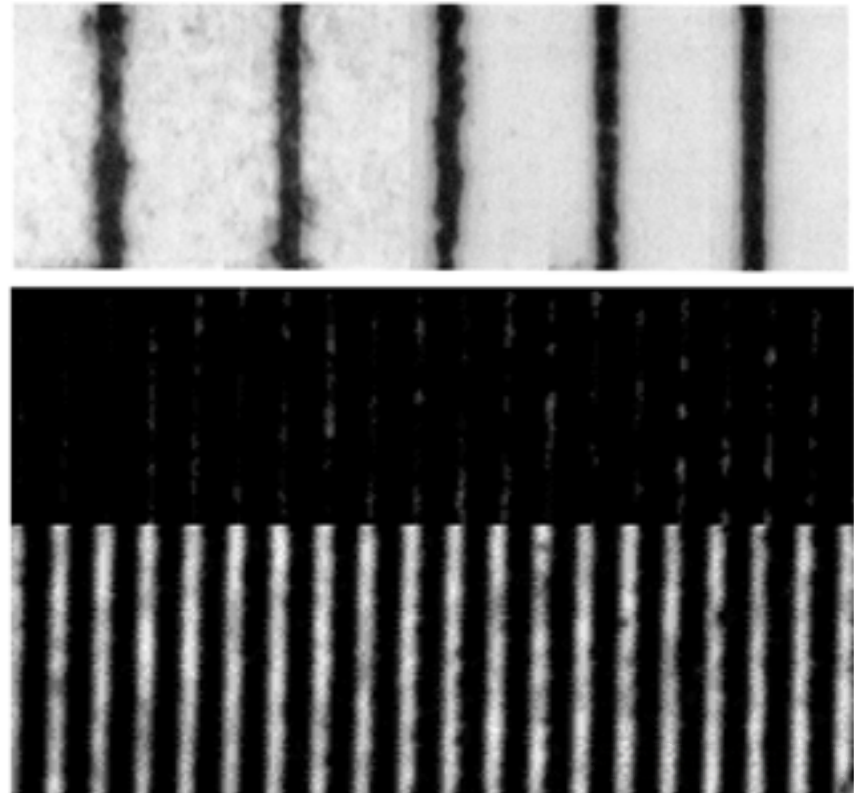
Interfacial Energy Control
Lower interfacial energy (for example, through the addition of fluorocarbon surfactants) reduces ink residue on channel walls, ensuring smooth droplet detachment.
3. Maintaining Ink Properties at the Meniscus
Viscoelastic Balance
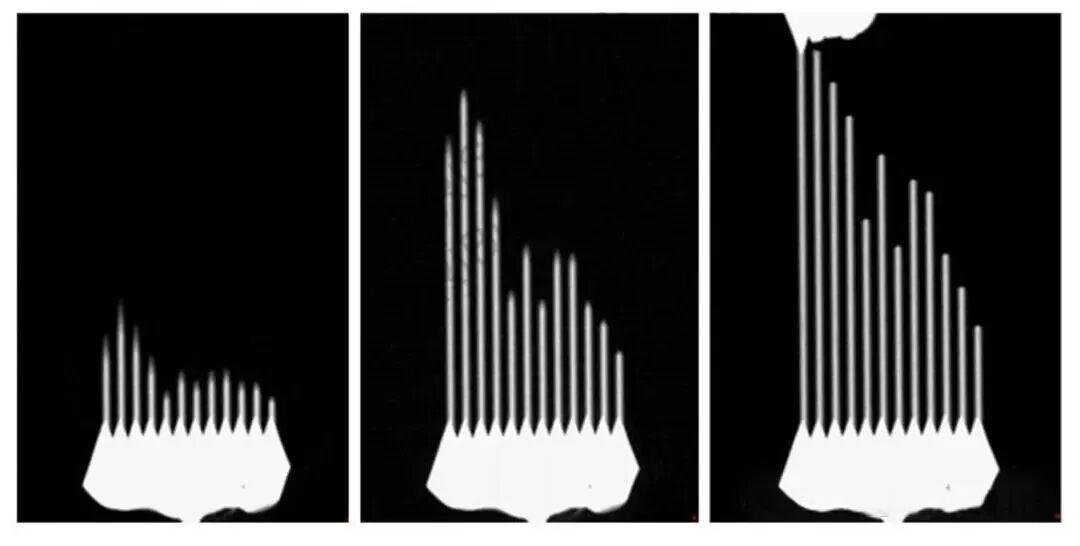
Ink must exhibit shear-thinning behavior (such as UV-curable inks) to maintain stable viscosity at the meniscus, preventing splashing or jet break-up.
Temperature Control
As temperature increases, ink viscosity decreases (e.g., water-based ink dropping from 5 cP to 3 cP). Real-time temperature regulation is required to maintain meniscus stability.
4. Droplet Formation Mechanisms
Thermal Inkjet Technology
Heating resistors瞬aneously rise above 300 °C, generating vapor bubbles that eject ink droplets. This process requires low-salt ink formulations to prevent crystallization and nozzle blockage.
Piezoelectric Actuation
Piezoelectric crystals expand and contract to generate pressure pulses. This method requires higher-viscosity inks (10–30 cP) matched to the driving frequency for optimal droplet formation.
5. Stable Jetting Performance
Rheological Properties
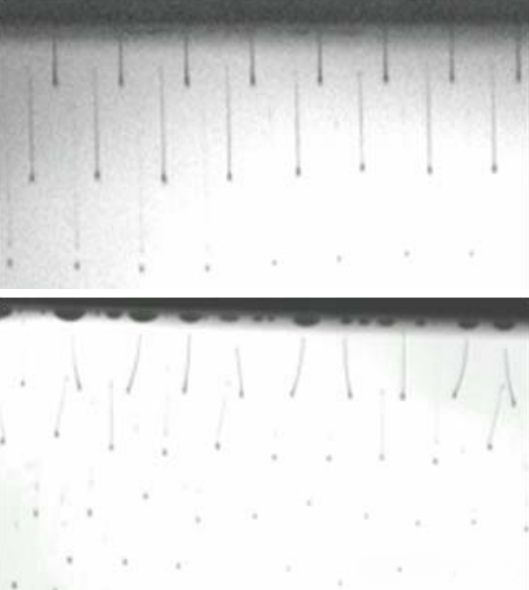
Ink must have rapid shear recovery (e.g., organic conductive gold inks) to prevent trailing and ensure clean jetting during high-speed printing.
Process Coordination
The distance between the printhead and substrate should be optimized (DOD printheads typically operate closer to the substrate) to minimize air turbulence and jet interference.
Summary of Process Elements, Parameters, and Solutions
| Process Stage | Key Parameters | Typical Issues & Solutions |
| Printhead Engineering | Nozzle geometry + recirculation system | Nozzle clogging → optimize flow channel design |
| Microfluidic Behavior | Capillary dimensions + interfacial energy | Droplet adhesion → surface modification |
| Meniscus Control | Viscosity + temperature | Ink splashing → real-time temperature control |
| Droplet Formation | Heating frequency / piezo drive | Satellite droplets → adjust pulse parameters |
| Jet Stability | Rheology + printhead-to-substrate distance | Image blur → reduce jetting distance |
Analysis of Variable Droplet Technology in Polaris Printheads
- Steep multi-stage waveform drop-off
- Different amplitudes for each waveform segment
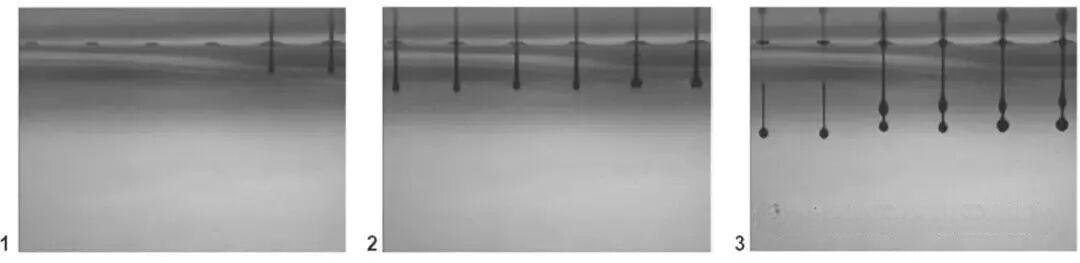
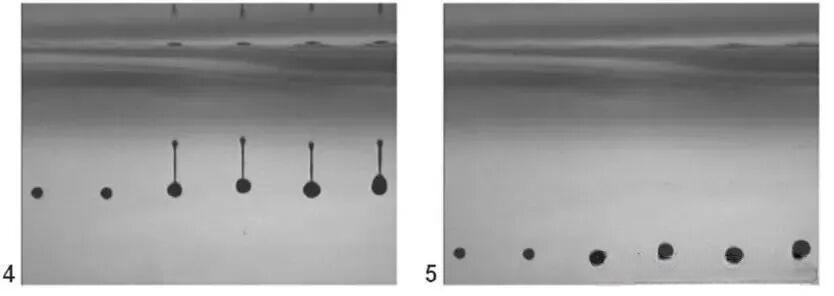
- Ink droplets separate from the nozzle plate before non-resonant frequency pumping reaches the required volume
- Waveforms are dynamically adjusted to match ink properties

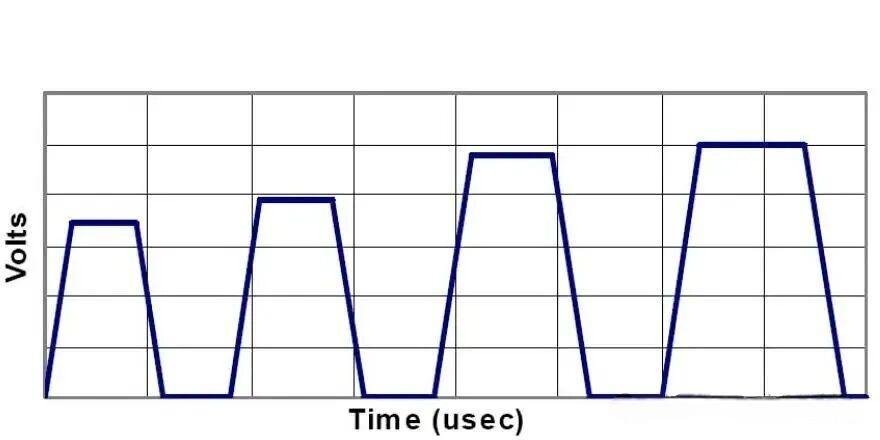
Variable Droplet Technology of Fujifilm Dimatix Polaris Printheads
1. Core Variable Droplet Architecture
The Fujifilm Polaris PQ-512 series printheads achieve dynamic droplet volume control from 15–150 pL through a three-layer technical architecture:
1.1 Piezoelectric Waveform Modulation
A 7th-order programmable drive waveform is used. Each pulse cycle includes:
- Pre-compression stage (0–2 μs):
Establishes a −15 V reference potential - Main drive stage (2–5 μs):
Trapezoidal waveform with a slope of 45 V/μs - Resonance suppression stage (5–8 μs):
12 MHz damped oscillation to eliminate residual vibration
By adjusting the main drive amplitude (18–42 V), linear control of droplet volume is achieved.
1.2 Dynamic Nozzle Aperture Control
A specially designed conical nozzle structure (35 μm inlet / 18 μm outlet) works in combination with:
- Piezoelectric ceramic ring radial displacement accuracy of ±0.8 μm
- Active fluid surface-tension control system
This enables the effective jetting aperture to be continuously adjusted between 12–28 μm, allowing precise droplet size modulation.
1.3 Multi-Pulse Superposition Technology
At a base frequency of 30 kHz, the system supports:
- Two-pulse superposition: droplet volume increases to 180% of nominal
- Three-pulse superposition: droplet volume reaches 250% of nominal
Pulse interval control is achieved via FPGA with 5 ns timing precision, ensuring highly stable droplet formation.
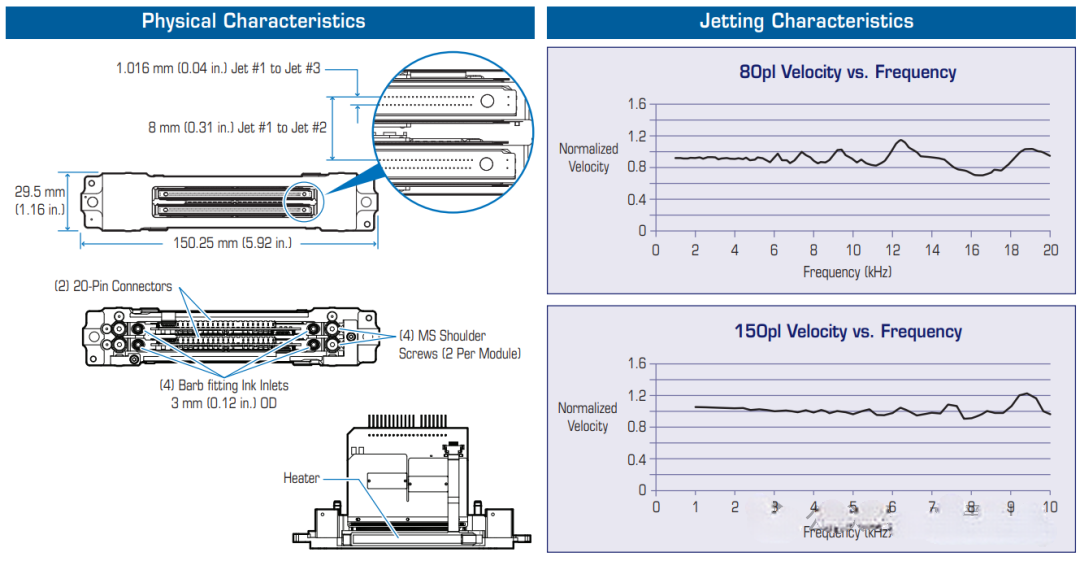
2. Key Technical Parameter Comparison
(Detailed parameter comparison table available upon request)
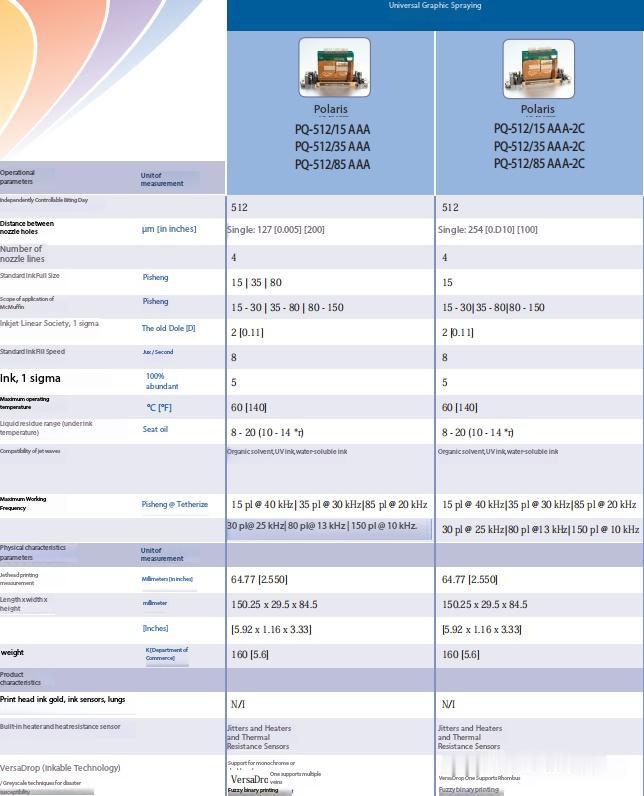
General-Purpose Piezo Printhead – Technical Specifications
Models
- Standard Version: PQ-512/15 AAA · PQ-512/35 AAA · PQ-512/85 AAA
- Circulation Version: PQ-512/15 AAA-2C · PQ-512/35 AAA-2C · PQ-512/85 AAA-2C
Operating Parameters
| Parameter | Unit | Standard Version | Circulation Version |
| Number of controllable nozzles | — | 512 | 512 |
| Nozzle pitch | μm (mil) | Single: 127 (0.005) [200] | Single: 254 (0.010) [100] |
| Number of nozzle rows | — | 4 | 4 |
| Nominal droplet volume | pL | 15 / 35 / 80 | 15 |
| Droplet volume range | pL | 15–30 / 35–80 / 80–150 | 15–30 / 35–80 / 80–150 |
| Jetting straightness (1 sigma) | mrad (°) | 2 (0.11) | 2 (0.11) |
| Nominal jetting velocity | m/s | 8 | 8 |
| Jetting velocity variation (1 sigma) | % | 5 | 5 |
| Maximum operating temperature | °C (°F) | 60 (140) | 60 (140) |
| Ink viscosity range (at jetting temp.) | cP | 8–20 (10–14 recommended) | 8–20 (10–14 recommended) |
| Compatible ink types | — | Solvent, UV, Water-based inks | Solvent, UV, Water-based inks |
| Maximum firing frequency | kHz (per nozzle row) | 15 pL @ 40 kHz / 35 pL @ 30 kHz / 85 pL @ 20 kHz 30 pL @ 25 kHz / 80 pL @ 13 kHz / 150 pL @ 10 kHz | Same as standard |
Physical Characteristics
| Parameter | Unit | Value |
| Effective print width | mm (inch) | 64.77 (2.550) |
| Dimensions (L × W × H) | mm | 150.25 × 29.5 × 84.5 |
| Dimensions (L × W × H) | inch | 5.92 × 1.16 × 3.33 |
| Weight | g (oz) | 160 (5.6) |
Product Features
| Item | Description |
| Printhead alignment / ink supply | N/A |
| Built-in temperature sensor & heating control | Equipped with temperature sensor and heating control |
| VersaDrop™ (variable dot technology) | Supports VersaDrop™ for multi-drop printing |
3. Industrial Application Performance Validation
3.1 Direct-to-Textile Printing Test Data (PQ-512/35 AAA)
- Droplet consistency:
CV < 3.2% at a 60 pL setting (ISO 2471 standard) - Placement accuracy:
Dot deviation of ±12 μm at a jetting speed of 8 m/s
3.2 UV-Curing Application Performance
- Supports dynamic ink temperature compensation from 20 °C to 50 °C
- Synchronization error with LED UV light source < 50 μs
- Post-curing color difference ΔE < 1.5 (D65 illuminant)