
Thermal Inkjet Technology
Thermal inkjet (TIJ) is a printing technology that ejects ink droplets by rapidly heating the ink inside the nozzle to generate vapor bubbles. Its core characteristics, advantages, and limitations are outlined below.
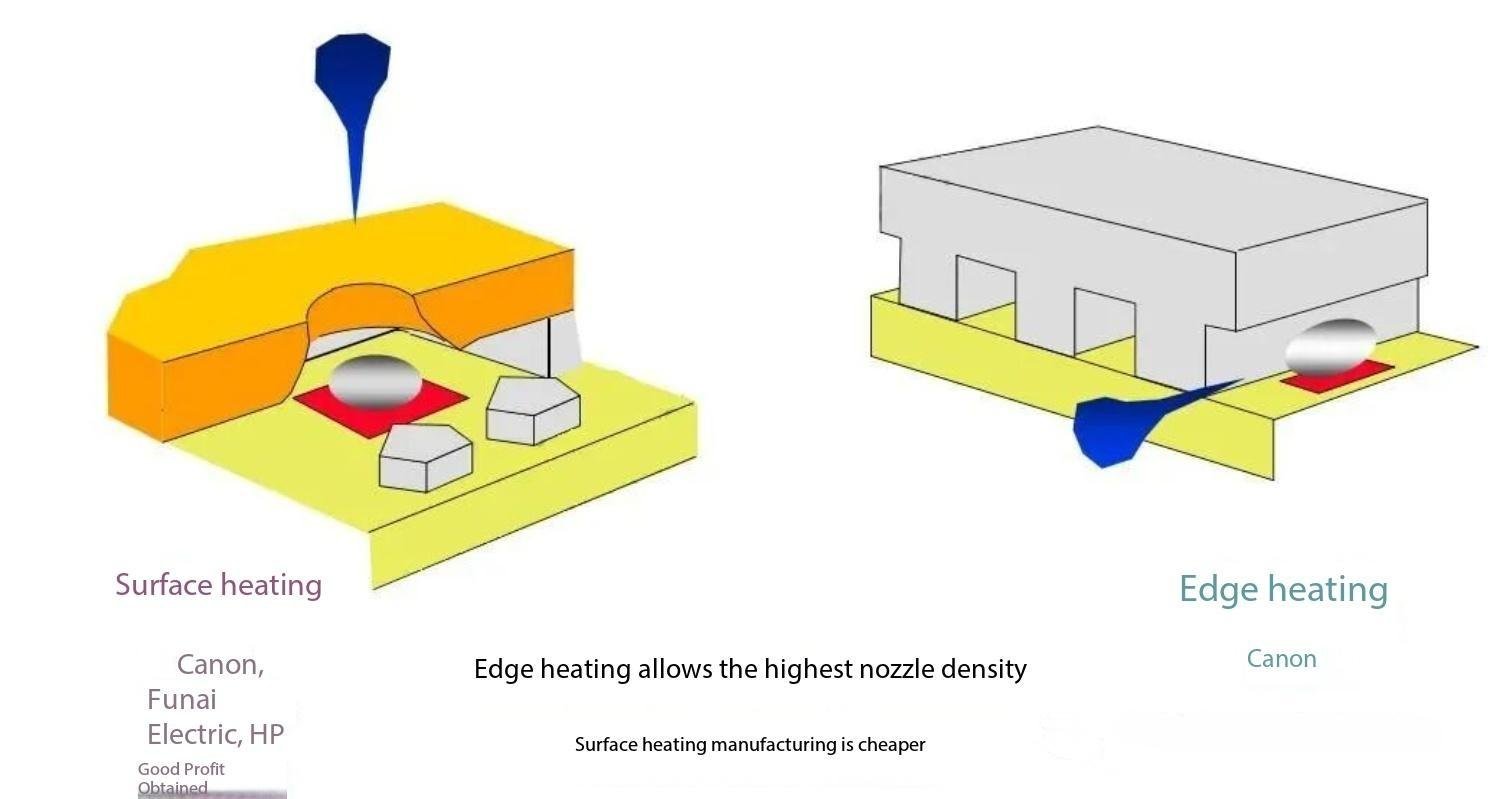
Technology Principles and Advantages
1. Working Principle
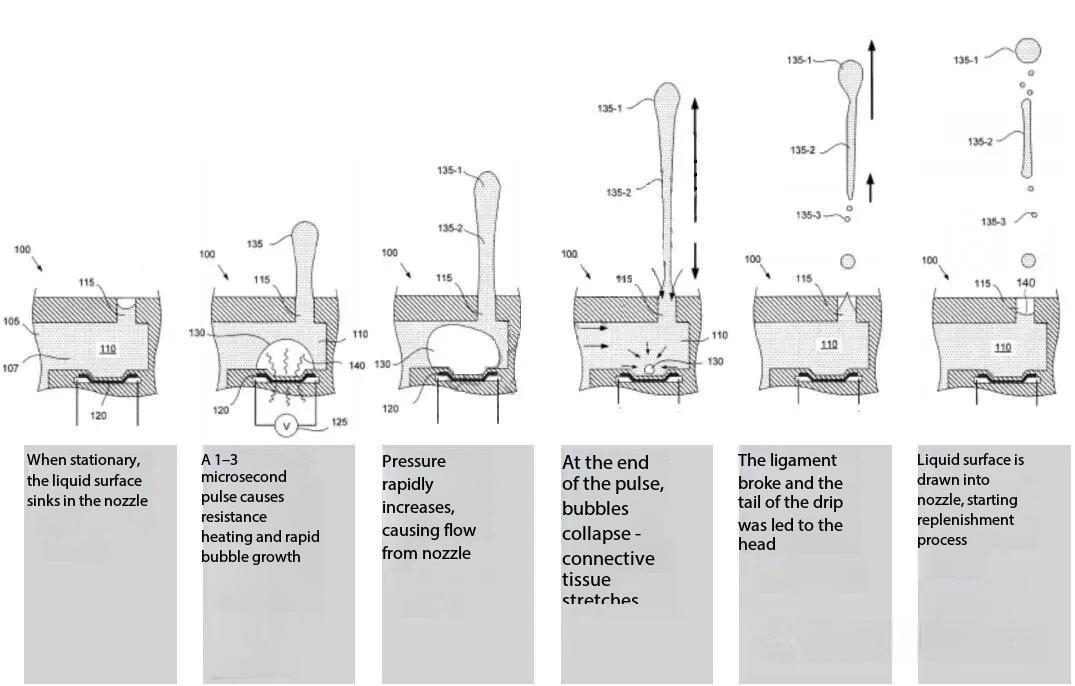
A thin-film resistor instantaneously heats the ink to temperatures above 300 °C, creating a vapor bubble whose rapid expansion forces an ink droplet out of the nozzle. This is essentially a high-temperature, high-pressure jetting process.
2. High Nozzle Density and Low Manufacturing Cost
- Manufactured using silicon semiconductor fabrication processes, enabling wafer-level, highly parallel chip production.
- Passive and active components are integrated on the same chip, reducing interconnection complexity and enabling compact device design.
- Integrated printhead–ink cartridge designs (typical of Canon and HP) simplify printhead replacement, although they result in relatively higher consumable costs.
3. Patents and Market Control
- The technology was historically dominated by Canon and HP, with licenses granted to companies such as Kodak and Lexmark.
- As key patents have expired, application restrictions have eased, allowing broader industry adoption.
Limitations
1. Ink and Printhead Wear
- The high-temperature and high-pressure environment accelerates nozzle erosion, increases the risk of ink misting and clogging, and can alter ink chemistry, negatively affecting color stability.
- Only compatible with low-viscosity, high-surface-tension water-based inks; it cannot support solvent-based inks required for many outdoor or industrial applications.
2. Print Quality Constraints
- Bubble-driven ejection offers limited directional control, making it difficult to achieve perfectly straight edges.
- Fine lines may exhibit jagged or serrated edges, reducing overall image precision.
Application Scenarios
Strengths
- Well suited for home and office document printing (e.g., Canon G-series printers).
- High firing frequency and very small droplet volumes (down to 5 picoliters) enable smooth tonal gradations and good photographic output.
Limitations
- Not suitable for industrial printing that demands high durability or the use of solvent or UV-curable inks (e.g., UV inkjet systems).
Outlook
Current development trends show that thermal inkjet technology continues to reduce costs through improved circuit integration. However, its inherent physical limitations—particularly related to ink compatibility and thermal stress—still constrain its expansion into high-end and industrial printing markets.
Canon UVgel Gel Technology
I. Core Technology Principle: Intelligent Transformation of Gel-Based Ink
Canon UVgel technology is built around temperature-controlled gel ink, combined with a step-by-step curing mechanism to create a closed-loop process of
“liquid jetting → gel fixation → full curing.”
1. Ink State Transformation
Inside the printhead, the gel ink is heated and converted into a liquid state to ensure precise jetting. Once the droplets contact the media at a controlled temperature of approximately 28 °C, the ink instantly returns to a gel state, effectively preventing ink spread and bleeding.
2. Sequential Curing Control
LED pre-curing is applied first to “anchor” the gel droplets onto the substrate surface, preventing droplet coalescence. After the entire image is formed, a full-surface LED curing step completes polymerization, producing a uniform, smooth finish.
3. Low-Temperature Advantage
LED curing is a cold-curing process, avoiding the high temperatures (up to 100 °C) typical of conventional UV printing. This prevents media deformation and enables reliable printing on heat-sensitive materials.
II. Five Breakthrough Advantages
1. Image Quality: Zero-Compromise Detail Reproduction
- No Dot Gain
Gel anchoring eliminates ink dot spread, enabling micron-level droplet control and increasing saturation in dark areas by over 30%. - Mixed-Finish Output
FLXfinish+ technology allows matte, gloss, or mixed finishes to be printed in a single pass without additional printheads. For example, wallpaper can feature a velvet-matte background with glossy text. - Tactile & 3D Effects
FiXTURE technology, powered by Prisma Guide XL, enables ink layering for embossed and textured effects, ideal for premium packaging and decorative applications.
2. Productivity & Media Versatility
- Instant Drying
No evaporation is required. Prints are ready for cutting, finishing, or installation immediately, reducing turnaround time by more than 50% and supporting true 24/7 production. - Broad Media Compatibility
Supports over 30 types of media, including vinyl, uncoated non-woven fabrics, canvas, perforated films, and other heat-sensitive substrates that are difficult for traditional UV technologies. - White Ink Solution
White ink delivers the same performance stability as color inks, without additional maintenance, making it ideal for backlit displays, window graphics, and double-sided printing.
3. Cost Efficiency & Durability
- Lower Ink & Energy Consumption
Ink usage is reduced by up to 40% compared with latex or eco-solvent inks, while LED energy consumption is reduced by 60%. The system is GREENGUARD Gold certified for low emissions. - No Lamination Required
Prints are scratch-resistant, graffiti-resistant, and weather-durable for over 3 years outdoors, eliminating lamination costs. - Scalable Hardware Platform
Compatible with the Colorado series 64-inch wide-format printers, featuring a modular design that supports productivity upgrades and multiple application scenarios—from wallpaper to vehicle graphics and signage.
III. Typical Application Scenarios
| Application Area | Use Case | Technical Value |
| Interior Décor | Custom wallpaper, canvas art | Matte texture, dimensional stability, odor-free |
| Retail & Display | Backlit panels, POP posters, window graphics | High saturation, fade resistance, instant use |
| Outdoor Advertising | Vehicle wraps, floor graphics, banners | Weather resistance, scratch resistance, no lamination |
| Premium Packaging | Gift boxes, textured labels | FiXTURE 3D effects, FLX mixed finishes |
IV. Technology Comparison: UVgel vs Traditional Solutions
| Parameter | Canon UVgel | Traditional UV Printing | Latex Printing |
| Ink Control | No spread (gel anchoring) | Prone to dot gain | Dependent on media absorption |
| Curing Temperature | ~28 °C (low temperature) | 60–80 °C | 40–60 °C |
| Media Compatibility | Uncoated & heat-sensitive media | Mainly coated media | Requires absorbent media |
| Environmental Impact | Low VOC, odorless | Noticeable odor | Requires ventilation |