
Comparative Analysis of Piezoelectric Inkjet and Thermal Inkjet Technologies
(Advantages, Disadvantages, and Application Scenarios)
This comparison analyzes piezoelectric (micro-piezo) inkjet and thermal inkjet technologies from the perspectives of working principles, performance differences, and suitable applications.
1. Comparison of Technical Principles
Piezoelectric Inkjet
Piezoelectric inkjet technology uses the inverse piezoelectric effect of piezoelectric ceramics (such as PZT). When voltage is applied, the ceramic deforms and compresses the ink chamber, ejecting ink droplets at room temperature.
Droplet size and direction are precisely controlled by the drive voltage waveform.
Thermal Inkjet
Thermal inkjet technology heats the ink rapidly to above 300 °C, generating vapor bubbles that force ink droplets out of the nozzle. This is a high-temperature, high-pressure process.
The printhead and ink cartridge are often designed as an integrated unit.
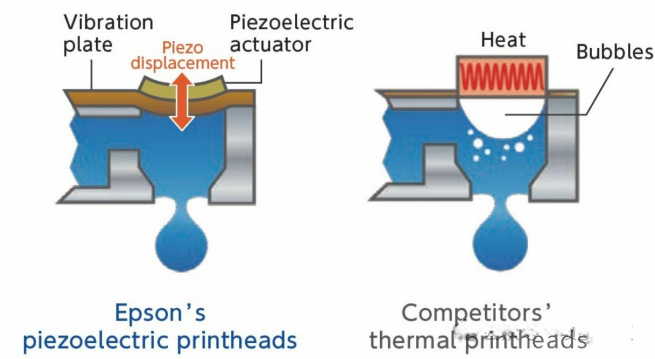
(Left: micro-piezo technology; Right: thermal inkjet technology)
2. Core Advantages and Disadvantages Comparison
| Dimension | Piezoelectric Inkjet | Thermal Inkjet |
| Printhead lifespan | Long (no thermal stress; lifespan can reach tens of thousands of pages) | Short (high temperatures cause nozzle erosion; frequent replacement required) |
| Printing precision | High (adjustable droplet size; up to 1440 dpi) | Lower (bubble ejection direction is harder to control) |
| Ink compatibility | Wide (supports water-based, solvent, and UV inks) | Limited (only suitable for high-surface-tension water-based inks) |
| Cost | Higher (complex piezoelectric ceramic manufacturing) | Lower (simple structure, lower equipment cost) |
| Nozzle clogging risk | Low (no heating, higher chemical stability) | High (prone to clogging after long idle periods) |
3. Recommended Application Scenarios
Piezoelectric Inkjet
- Industrial applications: high-precision coding and marking (e.g., electronic components), 3D printing, biomedical printing
- Office and photo printing: high-end models from brands such as Epson, suitable for long-term, stable output
Thermal Inkjet
- Home and commercial use: mid- to low-end printers from brands such as HP and Canon, suitable for low-cost color printing
- High-speed printing requirements: higher nozzle density enables faster continuous printing

(Comparison of nozzle density with the same nozzle size: left—piezoelectric, right—thermal inkjet)
Drop-on-Demand (DOD) Inkjet Technology

Drop-on-Demand (DOD) inkjet technology is a printing process in which ink droplets are ejected only when required. Its core principles and characteristics are described below:
1. Working Principle
Trigger Mechanism
Ink droplets are generated instantaneously in response to print signals through physical actuation mechanisms such as piezoelectric deformation, thermal bubble generation, or electromagnetic valve control, rather than being continuously emitted.
Droplet Control
By precisely adjusting driving parameters (e.g., pulse width, voltage, or heating duration), droplet size and ejection velocity can be controlled, enabling high-resolution printing.
2. Technology Categories
Piezoelectric DOD
This method uses the deformation of piezoelectric crystals under an electric field to compress the ink chamber and eject droplets. It offers broad ink compatibility and high precision.
Thermal DOD
Ink is locally heated by a thermal element to generate vapor bubbles that propel droplets. This method is cost-effective but may affect ink stability.
Electromagnetic Valve DOD
Ink ejection is controlled by micro-valves, making it suitable for large-character industrial coding and marking applications.
3. Application Advantages
- High precision: Supports micro-droplets (10–30 μm) and resolutions above 1200 dpi, suitable for precision applications such as PCB photoresist and solder mask printing.
- Flexibility: No physical templates are required; printing is directly driven by digital files, allowing rapid design modifications.
4. Comparison with Continuous Inkjet (CIJ)
- Efficiency differences: DOD ejects ink only when needed, resulting in higher ink utilization efficiency. CIJ continuously ejects ink and recirculates unused droplets, making it suitable for high-speed industrial printing but at higher operational costs.
Piezoelectric Inkjet Technology
Piezoelectric inkjet printing technology is based on the inverse piezoelectric effect of piezoelectric actuators. Its operating process is closely related to material properties. The key aspects are analyzed below.
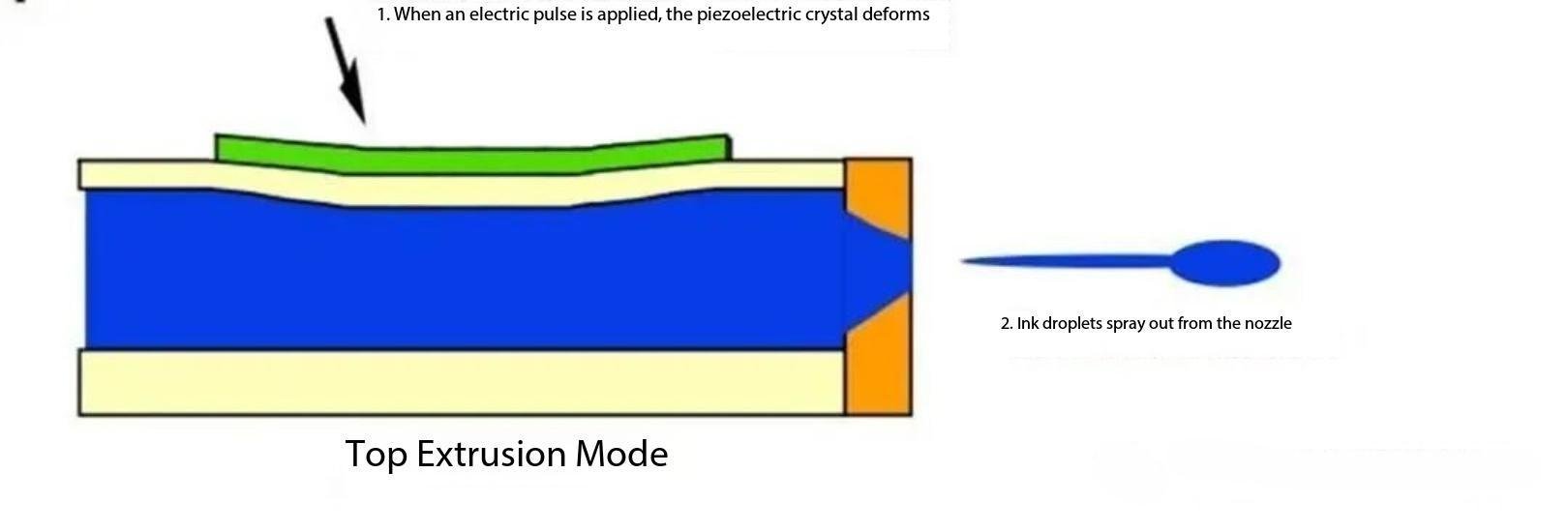
1. Piezoelectric Materials and Actuation Mechanism
PZT Ceramic Polarization
Lead zirconate titanate (PZT) ceramics are polarized by applying an external electric field, which aligns internal electric dipoles and induces piezoelectricity. After polarization, PZT undergoes nanometer-scale deformation under an applied electric field due to the inverse piezoelectric effect, with the magnitude of deformation being proportional to the applied voltage.
Curie Temperature Limitation
The piezoelectric properties of PZT remain stable below the Curie temperature (typically ≤350 °C). When this temperature is exceeded, depolarization occurs and piezoelectric functionality is lost. Inkjet printing systems must therefore ensure that operating temperatures remain well below the Curie point.
2. Detailed Inkjet Ejection Process
- Ink chamber deformation
The PZT actuator (such as a multilayer ceramic stack structure) is driven by a controlled voltage, causing deformation that compresses the ink chamber walls and pressurizes the ink. - Droplet ejection
The change in ink chamber volume generates a pressure wave that forces the ink to be expelled through the nozzle at high speed, forming a controllable ink droplet. - Waveform control
By precisely adjusting the drive voltage waveform (e.g., square waves or sawtooth waves), the deformation rate and amplitude of the PZT actuator can be controlled, enabling accurate regulation of droplet size and jetting frequency.


3. Technical Advantages and Challenges
Advantages
- High precision: PZT deformation resolution reaches sub-nanometer levels, making it suitable for high-resolution printing applications such as optical component manufacturing.
- Broad ink compatibility: Capable of handling a wide range of inks, including high-viscosity and solvent-based inks, offering advantages over thermal inkjet technology.
Challenges
- Temperature sensitivity: Heat generated during dynamic operation may affect PZT stability, requiring effective thermal management and heat dissipation design.
- Material cost and environmental concerns: PZT ceramics involve complex manufacturing processes and contain lead, which is subject to environmental regulations such as the RoHS Directive.
4. Application Scenarios
- Industrial printing: PCB inkjet printing, 3D printing (e.g., ceramic green body forming)
- Biomedical applications: Cell printing and drug delivery systems
Current technological trends are driving the development of lead-free piezoelectric materials (such as bismuth-based ceramics) to address challenges related to high-temperature stability and environmental compliance.