
The core characteristics of piezoelectric Drop-on-Demand (DOD) inkjet technology are closely related to fluid dynamic behavior. Factors such as nozzle shear rate, dynamic viscosity, polymer molecular weight, and solid loading significantly influence droplet formation and print quality. The following is a comprehensive analysis.
I. Nozzle Shear Rate and Dynamic Viscosity
1. Shear Rate Characteristics
The shear rate of piezoelectric DOD printheads is significantly lower than that of Continuous Inkjet (CIJ) technology, as it relies on pulsed pressure rather than a continuous jet stream.
A low shear rate (typically <10⁴ s⁻¹) can reduce the shear-thinning effect of high-viscosity inks, but dynamic viscosity adjustment is still required to ensure stable droplet break-up.
2. Jet Break-Up Control
Droplet formation depends on the rate of change of shear rate (dγ/dt), which must match the deformation speed of the piezoelectric crystal.
Experimental results show that when dγ/dt exceeds a critical threshold (approximately 10⁵ s⁻²), the jet breaks into uniform microdroplets due to inertial forces dominating the process.
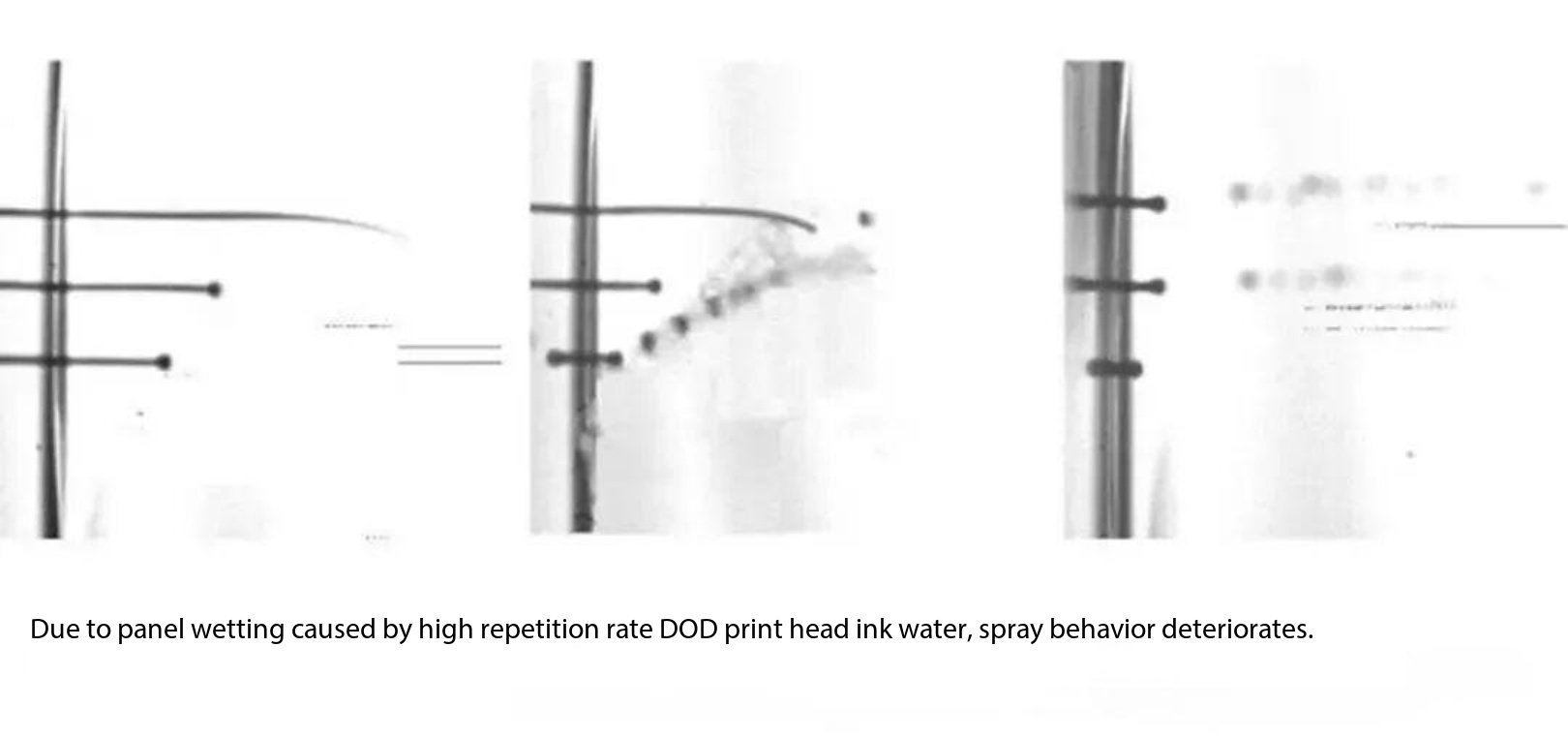
II. Polymer Molecular Weight and Print Quality
1. Influence of Molecular Weight
Ligament Length:
High molecular weight polymers (such as PVA) can increase ligament length (L ∝ √(η/ρ)). However, excessively high molecular weight (>100 kDa) may cause droplet tailing.
Throw Distance:
Increasing molecular weight reduces droplet kinetic energy (E ∝ 1/η), which shortens the droplet throw distance. This effect must be compensated by adjusting the piezoelectric driving voltage.
2. Print Resolution Optimization
Low molecular weight binders (<5 kDa) can improve droplet positioning accuracy, but a balance must be maintained between film strength and viscosity (recommended viscosity η = 10–20 mPa·s).
III. Solid Loading and PQ Relationship
1. Momentum and Ligament Length
Increasing solid loading (such as nanoparticles) increases droplet momentum (P ∝ ρv²). However, excessive loading (>15 wt%) causes nonlinear growth of ligament length (L), which may generate satellite droplets.
2. PQ Curve Regulation
Commercial printheads optimize the PQ curve (pressure–flow relationship) to match inks with different viscosities.
For example, high solid-loading inks require lower driving frequencies (<5 kHz) to avoid nozzle starvation.
IV. Technology Comparison and Engineering Applications
| Parameter | Piezoelectric DOD Printhead | CIJ Printhead | Thermal Inkjet Printhead |
| Shear Rate | Low (<10⁴ s⁻¹) | High (>10⁵ s⁻¹) | Medium (10⁴–10⁵ s⁻¹) |
| Applicable Viscosity Range | 10–50 mPa·s | 1–10 mPa·s | 5–20 mPa·s |
| Molecular Weight Sensitivity | High | Low | Medium |
Piezoelectric DOD technology shows significant advantages in high-precision printing applications, such as electronic packaging and biopharmaceutical printing. However, optimal performance requires coordinated optimization of binder formulations and driving parameters.