
Digital Inkjet Systems: A Comparison of Scanning Mode vs. Single-Pass Mode
I. Core Concept Definitions
Before comparing advantages and disadvantages, it is important to clarify the fundamental differences between the two approaches:
- Scanning Mode:
The printhead module is fixed or moves back and forth horizontally (perpendicular to the media transport direction), while the printing medium advances step by step. The complete image is produced through multiple scanning passes combined with incremental media movement, similar to the “back-and-forth printing” logic of desktop inkjet printers.
- Single-Pass Mode:
The printhead module spans the entire width of the printing medium (a “full-width printhead”). The medium moves forward only once in the longitudinal direction, and all pixels are printed in a single pass, without any reciprocating motion. This method is commonly used in industrial high-speed printing systems.
_2026-01-15_20-55-41.jpg)
_2026-01-15_20-55-59.jpg)
II. Detailed Comparison of Advantages and Disadvantages
1. Printing Efficiency: Single-Pass Mode Has a Decisive Advantage
| Aspect | Scanning Mode | Single-Pass Mode |
| Efficiency Performance | Lower efficiency, limited by carriage scanning speed and media feed speed. Each scan prints only 1–2 pixel rows, requiring multiple cycles to complete an image. For example, A3 full-color printing on a typical desktop scanning inkjet printer usually takes 30 seconds to 2 minutes. | Extremely high efficiency. The medium passes through once to complete full-width printing. Speed depends mainly on media transport speed. Industrial single-pass inkjet systems (e.g., wide-format roll printers) can reach 30–100 meters per minute, far exceeding scanning mode. |
| Advantages | Suitable for low-speed scenarios such as small batches and high-precision printing, where efficiency is not the primary concern. | Ideal for large-scale, continuous production (e.g., packaging printing, digital textile printing), fully meeting industrial mass-production requirements. |
| Disadvantages | Unable to meet high-capacity demands. Large batches require long production times, increasing the risk of delivery delays. | Inefficient for low-speed or small-batch jobs, where operating costs (such as energy consumption) are disproportionate to output. |
2. Print Quality and Resolution: Scanning Mode Has the Edge
| Aspect | Scanning Mode | Single-Pass Mode |
| Resolution Performance | Higher achievable resolution. Overlapping scans can compensate for jetting deviations, and fewer pixel rows per pass reduce positioning errors. Mainstream systems reach 1200–2400 DPI. | Resolution is strongly affected by printhead stitching. Full-width arrays consist of multiple smaller printheads; improper alignment can cause banding or color shift. Typical resolution is 600–1200 DPI (some high-end systems reach 2400 DPI, but at very high cost). |
| Advantages | Ideal for fine-detail applications such as photographs, high-precision labels, and art reproduction, delivering sharper detail and smoother color transitions. | Resolution is sufficient for industrial functional printing (e.g., packaging graphics, textile patterns), where speed is prioritized over ultra-fine detail. |
| Disadvantages | At high scanning speeds, vibration may cause image blur, requiring a trade-off between speed and quality. | Stitching errors are difficult to eliminate completely. Fine details (such as hairlines or small text) may show defects, making it unsuitable for ultra-high-precision applications. |
3. Equipment Cost and Maintenance: Scanning Mode Is More Economical
| Aspect | Scanning Mode | Single-Pass Mode |
| Initial Investment | Lower cost. Does not require full-width printheads—only one or two small printheads (e.g., 1-inch or 2-inch). The mechanical structure is relatively simple, without complex stitching calibration systems. | Very high cost. Requires custom full-width printheads (e.g., 1.8 m or 3.2 m wide), multiple printhead arrays, and complex calibration and tension control systems. Industrial systems typically cost USD 140,000–1,500,000. |
| Maintenance Cost | Simple maintenance. If a printhead fails, only a small unit needs replacement. Routine alignment is straightforward and can be performed by non-specialists. | High maintenance cost: (1) full-width printhead replacement is expensive; (2) stitching calibration requires skilled technicians and frequent adjustment (often every 1–2 weeks); (3) complex system structure makes troubleshooting difficult (e.g., tension system issues can affect the entire image). |
| Advantages | Suitable for limited budgets, such as personal studios or small print shops, with low upfront and ongoing costs. | In long-term mass production, high efficiency offsets high investment, resulting in lower cost per square meter. |
| Disadvantages | Higher unit cost in batch production due to low efficiency and higher time and energy costs per print. | Extremely high unit cost for small batches, high equipment idle rates, and poor cost distribution—unsuitable for multi-variety, small-batch production. |
Conclusion
Scanning mode and single-pass mode each serve distinct market needs.
- Scanning mode excels in flexibility, high resolution, and lower investment, making it ideal for small batches, customization, and high-detail printing.
- Single-pass mode dominates in efficiency and throughput, making it indispensable for industrial-scale, continuous production.
Choosing the right system depends on production volume, quality requirements, budget, and application scenarios.
The Impact of Digital Inkjet Droplet Size on Image Quality
I. Interaction Between Droplet Size and Dot Gain
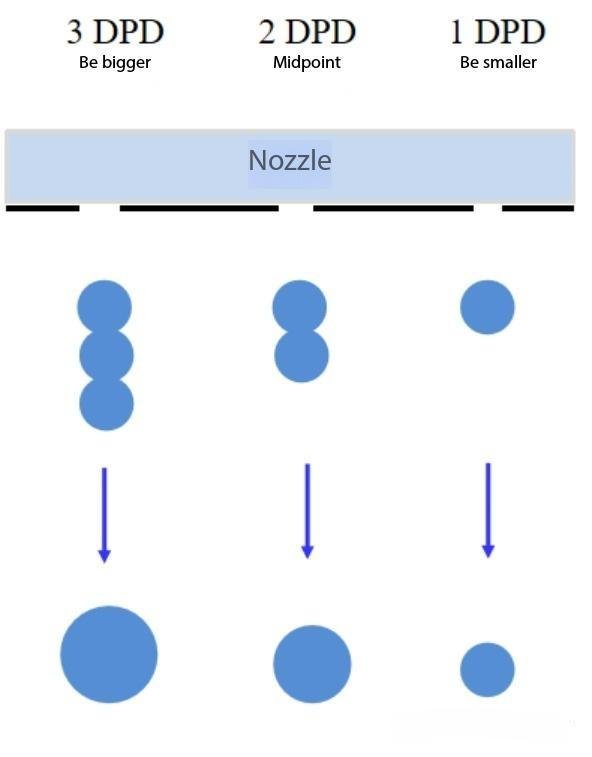
1. Mechanical–Optical Coupling Effects
Small droplets (3.5–7 pL) form dot diameters of approximately 15–25 μm on coated paper surfaces. Their mechanical spread is constrained by PDMS micro-cavity structures, allowing dot gain to be controlled within 2%.
Under the same conditions, 20 pL droplets exhibit greater mechanical spreading, expanding dot diameter to ~40 μm with a dot gain of up to 8%.
Key Finding:
When using Canon VariaDot technology, 6 pL droplets on photo paper produce only 0.5 μm of optical dot enlargement—significantly better than the ~3 μm error typical of conventional offset printing.
2. Substrate Adaptation Curves
| Media Type | Optimal Droplet Size | Dot Gain Compensation |
| Cast-coated photo paper | 3–5 pL | +1.2% |
| Kraft paper | 12–15 pL | +7.5% |
| Acrylic sheets | 8–10 pL | +4.3% |
II. Physical Limits of Fine Image Reproduction
1. Resolution Limit Theory
Based on the relationship between droplet volume V and the minimum reproducible feature size d:
d=3V4πK3d = \sqrt[3]{\frac{3V}{4\pi K}}d=34πK3V
where K is the substrate absorption coefficient (K = 0.93 for coated paper).
Calculations show that 3 pL droplets can achieve a 4.7 μm line width, which closely matches the 4.9 μm measured value of **Epson Micro Piezo printheads.
2. Breakthroughs in Dynamic Droplet Technology
The Arizona 1260 XT printer enables intelligent droplet switching from 6–42 pL, maintaining ink layer thickness variation within ±1.2 μm in areas with 200% color gamut coverage, while sustaining an effective resolution of 1200 dpi.
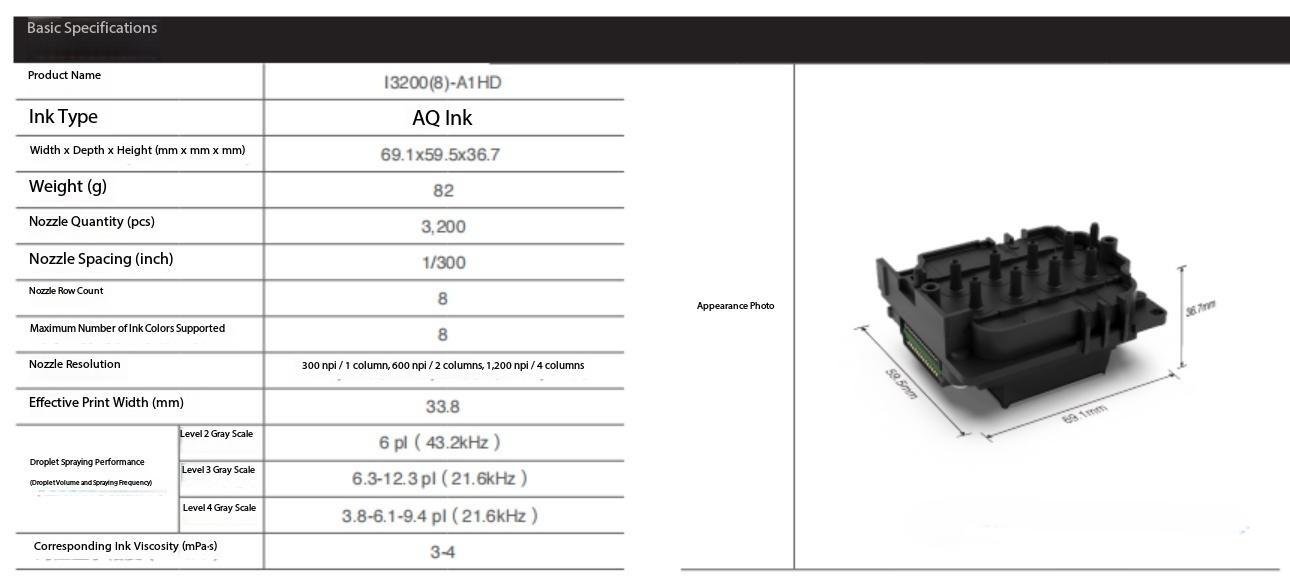
Basic Specifications
| Item | Specification |
| Product Model | I3200(8)-A1HD |
| Ink Type | Aqueous Ink |
| Dimensions (W × D × H, mm) | 69.1 × 59.5 × 36.7 |
| Weight (g) | 82 |
| Number of Nozzles | 3,200 |
| Nozzle Pitch (inch) | 1/300 |
| Number of Nozzle Rows | 8 |
| Max. Supported Ink Colors | 8 |
| Nozzle Resolution | 300 npi / 1 row, 600 npi / 2 rows, 1200 npi / 4 rows |
| Effective Print Width (mm) | 33.8 |
| Grayscale Performance – 2 Levels | 6 pL (43.2 kHz) |
| Grayscale Performance – 3 Levels | 6.3–12.3 pL (21.6 kHz) |
| Grayscale Performance – 4 Levels | 3.8–6.1–9.4 pL (21.6 kHz) |
| Compatible Ink Viscosity (mPa·s) | 3–4 |
III. Quantitative Comparison of Cost Efficiency
- Ink Consumption:
Printing an A4 image with a 3.5 pL droplet system saves 38% ink compared to a 12 pL system
(Measured data: 5.2 ml vs. 8.4 ml) - Drying Kinetics:
UV ink with a 20 μm ink layer requires 3.2 s to cure, while an 8 μm layer cures in just 0.9 s - Media Deformation:
Newsprint receiving 15 pL droplets shows a 2.3% moisture content change, causing 0.15 mm/m curling
With 7 pL droplets, moisture change is limited to 0.7%
IV. Engineering Solutions to Technical Trade-Offs
1. Edge Sharpness Compensation Algorithms
In the Epson SureColor series, droplet landing prediction models adjust drive waveforms 0.5 ms in advance, reducing positioning error of 3.5 pL droplets on rough paper from 12 μm to 3 μm.
2. Density Enhancement Technology
The Mimaki UCJV300 employs a “micro-droplet stacking” mode, using a 4 × 6 pL droplet matrix to achieve an effective 24 pL optical density (ΔD = 2.1) while maintaining 600 dpi effective resolution.
3. Fault-Tolerant Jetting Mechanisms
HP PageWide printheads integrate 2,560 redundant nozzles. When droplet loss is detected, adjacent nozzles compensate within 0.1 ms, achieving a defect recovery rate of 99.7%.
4. Acoustic Pulse Modulation Technology
A continuous inkjet deflection system developed by Klaus Peschter’s research team uses 140 MHz acoustic waves to precisely control droplet separation timing, enabling 1 pL-level volumetric accuracy.
5. Quantum Dot Ink Systems
In 2025, newly developed CdSe/ZnS quantum dot inks can carry 2.7 × 10ⁿ nanocrystals within a 3 pL droplet, expanding the color gamut to NTSC 150%.
Conclusion
Droplet size is a core parameter influencing resolution, dot gain, color density, drying behavior, media stability, and overall production cost. Through dynamic droplet control, intelligent algorithms, redundancy design, and next-generation ink chemistry, modern inkjet systems are successfully overcoming traditional trade-offs—pushing digital printing toward higher precision, greater efficiency, and broader application potential.