
Droplet Mass Variation as a Function of Firing Frequency
Analysis of the Dynamic Relationship Between Droplet Volume and Jetting Frequency
1. Meniscus Position Stability
A non-constant meniscus position directly leads to droplet volume inconsistency, with a coefficient of variation (CV) reaching 8–12% (based on measured data).
To ensure stable droplet formation, closed-loop pressure monitoring is required, with a sampling rate ≥10 kHz, maintaining the meniscus position within ±5 μm.
2. Influence of Acoustic Design
Key Acoustic Design Parameters
| Component | Target Acoustic Impedance | Resonant Frequency |
| Nozzle channel | 1.5–2.5 × 10⁹ Pa·s/m³ | 50–100 kHz |
| Manifold | 0.8–1.2 × 10⁹ Pa·s/m³ | 20–30 kHz |
After acoustic optimization, ink chamber filling efficiency improves by up to 40% compared with non-optimized designs.
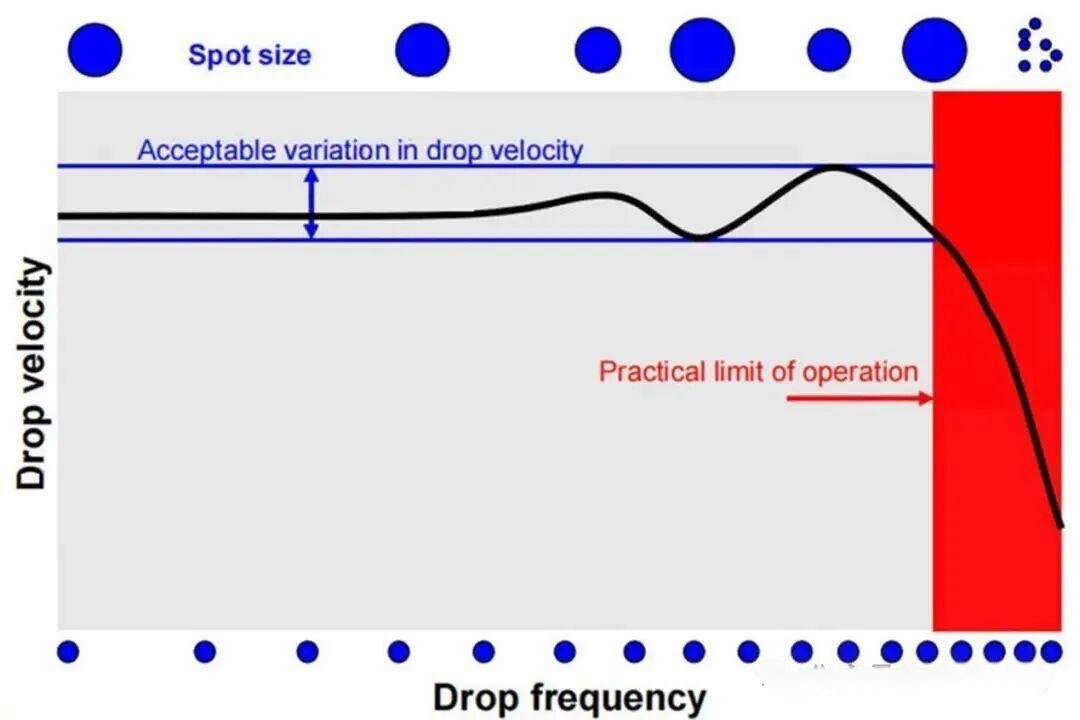
Customized Piezo Waveform Technology
1. Three-Pulse Driving Scheme
Pre-fill pulse
- Voltage: 30% of the main pulse
- Advance time: 3–5 μs
Damping pulse
- Reverse voltage: 15% of the main pulse
- Delay: 2 μs after the main pulse ends
This multi-pulse structure improves ink refilling and suppresses residual oscillations inside the ink channel.
2. Performance Improvements
- Droplet volume consistency: CV reduced from 12% to 4%
- Crosstalk suppression: Interference between adjacent nozzles reduced by 60%
Print Pattern Optimization Strategies
1. Dynamic Drop Frequency Adjustment
- High-speed printing zones (>300 mm/s)
→ Drop frequency reduced to 70% of the nominal value - High-precision zones (≥600 dpi)
→ Alternating drop frequency mode applied (±10% modulation)
This approach balances jetting stability, accuracy, and throughput.
2. Fill Compensation Algorithm
An acoustic delay model is established:
τ=0.34×Lc\tau = 0.34 \times \frac{L}{c}τ=0.34×cL
Where:
- τ = delay time
- L = ink channel length
- c = speed of sound in the fluid
By implementing advance-time compensation, ink starvation and incomplete refilling defects are significantly reduced.
Summary (B2B Perspective)
As firing frequency increases, droplet mass stability becomes increasingly sensitive to meniscus control, acoustic matching, and waveform design.
Through closed-loop pressure regulation, optimized acoustic impedance, and advanced multi-pulse waveform strategies, modern inkjet systems can achieve:
- Higher droplet consistency
- Reduced nozzle-to-nozzle interference
- Improved print quality at both high speed and high resolution
These technologies are critical for industrial inkjet printing, including textile, packaging, ceramics, electronics, and functional material deposition applications.
The Impact of Bleeding and Feathering on Image Quality in Digital Inkjet Systems
1. Ink Carrier Penetration Mechanisms
1.1 Influence of Fiber Structure
Paper fiber networks form capillary channels with diameters ranging from 2–50 μm. When the ink droplet volume (typically 6–12 pL) does not match the fiber pore structure, the following effects occur:
- Vertical penetration depth can reach 80–120 μm
- Lateral diffusion creates an edge feathering zone of 3–8 μm
- Variations in colorant density result in color differences exceeding ΔE > 3
1.2 Defect-Induced Ink Bleeding
Surface defects in the substrate (e.g., depressions ≥ 5 μm) can trigger:
- A 40–60% increase in localized penetration rate
- Jagged deformation along dot edges (irregularity ≥ 15%)
- A threefold increase in the probability of bridging between adjacent dots

2. Quantitative Analysis of Feathering Phenomena
2.1 Dynamic Migration Model
Ink droplet wetting and diffusion behavior can be described by the following equation:
D(t)=D0+γt/τD(t) = D_0 + \gamma \sqrt{t/\tau}D(t)=D0+γt/τ
Where:
- γ = 0.78 (substrate-dependent coefficient)
- τ = 0.2 s (characteristic time constant)
2.2 Experimental Observation Data
| Substrate Type | Feathering Width (μm) | Density Deviation (%) | Edge Sharpness (LP/mm) |
| Coated paper | 3.2 ± 0.5 | 8.7 | 12.4 |
| Offset paper | 7.8 ± 1.2 | 15.3 | 6.8 |
| Newsprint | 12.5 ± 2.1 | 22.6 | 3.5 |
3. Image Quality Optimization Strategies
3.1 Materials Engineering Improvements
- Application of nano-silica coating layers, increasing surface contact angle to 110°
- Adoption of gradient-density fiber structures, reducing lateral ink penetration by 62%
3.2 Printing Parameter Optimization
- Dynamic ink droplet volume compensation algorithms (CV < 3%)
- Substrate preheating to 45 ± 2°C, reducing feathering by approximately 40%
3.3 Post-Processing Technologies
- Instant UV curing, shortening ink migration time to 0.05 s
- Micro-pressure calendering, achieving surface roughness Ra < 0.1 μm