
Epson (EPSON) PrecisionCore Technology
Epson PrecisionCore
- MEMS piezoelectric printhead technology
- Chip-based, scalable architecture
- TFP print chip: 720 npi, 2 rows × 360 nozzles
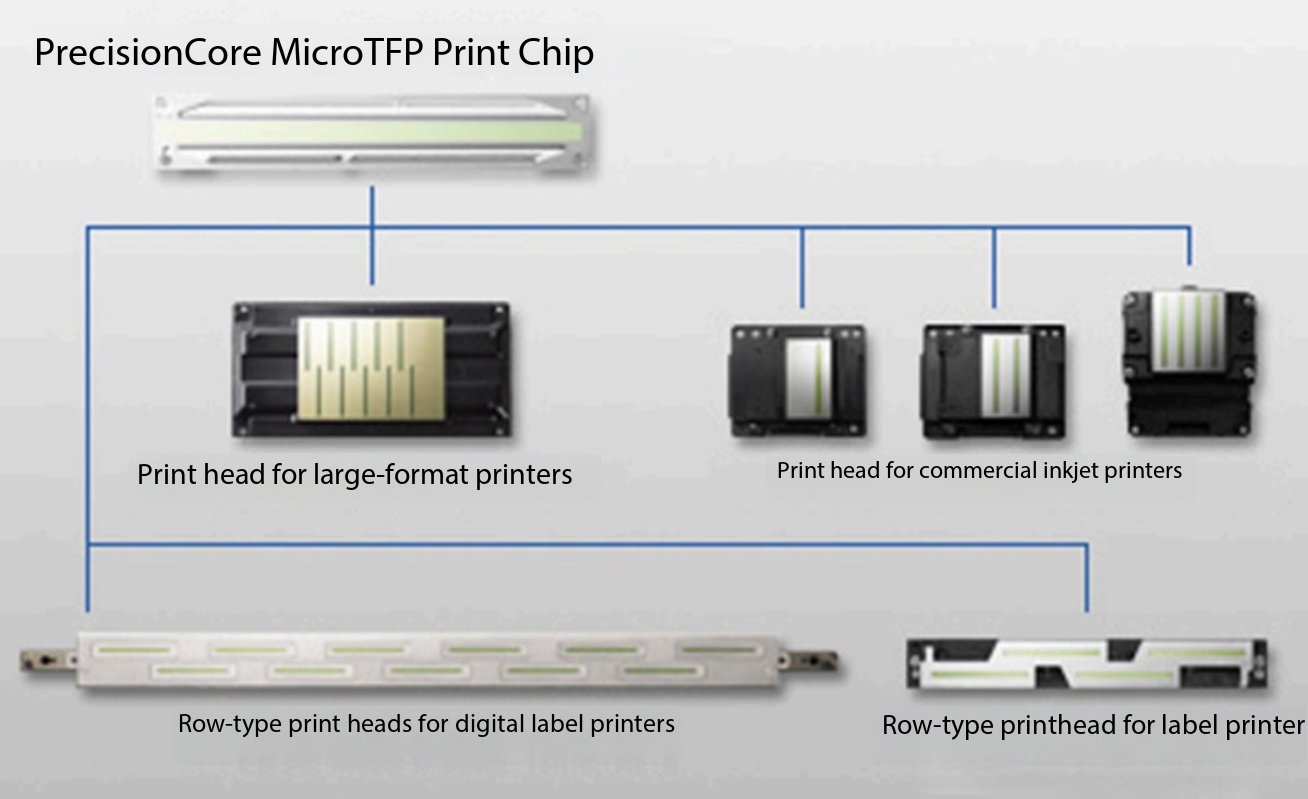
- MicroTFP print chip: 600 npi, 2 rows × 400 nozzles
- Jetting frequency: up to 50 kHz
- Droplet volume: 1.5–32.5 pl
TFP Print Chip
MicroTFP Print Chip

33 cm Printhead
SurePress L-4033AW
- Resolution: 600 × 600 dpi
- Printing speed: 15 m/min
- Ink droplet firing detection
- Monitors piezoelectric output after droplet ejection
- Automatically compensates for nozzle clogging, air bubbles, and abnormal jetting conditions
PrecisionCore技术.png)
PrecisionCore技术-2_2026-01-27_20-57-14.png)
Overview of Epson PrecisionCore Technology
Epson PrecisionCore technology is a core innovation in Epson’s inkjet printing portfolio. By combining Micro Piezo technology with MEMS manufacturing processes, it achieves an optimal balance of high precision, high speed, and cost efficiency. The key features and applications are outlined below.
I. Technical Principles and Core Advantages
1. Micro Piezo Inkjet Technology
Ink is ejected by deforming piezoelectric elements under voltage control, avoiding the thermal stress associated with thermal inkjet technology. This results in longer printhead lifespan and lower nozzle clogging risk.
Droplet placement accuracy is up to 10 times higher than conventional technologies, enabling hairline-level detail reproduction.
2. MEMS-Based Manufacturing
Printheads are manufactured using Micro-Electro-Mechanical Systems (MEMS) technology, achieving nozzle densities of up to 600 npi (600 nozzles per inch). This enables a compact structure with high durability and consistency.
3. Intelligent Droplet Control
Supports multi-level grayscale printing (VSDT technology), allowing dynamic adjustment of droplet size (minimum 3.3 pl). This reduces graininess and improves smooth color gradation.
II. Performance Characteristics
1. High Resolution and High Speed
- Nozzle resolution up to 600 dpi (monochrome) or 300 dpi (CMYK)
- Selected models support output up to 720 × 1440 dpi
- Jetting frequency up to 50,000 droplets per second, enabling both high-speed printing and high image quality
2. Color Accuracy
Compatible with a wide range of inks (eco-solvent, pigment, sublimation, etc.), delivering significantly improved color saturation and color reproduction accuracy.
III. Application Scenarios
1. Industrial Printing
Used in textile printing, signage, and graphics, supporting wide-format, high-precision output (up to 1626 mm).
Industrial models (e.g., I1600-E1) feature enhanced durability and are suitable for continuous operation.
2. Consumer and Commercial Printing
Home and office printers (e.g., L8168) use six-color ink systems to achieve photo-quality output.
3. Special Environment Applications
The technology has been tested in microgravity environments for space printing, demonstrating exceptional stability and reliability.
PrecisionCore TFP
Third-generation technology utilizes a 1-micron-thick TFP piezoelectric film, enabling more precise droplet control and improved printing performance.
In-Depth Analysis of Epson PrecisionCore Technology
In the field of inkjet printing technology, Epson’s PrecisionCore technology is widely regarded as an industry benchmark. It not only serves as the core foundation behind Epson printers’ outstanding performance but also acts as a key driving force pushing inkjet printing toward higher speed, higher quality, and lower energy consumption. It has fundamentally reshaped users’ perception and experience of inkjet printing.
Technical Definition and Core Positioning
PrecisionCore technology is Epson’s independently developed next-generation Micro Piezo printhead technology. Its core positioning is to break through the performance limitations of traditional inkjet printheads through ultra-precise manufacturing and innovative structural design, achieving a perfect balance of high precision, high speed, and high stability.
Unlike traditional printhead technologies, PrecisionCore is not merely an upgrade of a single component. Instead, it is a comprehensive system integrating multiple disciplines, including materials science, precision engineering, fluid dynamics, and electronic control, providing full-process optimization from ink ejection to quality control.
Core Structure and Components
1. Micro Piezo Element Array
The core component of the PrecisionCore printhead is a high-density micro piezoelectric element array. These elements are made of specialized piezoelectric ceramic materials and are extremely small (micron-level precision), yet exhibit high sensitivity and mechanical stability.
Unlike traditional printheads with distributed piezo elements, PrecisionCore utilizes advanced multilayer stacking technology to densely integrate hundreds or even thousands of piezo elements into a compact chip, forming an array structure.
This design significantly increases nozzle density per unit area and allows independent control of each element, enabling precise droplet control.
2. Precision Nozzle and Flow Channel System
Paired with the piezo array is a micro-precision nozzle and ink flow channel system.
Using nanometer-scale lithography and precision etching, Epson fabricates micro nozzles aligned with each piezo element. The nozzle diameter is precisely controlled between 10–20 microns, with an error margin of less than 1 micron.
Internally, the ink flow channels are designed with streamlined geometry and polished surfaces to minimize resistance and ink residue, ensuring stable and uniform ink delivery.
This integrated “element–channel–nozzle” design fundamentally eliminates issues such as uneven ink supply and ink splashing found in traditional printheads.
3. Integrated Driving and Control Circuit
To precisely control the high-density piezo array, PrecisionCore printheads incorporate integrated driving and control circuits.
Using chip-level packaging technology, these circuits are tightly integrated with the piezo elements and flow system, reducing signal transmission distance, interference, and latency.
Each driving unit can output independently adjustable voltage signals (millivolt-level precision), enabling precise control of:
- Droplet size (from sub-picoliter to tens of picoliters)
- Ejection speed (up to 5 m/s)
- Complex operations such as multi-size droplet ejection in a single firing cycle
Working Principle: From Voltage Signal to Precise Inkjet
PrecisionCore operates based on the inverse piezoelectric effect and fluid dynamics, divided into three key stages:
Stage 1: Signal Activation and Piezo Deformation
When ink ejection is required, the main controller sends voltage signals to the printhead. The driving circuit applies precise voltage to specific piezo elements.
Under voltage, the piezo elements undergo controlled deformation. This deformation is reversible and highly precise, with displacement accuracy within 0.1 microns.
Stage 2: Ink Compression and Droplet Formation
The deformation compresses the ink chamber, pushing ink toward the nozzle. Due to the precision design, ink forms spherical droplets rather than irregular jets.
By adjusting deformation speed and amplitude, the system precisely controls:
- Droplet size (small droplets for detail, large for filling)
- Ejection direction (deviation < 0.5°)
Stage 3: Piezo Reset and Ink Refill
After ejection, voltage is removed, and the piezo element returns to its original position, creating negative pressure that draws in fresh ink.
This cycle (deformation → compression → reset → refill) occurs within microseconds, enabling high-speed printing. A single nozzle can reach over 30 kHz firing frequency (30,000 droplets per second).
Core Technical Advantages
1. Ultra-High Printing Precision
PrecisionCore can produce droplets as small as 0.3 picoliters with positioning accuracy within 20 microns, enabling pixel-level detail reproduction.
It supports resolutions up to 4800 dpi, delivering photo-quality output with sharp textures and smooth gradients.
2. High-Speed Printing
With high nozzle density and firing frequency, PrecisionCore achieves both speed and quality.
For example, Epson business printers can reach 30+ pages per minute without sacrificing droplet accuracy.
3. Long-Term Stability
Using durable ceramic materials and optimized flow structures, PrecisionCore printheads offer:
- Longer lifespan (1.5–2× traditional printheads)
- Reduced clogging
- Lower maintenance costs
Combined with Epson’s nozzle monitoring systems, reliability is significantly improved.
4. Wide Compatibility
PrecisionCore supports various ink types:
- Dye ink
- Pigment ink
- Solvent ink
- UV-curable ink
It also adapts to diverse materials:
- Paper
- Photo media
- Fabric
- Plastic films
- Metal surfaces
Application Scenarios
1. Home and Office Printing
PrecisionCore printers (e.g., Epson L and WF series) balance speed and quality, delivering sharp text and vibrant images with 30% lower energy consumption compared to thermal inkjet.
2. Professional Imaging and Graphic Printing
In professional photography and print shops, PrecisionCore enables high-end output.
Epson P-series printers can achieve 16-color precision printing, meeting strict color accuracy requirements.
3. Industrial and Commercial Printing
PrecisionCore excels in industrial environments:
- Textile printing: High-speed, high-precision printing on fabrics
- Label printing: Durable barcodes on plastic or metal
- Specialty applications: Waterproof and oil-resistant inks
Continuous Inkjet (CIJ) – Multi-Deflection Technology
Continuous Inkjet – Multi-Deflection
- Typically configured with a single nozzle, but can also be implemented in array configurations
- Ink flows out of the nozzle under pressure
- A piezoelectric crystal induces regular breakup of the ink stream into droplets
- Conductive ink droplets are selectively charged at the breakup point
- Charged droplets retain their charge and are deflected by an electrostatic field
- Printing droplets are deflected to multiple positions on the substrate
- Non-printing droplets are collected in a gutter and returned to the ink circulation system
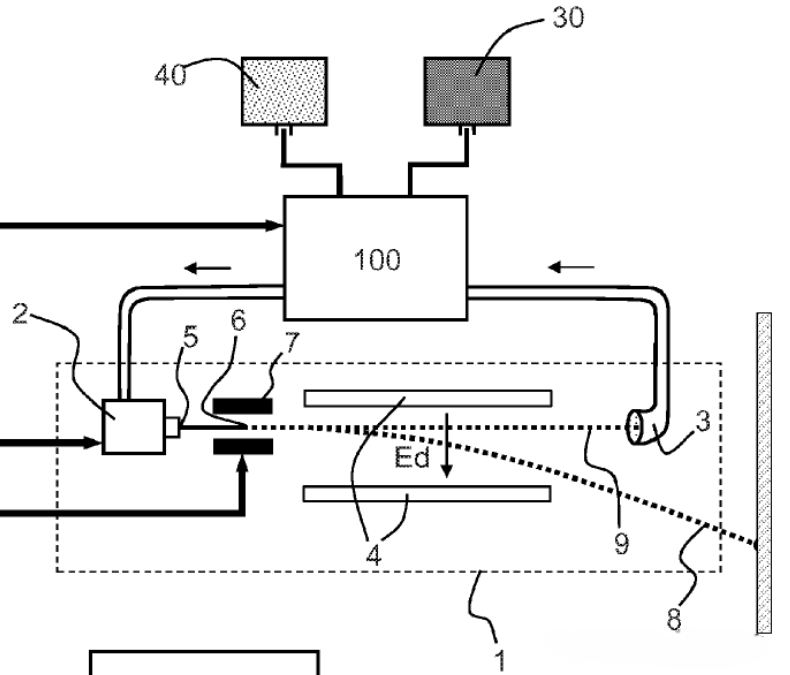
Overview of Continuous Inkjet Multi-Deflection Technology
Continuous Inkjet (CIJ) multi-deflection technology is a high-precision inkjet printing method. Its core workflow and characteristics are described below:
1. Nozzle Configuration
CIJ systems are typically designed with a single nozzle, but can be expanded into nozzle arrays to meet different printing requirements.
2. Droplet Formation and Charging
Ink is forced through the nozzle under pressure. High-frequency vibration from a piezoelectric crystal stimulates the ink stream to break up into uniformly sized droplets.
Conductive ink droplets are selectively charged at the breakup point. The charged droplets retain their electrical charge and enter the electrostatic deflection stage.
3. Deflection and Recovery Mechanism
Charged droplets are deflected by an electrostatic field to multiple target positions on the substrate, enabling multi-level positioning and printing.
Uncharged droplets are collected in a gutter and returned to the ink system for recirculation, reducing ink waste.
4. Technical Advantages
- High-speed jetting capability: a single nozzle can eject up to 62,000 droplets per second
- Long throw distance with high precision, suitable for industrial coding, marking, and large-format graphics
- Automatic ink viscosity control, ensuring consistent print quality
Analysis of Kodak Continuous Inkjet (CIJ) Technology
Kodak Stream CIJ
- Silicon nozzle plate strip
- CMOS circuitry and heaters integrated around the nozzles
- Thermal pulse modulation
- Droplet size controlled by adjusting pulse width
- Airflow-based separation of smaller non-printing droplets
- Note: No piezoelectric actuation, no charging or electrostatic deflection

Overview of Kodak Continuous Inkjet (CIJ) Technology
Kodak Continuous Inkjet (CIJ) technology is based on a thermal inkjet principle. Its core features and process flow are outlined below.
1. Nozzle Structure and Drive Mechanism
Silicon Nozzle Plate Strip
The system uses a silicon-based nozzle plate strip, fabricated using MEMS processes, with CMOS control circuits and micro-heaters integrated around each nozzle. This design enables high nozzle density and precise thermal control.
Thermal Pulse Modulation
Droplet size is controlled by adjusting the heater pulse width, typically in the range of 1–10 μs.
A wider pulse generates more thermal energy, resulting in a larger droplet volume, while a narrower pulse produces smaller droplets.
2. Droplet Separation and Recovery
Airflow-Assisted Separation
Instead of electrostatic charging and deflection, airflow is used to separate smaller, non-printing droplets from the main ink stream. These non-printing droplets are collected and returned to the ink circulation system for reuse.
Non-Piezoelectric Design
Unlike piezoelectric inkjet systems, Kodak’s CIJ solution relies entirely on thermal actuation rather than piezoelectric crystals.
This simplifies the mechanical structure but requires highly precise temperature control to ensure stable droplet formation.
3. Technical Advantages and Limitations
Advantages
- Ultra-high jetting speed, with single-nozzle frequencies exceeding 100 kHz
- No charging or electrostatic deflection modules, reducing overall system complexity
Limitations
- Heater lifetime is strongly influenced by ink chemistry, affecting long-term durability
- Limited droplet size adjustment range, requiring algorithm-based compensation for high-precision printing
Application Scenarios
This technology is well suited for industrial coding, packaging printing, and other applications that demand very high printing speed with moderate precision requirements.