
I. Formation Mechanism of Satellite Droplets:
An Inevitable Outcome of Fluid Breakup During Jetting
The process by which ink droplets are ejected from an inkjet printhead is essentially a dynamic fluid breakup process, in which liquid is driven by pressure from a confined space (the nozzle) into an open environment (air) and subsequently fragments into droplets.
The generation of satellite droplets is directly linked to the fluid dynamics governing this process and can be explained through three key stages:
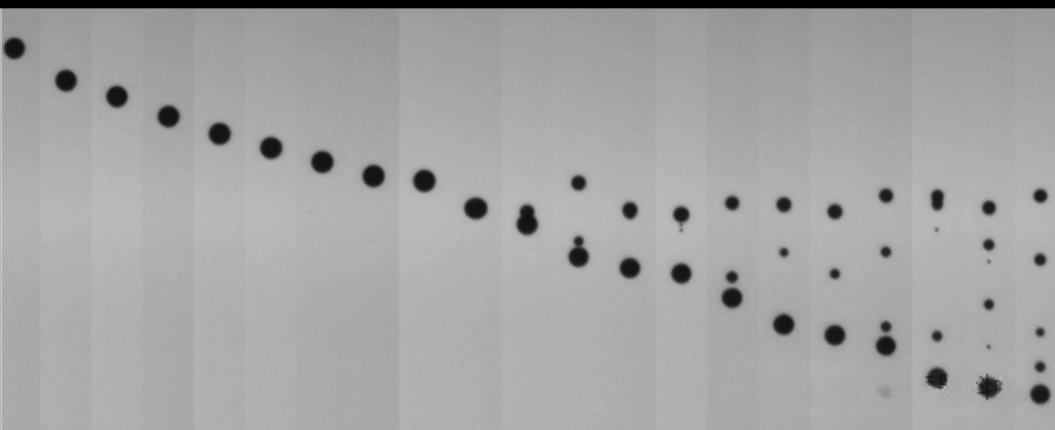
1. Ink Jetting Stage: Initial Competition Between Surface Tension and Inertial Forces
When ink is driven out of the nozzle by internal pressure—such as the pulse pressure generated by piezoelectric actuation—a continuous liquid column (ink jet) is formed. At this stage, the ink jet is governed by two dominant forces:
- Surface tension, which acts to minimize surface energy by contracting the liquid into a spherical shape
- Inertial force, provided by the jetting pressure, which propels the ink forward and maintains the columnar structure
At the moment the ink exits the nozzle, inertial force dominates, allowing the ink jet to extend forward in a relatively stable cylindrical form.
2. Jet Instability Stage: Amplification of Disturbances by Rayleigh Instability
As the ink jet travels farther from the nozzle, inertial forces gradually weaken while surface tension becomes increasingly influential. Due to factors such as nozzle manufacturing tolerances, non-uniform ink viscosity, or pressure fluctuations, microscopic disturbances inevitably exist on the jet surface (e.g., slight variations in jet diameter).
According to Rayleigh instability theory, these small disturbances are amplified under the influence of surface tension:
- Thinner regions of the jet contract further
- Thicker regions grow as fluid flows toward them
Eventually, the continuous ink column breaks up into multiple discrete droplets.
3. Satellite Droplet Separation Stage: Energy and Mass Distribution Imbalance
At the moment of jet breakup, the distribution of energy and mass among the resulting droplets is not uniform.
- Most of the ink accumulates into a primary droplet, which has larger volume and higher kinetic energy and performs the main printing function
- A small fraction of ink at the breakup points—lacking sufficient inertia to follow the primary droplet—contracts under surface tension into extremely fine droplets, known as satellite droplets
These satellite droplets may disperse with surrounding airflow or settle slowly under gravity.
II. Why Solvent-Based Inks Are More Prone to Satellite Droplet Formation
The Role of Physical Properties and Jetting Compatibility
Compared with water-based and UV-curable inks, solvent-based inks—which use organic solvents such as esters or ketones as carriers—exhibit distinct physical properties that strongly influence jet formation, instability, and breakup behavior. As a result, they tend to generate more frequent and more numerous satellite droplets. This can be explained through four key material characteristics:
1. Low Surface Tension: Reduced Jet Stability and Faster Disturbance Growth
Surface tension is a critical force in stabilizing the ink jet. Solvent-based inks typically have significantly lower surface tension than other ink types (approximately 25–35 mN/m for solvent inks versus 40–50 mN/m for water-based inks).
Lower surface tension leads to:
- Reduced suppression of initial surface disturbances, allowing small diameter fluctuations to grow more rapidly
- Easier fragmentation of the jet into multiple small droplets rather than consolidation into a single primary droplet
As a result, satellite droplet generation increases significantly.
2. Low Viscosity: Enhanced Flowability and Increased Fragmentation
Viscosity reflects internal fluid friction and directly affects jet stability and breakup behavior. Solvent-based inks typically exhibit low viscosity due to their organic solvent carriers (commonly 5–20 mPa·s, compared with >100 mPa·s for UV-curable inks).
Low viscosity results in:
- Greater jet spread after nozzle exit, leading to non-uniform jet diameter and enhanced Rayleigh instability
- Reduced resistance to fragmentation during breakup, allowing small ink fragments to detach from the primary droplet more easily
By contrast, high-viscosity inks exhibit stronger internal cohesion and are more likely to form a single stable primary droplet.
3. Low Density: Reduced Entrainment of Small Droplets by the Main Droplet
Ink density affects droplet inertia and motion. Solvent-based inks generally have lower density than water-based inks (approximately 0.8–0.9 g/cm³, compared with 1.0 g/cm³ for water).
This leads to:
- Lower mass and inertia of the primary droplet, resulting in weaker viscous entrainment forces acting on nearby small droplets
- Increased likelihood that small droplets will separate from the primary droplet and remain as independent satellite droplets
Higher-density inks produce heavier primary droplets that can more effectively “pull” nearby micro-droplets, reducing satellite formation.
4. High Volatility: Indirect Promotion of Satellite Droplet Formation
Although solvent volatility does not directly cause jet breakup, it indirectly intensifies satellite droplet formation:
- Rapid solvent evaporation during jetting creates localized variations in concentration and viscosity along the jet surface, further destabilizing the ink column
- Evaporation reduces droplet mass and volume—especially in small droplets with high surface-area-to-volume ratios—making them more prone to separation and less likely to re-coalesce with the primary droplet
III. Summary: The Fundamental Nature of Satellite Droplets and the “High-Risk” Profile of Solvent-Based Inks
Satellite droplets are an inevitable consequence of fluid jet breakup driven by surface tension–inertia imbalance and Rayleigh instability.
The four core characteristics of solvent-based inks—low surface tension, low viscosity, low density, and high volatility—amplify this mechanism by:
- Reducing jet stability
- Increasing fragmentation during breakup
- Weakening the entrainment capability of the primary droplet
- Enhancing local non-uniformities during jetting
As a result, solvent-based inks exhibit a higher propensity for satellite droplet and ink mist (“flying ink”) formation compared with other ink systems.
In practical printing applications—such as wide-format solvent inkjet printing—this behavior necessitates additional control measures, including:
- Optimizing printhead and nozzle design (e.g., reducing nozzle diameter)
- Fine-tuning jetting pressure and waveform parameters
- Adding surfactants to subtly adjust surface tension
These strategies help mitigate ink misting and improve print quality and system stability.