
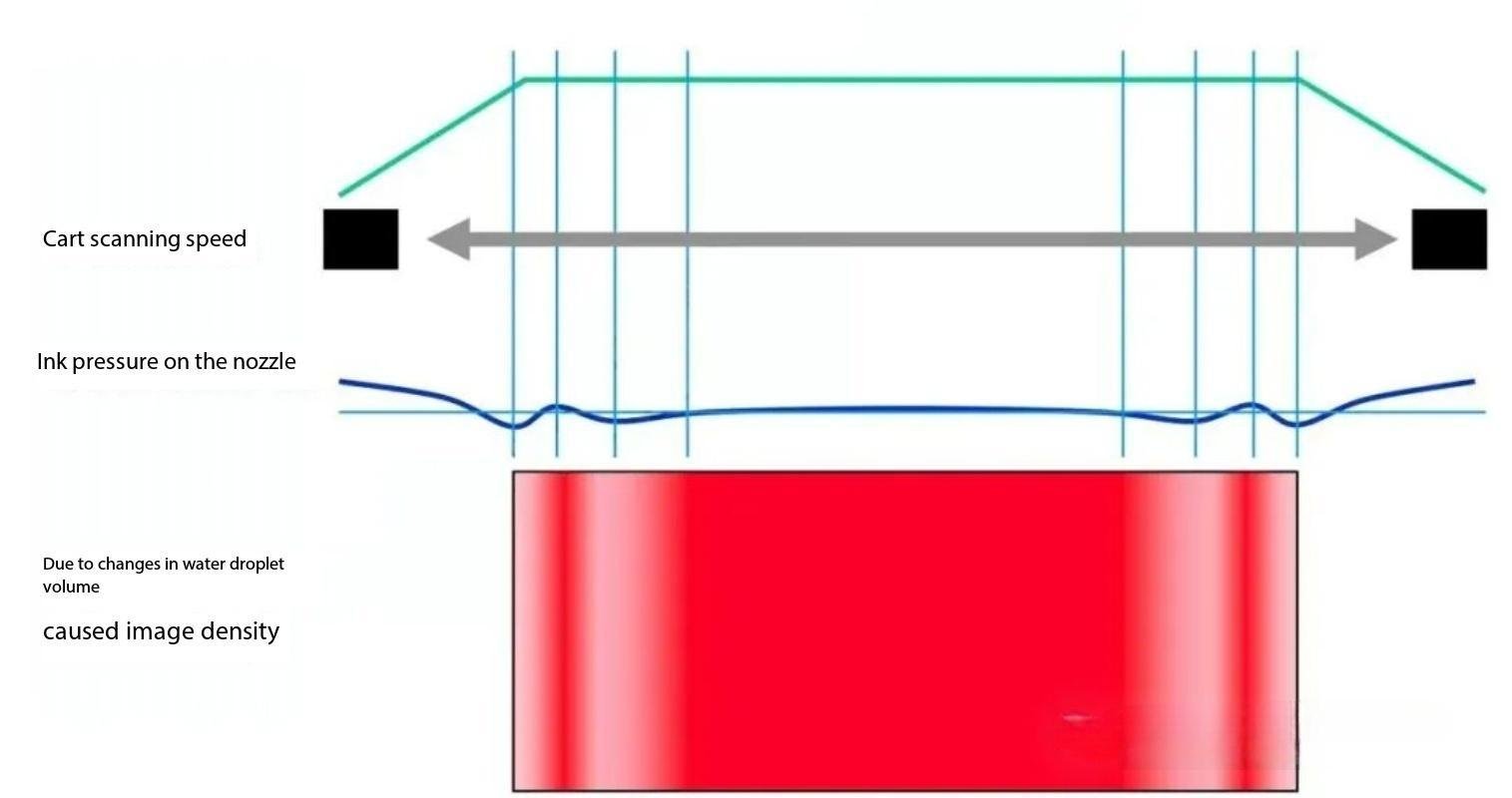
I. Dynamic Mechanisms by Which Motion Speed Affects Ink Pressure
1. Fluid-Dynamics Effects
- Enhanced Bernoulli effect:
When the printhead traveling speed exceeds 2 m/s, the static ink pressure at the nozzle exit decreases by approximately 12–15%, resulting in insufficient initial droplet kinetic energy and causing tailing phenomena. - Negative-pressure system response delay:
At high speeds (>3 m/s), the ink supply system must maintain a negative pressure of –20 kPa to –25 kPa. If pressure-feedback latency exceeds 0.5 ms, jetting frequency desynchronization may occur, leading to missing jets or non-uniform droplet volumes.
2. Critical Thresholds in Droplet Formation
- When the motion speed causes the Reynolds number to exceed the critical value (Re > 2300), ink flow transitions from laminar to turbulent. As a result, droplet breakup locations become more random, and the satellite droplet occurrence rate increases by about 37%.
- For piezoelectric printheads operating at 50 kHz, every 0.5 m/s increase in motion speed requires an 8–10% increase in driving voltage to maintain droplet volume consistency.
II. Three-Dimensional Degradation Model of Imaging Quality
1. Geometric Distortion
- Edge jaggedness:
At a speed of 1.5 m/s, droplet landing position deviation can reach ±15 μm, causing stroke breakage in text smaller than 5 pt. - Gradation loss:
In high-speed modes (120 m/min), six-level grayscale transition regions exhibit color density fluctuations of ΔE > 3.5, exceeding the human visual perception threshold.
2. Chain Reactions of Curing Defects
- UV curing energy accumulation model:
E=P×tv×dE = \frac{P \times t}{v \times d}E=v×dP×t
where P is UV power, t is exposure time, v is motion speed, and d is irradiation distance.
A 30% increase in speed requires a 50% increase in UV intensity; otherwise, the curing degree drops below 85%, leading to adhesion failure. - Thermosensitive substrates (e.g., PET film):
During high-speed printing, if the cooling rate is below 200 °C/s, wave-like deformation of 0.1–0.3 mm may occur.
III. System Optimization Pathways
| Technical Parameter | Low-Speed Mode (<1 m/s) | High-Speed Mode (>3 m/s) | Compensation Strategy |
| Ink supply pressure (kPa) | –15 ± 2 | –25 ± 1 | Dynamic PID control + dual pressure sensors |
| Droplet volume (pL) | 10 ± 0.5 | 7 ± 0.3 | Variable pulse-width piezoelectric driving |
| UV intensity (mW/cm²) | 1200 | 1800 | Zoned multi-wavelength LED array control |
IV. Industrial Application Validation Data
- CIJ systems:
In beverage bottle coding, when line speed increases from 150 m/min to 280 m/min, ink viscosity must be reduced from 3.5 cP to 2.8 cP, and charging voltage increased by 18% to maintain a character recognition rate of ≥99.9%. - Digital textile printing:
When conveyor speed exceeds 25 m/min, applying pre-heating at 60 °C reduces ink surface tension from 32 mN/m to 28 mN/m, effectively minimizing feathering.