
The following provides a comprehensive analysis of the relationship between driving voltage and key parameters in ink reliability testing, combined with the latest research progress in inkjet printing technology:
1. Driving Voltage and Temperature
1.1 Impact of Temperature on Droplet Ejection
- Increasing ink temperature reduces viscosity. For example, a 10 mol% ethylene glycol aqueous solution at 30 °C can form a stable meniscus at 20 V.
- High-temperature environments (>30 °C) accelerate the evaporation of aqueous inks, requiring adjustments in the driving voltage to compensate for reduced cooling efficiency.
1.2 Temperature Compensation Strategy
- Integrate a temperature feedback module into the driving waveform.
- Dynamically adjust pulse voltage within ±5 V to maintain stable droplet speed.
2. Driving Voltage and Ink (Meniscus) Pressure
2.1 Pressure Control Mechanism
- When the driving voltage rises, cavity pressure oscillates in a cosine pattern.
- Maximum negative pressure should be controlled within 250 mmH₂O.
- Meniscus pressure is directly related to the voltage rise slope, and waveform optimization is required to prevent satellite droplets.
2.2 Multi-Waveform Cooperative Control
- In dual-waveform driving, a time interval Ts of 14–17 µs can optimize the meniscus pressure distribution.
3. Driving Voltage and Pulse Shape
3.1 Waveform Parameter Optimization
- The rising edge slope affects ink ejection speed.
- The falling edge phase determines droplet separation quality.
- Recommended parameters: 16 V pulse voltage, 20 µs pulse width, 200 Hz frequency to suppress lateral pressure fluctuations.
3.2 Special Waveform Design
- Radical/cationic mixed systems require matching with specific pulse sequences.
- Dual-peak waveforms can improve UV curing efficiency.
4. Driving Voltage and Printing Frequency (Pulse Frequency)
4.1 Frequency-Voltage Balance
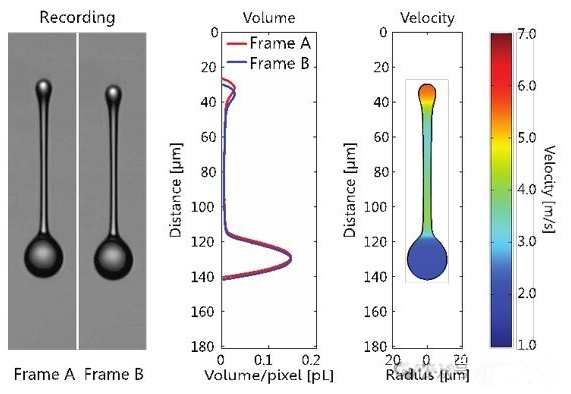
- At 5000–7500 Hz, voltage must be simultaneously increased (e.g., 30 V) to maintain droplet speeds of 5–6 m/s.
- High-frequency printing (>8 kHz) requires shortened pulse intervals to avoid failed ejection caused by incomplete cavity pressure recovery.
4.2 Dynamic Frequency Adjustment
- Recommend automatically switching frequency modes based on ink viscosity (3–50 mPa·s).
- High-viscosity inks are suitable for low-frequency, large-droplet modes.
5. Comprehensive Testing Recommendations
5.1 Test Matrix Design
| Parameter Combination | Test Objective | Reference Standard |
| Voltage 12–20 V + Frequency 200 Hz | Basic droplet ejection stability | ISO 24711 |
| Voltage 16 V + Dual Waveform | Satellite droplet suppression | Company Standard |
| Temperature Cycling + Voltage Compensation | Environmental adaptability | GB/T 17974 |
5.2 Key Parameter Monitoring
- Droplet speed: 5–6 m/s
- Satellite droplet rate: <5%
- Meniscus pressure: -2 to -5 cmH₂O
This analysis ensures that ink reliability can be optimized by correlating driving voltage, temperature, meniscus pressure, pulse waveform, and frequency, providing a robust guideline for industrial inkjet systems and high-precision printing applications.