
Printhead Materials and Working Principles
Different Layout Designs

Different Materials
- Electroformed Nickel with Gold Coating
- Punched Stainless Steel
- Laser-Etched Polyimide
- EDM (Electrical Discharge Machining) Stainless Steel


I. Nozzle Layout Comparison
1. Epson Printhead Series
Layout Characteristics
- Matrix-style nozzle arrangement
- Independent nozzle groups for each color channel
- Minimum droplet size: 3.5 pl
Advantages
- High-precision color gradation (up to 1440 dpi), ideal for fine textile printing
- Optimized nozzle spacing reduces ink cross-contamination
Disadvantages
- Lower nozzle density limits overall printing speed
2. Ricoh Gen5 Printhead
Layout Characteristics
- Dual-row staggered nozzle configuration
- 1,280 nozzles per head, effective width 54.1 mm
- Supports variable droplet sizes from 7–35 pl
Advantages
- Industrial-grade high-speed output (up to 30 kHz firing frequency)
- Precise grayscale control, well suited for UV printing
Disadvantages
- Larger nozzle spacing may cause graininess in small-format printing
3. Kyocera Printhead
Layout Characteristics
- Dual-channel design with 2,656 nozzles
- Ultra-wide print width of 112.35 mm
- Supports multi-level grayscale from 4–14 pl
Advantages
- Outstanding productivity (up to 50 m/h in high-speed mode)
- Steel nozzles provide excellent wear resistance
Disadvantages
- High nozzle density increases maintenance and servicing costs
4. Brother Printhead
Layout Characteristics
- Industrial-inspired design (e.g., Brother RJ-600 series)
- Nozzle density between Ricoh and Kyocera
Advantages
- Balanced printing speed and resolution (600 dpi)
Disadvantages
- Limited market share
- Insufficient availability of after-sales parts and support
5. HP Printhead
Layout Characteristics
- Consumer models use cartridge-integrated printheads
- Commercial models (e.g., PageWide) adopt linear array layouts
Advantages
- Low maintenance cost due to full cartridge replacement
Disadvantages
- Shorter nozzle lifespan in industrial applications (approximately 1 year)
II. Substrate Material Comparison
1. Steel Substrate (Ricoh / Kyocera / Seiko)
Advantages
- High temperature resistance and corrosion resistance
- Service life of 3–4 years
- Fully sealed design prevents water ingress and aging
Disadvantages
- Heavier weight, which may affect printhead movement speed
2. Ceramic Substrate (Epson)
Advantages
- Lightweight design, suitable for high-precision moving print systems
- Smooth surface improves ink droplet control accuracy
Disadvantages
- High brittleness and weaker impact resistance
3. Composite Materials (HP / Brother)
Advantages
- Significant cost-control advantages
Disadvantages
- Long-term use may cause deformation, leading to nozzle misalignment
Ink Flow Analysis During Printhead Startup
I. Dynamic Flow Characteristics and Influencing Factors
1. Transient Response Behavior
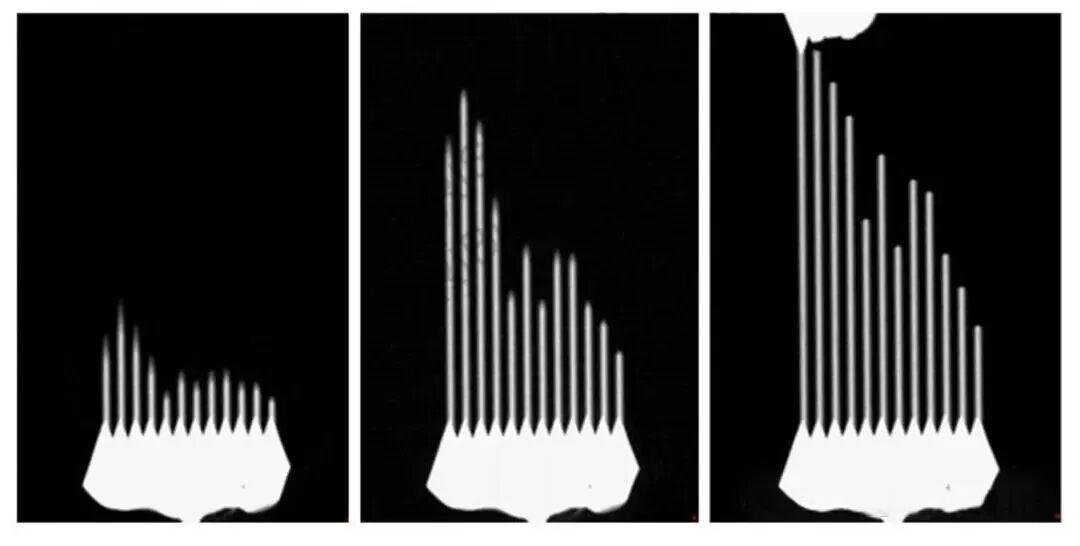
During printhead startup, the rising edge of the drive signal applied to the piezoelectric crystal or thermal bubble actuator (typically < 1 μs) generates an instantaneous pressure pulse. This pulse induces standing wave phenomena within the micrometer-scale ink channels.
Experimental data show that within the first 5 ms, ink flow fluctuations can reach ±30% of the steady-state value.
2. Coupling of Key Parameters
Viscosity–Temperature Effect
For every 10 °C increase in ink temperature, viscosity decreases by approximately 40%.
For example, UV ink viscosity drops from 12 mPa·s at 25 °C to 7 mPa·s at 35 °C.
Ink Channel Geometry Constraints
The startup pressure differential required for a 50 μm diameter channel is approximately 3.2 times higher than that of a 100 μm channel, consistent with the Bernoulli relationship:
ΔP ∝ 1 / r⁴
Gas–Liquid Interfacial Tension
When ink contains 1% surfactant, the printhead startup time can be reduced by approximately 15%.
Ink Flow Behavior During Printhead Startup
(Ink flow characteristics at the moment of printhead activation)
2D X-ray Imaging of Printhead Startup
(Visualization of internal ink dynamics during initial firing)
II. Evolution of Ink Flow Control Technologies
| Control Technology | Response Time | Flow Accuracy | Typical Applications |
| Voltage Pulse Control | 0.5 ms | ±5% | Epson Micro Piezo printheads |
| Thermal Gradient Control | 2 ms | ±8% | HP thermal inkjet printheads |
| Dual-Valve Coordinated Control | 1.2 ms | ±3% | Canon MEMS-based systems |
III. Engineering Optimization Strategies
Pre-Ink Charging Technology
By using a pilot valve to establish a 0.5 bar pre-pressure before startup, the first-drop delay effect can be effectively eliminated.
Measured results show that droplet volume deviation can be reduced from ±18% to ±6%, significantly improving print consistency during initial firing.