
Introduction
In digital inkjet printing, the droplet ejection distance directly affects printing accuracy and image quality. As the ejection distance increases, the droplet flight dynamics change, intensifying issues such as droplet breakup, jet angle deviation, and air-turbulence interference. This paper discusses the mechanisms by which ejection distance affects print quality from three aspects—droplet separation, jet angle deviation, and air turbulence—and proposes possible optimization strategies.
1. Increased Separation Between Main Droplets and Ligaments/Satellite Droplets
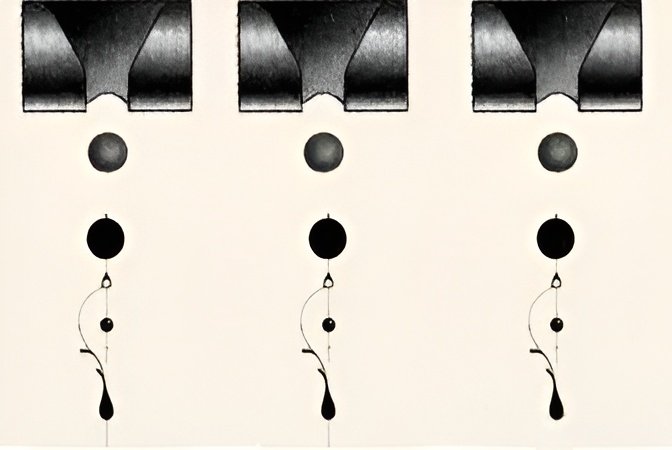
Dynamic instability: As the ejection distance increases, droplets spend more time in flight. The balance between surface tension and inertial forces is disrupted, leading to enhanced separation between the main droplet and satellite droplets.
Viscoelastic effects: High-viscosity or elastic fluids (e.g., bio-inks) can delay filament breakup and reduce satellite droplet formation. However, over long distances, Plateau–Rayleigh instability may still cause satellite droplet deviation.
Optimization strategies: Adjusting the fluid Z-number (the inverse of the Ohnesorge number) or using substrates with asymmetric wettability can suppress droplet breakup.
2. Amplification of Jet Angle Deviation
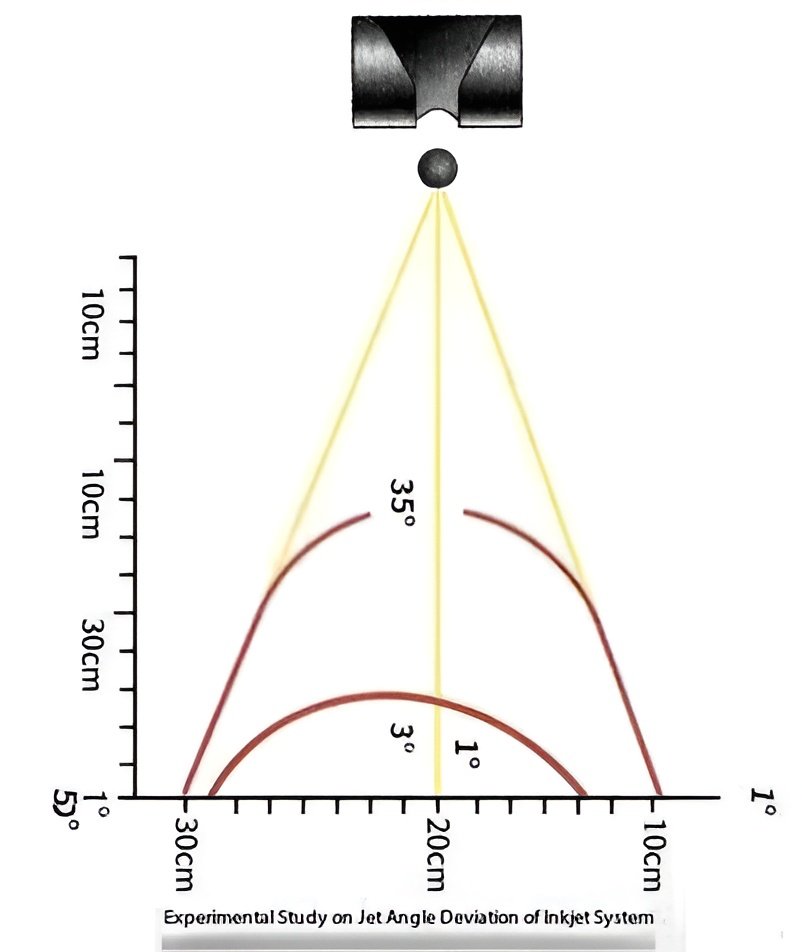
Accumulation of initial disturbances: Small angular deviations or nozzle vibrations are amplified over long flight distances, causing droplet landing positions to deviate from the target.
Aerodynamic interference: During high-speed ejection, air drag has a more pronounced effect on small droplets, further increasing trajectory deviation.
Optimization strategies: Implement closed-loop control systems to correct nozzle posture in real time, or improve drive-voltage stability to reduce initial disturbances.
3. Interference from Air Turbulence
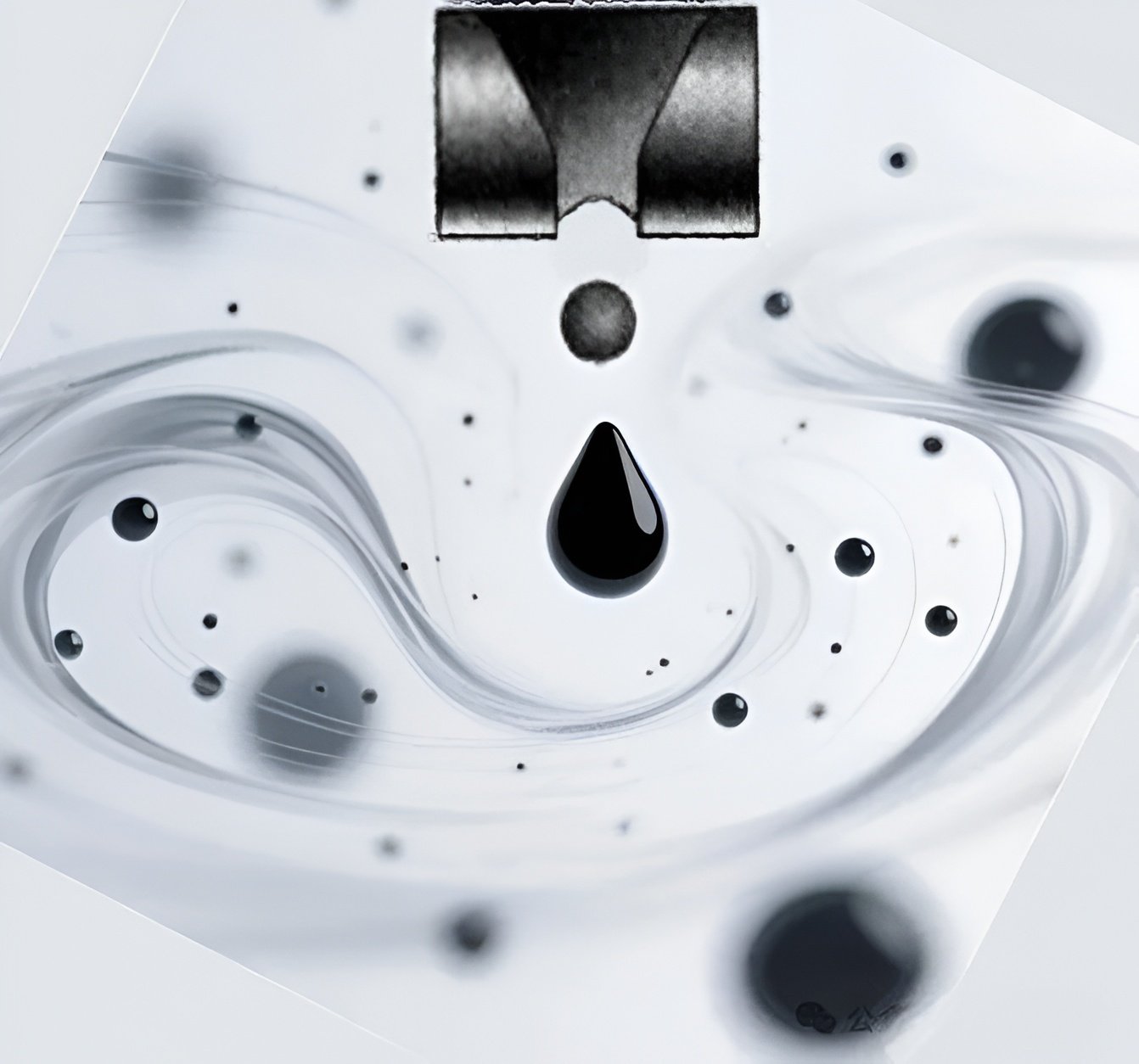
Turbulence dissipation effects: Over long distances, air turbulence causes non-uniform droplet velocity distributions, with some droplets lacking sufficient kinetic energy to land accurately.
Evaporation effects: For solvent-based inks, evaporation during flight reduces droplet volume, exacerbating landing errors.
Optimization strategies: Optimize environmental temperature and humidity control, or use non-Newtonian fluids (e.g., shear-thinning inks) to reduce sensitivity to turbulence.
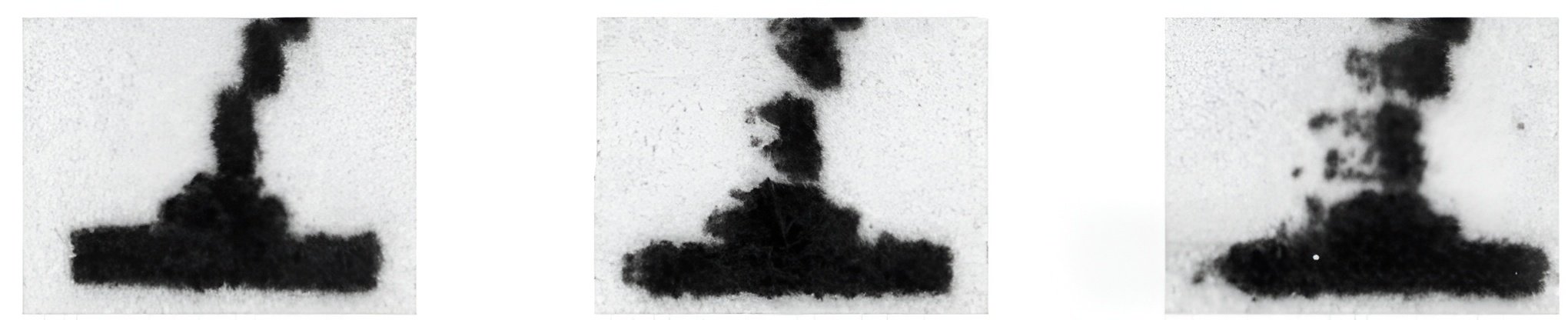
Printing height increases from left to right
The first image represents printing at a normal distance.
Print quality deteriorates as printing height increases due to:
Increased separation between droplets and ligaments/satellites;
Amplified jet angle deviation;
Air turbulence effects.
Conclusion and Outlook
Increasing printing height degrades print quality through droplet separation, angle deviation, and turbulence. Optimization requires a comprehensive approach combining fluid property tuning, hardware control improvements, and environmental management. Future research may focus on dynamic behavior modeling of high-viscosity inks or the design of novel aerodynamically stabilized nozzles.