
Technical Characteristics of Piezoelectric Printheads
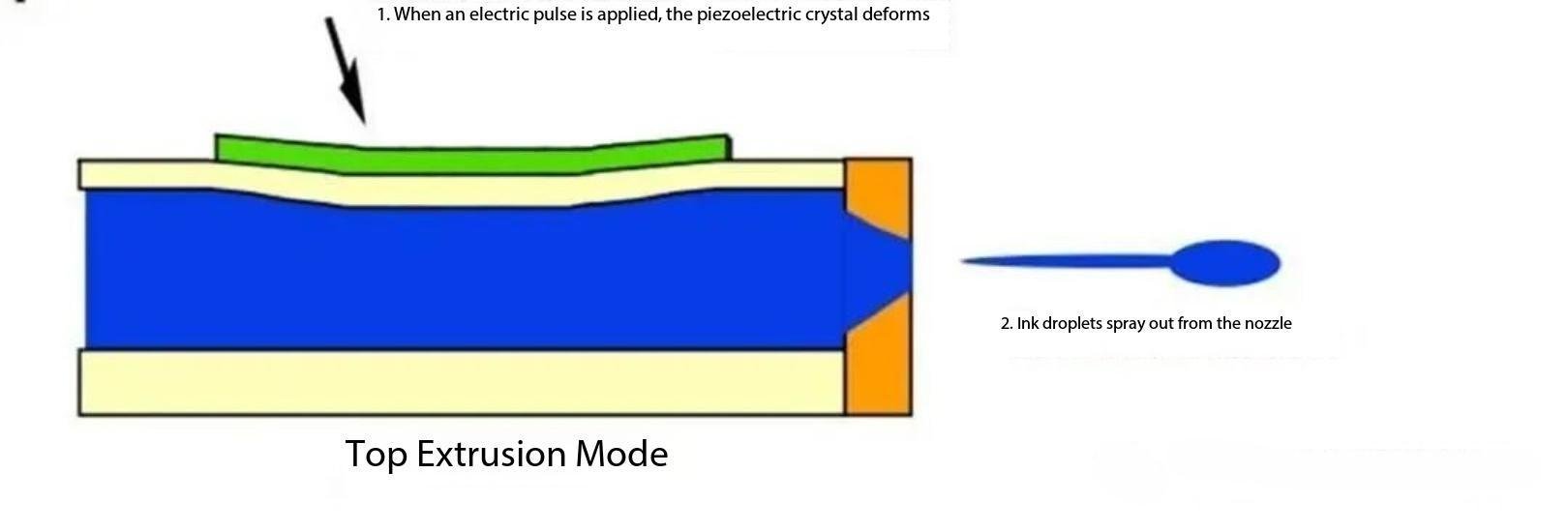
1. High Manufacturing Cost, Not Designed as Disposable
Reason:
Piezoelectric printheads use precision ceramic piezoelectric elements and complex ink channel structures. The materials and manufacturing processes result in significantly higher costs compared with thermal inkjet printheads.
Advantage:
The non-disposable design (for example, Kyocera printheads can reach hundreds of millions of firing cycles) reduces long-term operating costs and is suitable for industrial high-duty applications.
2. High Printhead Cost Leads to Higher Product Cost
Cost Structure:
The unit price of a piezoelectric printhead is typically 3–5 times higher than that of a thermal inkjet printhead. This is mainly due to the ceramic materials, driver circuits, and high-precision manufacturing processes.
Market Impact:
High-end equipment (such as UV flatbed printers) has a significantly higher overall machine price because the printhead represents a large portion of the total cost. However, the use of compatible inks can help reduce consumable costs.
3. Very High Printhead Reliability
Technical Assurance:
Ceramic materials provide strong corrosion resistance. Printheads from brands such as Kyocera can maintain stable ink ejection even under 60 kHz high-frequency driving, and their failure rate is lower than that of thermal inkjet printheads.
Maintenance Cost:
Regular cleaning is required (such as using dedicated cleaning solutions), but due to the stable structure, the maintenance frequency is relatively low during long-term operation.
4. Greater Freedom in Ink Development
Compatibility Advantage:
Piezoelectric printheads have higher tolerance for ink parameters such as viscosity and conductivity. They support various ink types including water-based inks, UV inks, and solvent inks, allowing manufacturers to flexibly develop specialized ink formulations.
Environmental Potential:
For example, companies like TE reduce carbon emissions through bio-based materials. Piezoelectric printhead technology can also adapt to environmentally friendly inks, helping promote sustainable printing.
Summary Comparison
| Feature | Piezoelectric Printhead Performance | Thermal Inkjet Printhead Comparison |
| Manufacturing Cost | High (ceramic materials + precision manufacturing) | Low (plastic structure) |
| Printhead Lifespan | Long (hundreds of millions of firings) | Short (prone to aging) |
| Ink Compatibility | Wide (supports high-viscosity / UV inks) | Limited (often requires original manufacturer inks) |
| Long-Term Cost | Low consumable cost (compatible inks allowed) | High consumable cost (OEM ink cartridges) |
Note:
The high cost and high reliability of piezoelectric printheads make them more suitable for industrial-grade applications, while thermal inkjet technology mainly dominates the consumer market.
Surface Tension Control in Piezoelectric Inkjet Technology
Surface tension control and meniscus wetting behavior in piezoelectric drop-on-demand (DOD) inkjet technology have a decisive impact on printing performance. The mechanisms and optimization directions are outlined as follows:
I. Influence of Surface Tension on Printhead Performance
1. Priming Delay and Air Entrapment Control
Surface tension (usually measured in dyne/cm) directly affects the initial stability of droplet formation.
- High surface tension (>40 dyn/cm) may lead to priming delay (droplet ejection lag) and air entrapment.
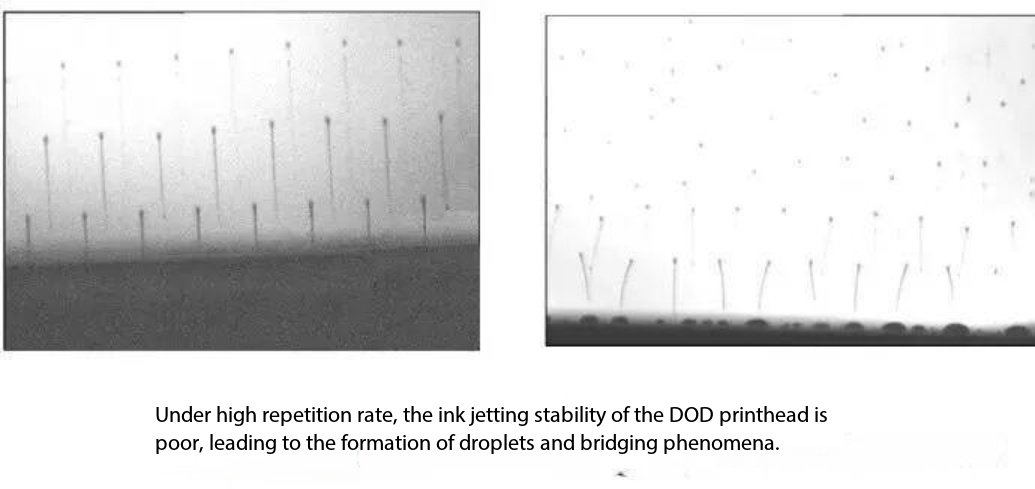
- Low surface tension (<30 dyn/cm) may cause satellite droplets.
Critical range:
Industry standards in the PCB sector indicate that surface tension for lead-free soldering processes should be maintained at 38–48 dyn/cm to balance wettability and bubble suppression.
Solution:
Using plasma cleaning (power 300 W, duration 30 seconds) to increase the surface energy of the nozzle plate can significantly reduce the risk of air entrapment.
2. Meniscus Wetting Control
The meniscus shape (positive/negative wetting) determines the droplet break-off dynamics.
- Positive wetting (contact angle <90°):
Promotes droplet detachment, but excessive wetting may cause ink residue on the nozzle plate. - Negative wetting (contact angle >90°):
Suppresses ink spreading but may result in uneven drying.
Optimal parameter:
The contact angle should be stabilized between 30°–60°
(measured using a dynamic tension analyzer with ±0.1 mN/m precision).
II. Interfacial Energy and Capillary Wetting
1. Capillary Wetting Failure
When capillary force (F ∝ γcosθ / r) is insufficient, ink cannot fully fill the microchannels of the nozzle, resulting in:
Air Entrapment
Air pockets form within the channel, disrupting droplet consistency.
Ink viscosity should typically be controlled within 10–20 mPa·s.
Extended Drying Time
Lower interfacial energy (e.g., due to siloxane additives) can accelerate drying.
2. Propulsion Capability Optimization
The meniscus wetting condition affects ink propulsion efficiency through capillary pressure:
ΔP=2γcosθrΔP = \frac{2γ\cosθ}{r}ΔP=r2γcosθ
Forward Propulsion
Requires:
- Surface tension γ > 35 dyn/cm
- Contact angle θ < 45°
Reverse Suppression
When θ > 90°, the drive voltage must be increased (typically by 10–15%) to compensate.
III. Process Control and Testing Technologies
| Control Objective | Key Parameter | Measurement Method | Standard Range |
| Surface tension | Dyne value (dyn/cm) | Dyne pen test | 38–48 dyn/cm |
| Contact angle | Wetting angle (°) | Optical contact angle meter | 30°–60° |
| Capillary filling | Ink viscosity (mPa·s) | Rotational viscometer | 10–20 mPa·s |
| Meniscus stability | Dynamic tension (mN/m) | Oscillating drop tensiometer | ±0.1 mN/m |
IV. Fault Diagnosis and Optimization
1. Air Entrapment Issues
Cause:
Poor capillary wetting, such as:
- Ink viscosity >25 mPa·s
- Contact angle >70°
Solution:
Apply laser surface treatment to improve nozzle plate surface energy.
Typical parameters:
- Wavelength: 355 nm
- Pulse frequency: 50 kHz
2. Abnormal Drying Time
Cause:
Interfacial energy too low
(e.g., surface tension <35 dyn/cm), which slows solvent evaporation.
Solution:
Add 0.1–0.5 wt% surfactants (such as fluorocarbon-based surfactants) to regulate surface tension.