
The Impact of Ink and Ink Delivery Systems on Printing Quality
From the perspectives of ink delivery system stability and ink chemical properties, the following analysis explains the mechanisms by which they affect printing quality.
I. Printing Defects Caused by Ink Degradation
1. Solvent Evaporation and Viscosity Imbalance
In open-nozzle environments, continuous solvent evaporation increases local ink viscosity (for example, UV ink viscosity may rise by 30–50%), resulting in ink droplet volume deviation and trajectory deflection.
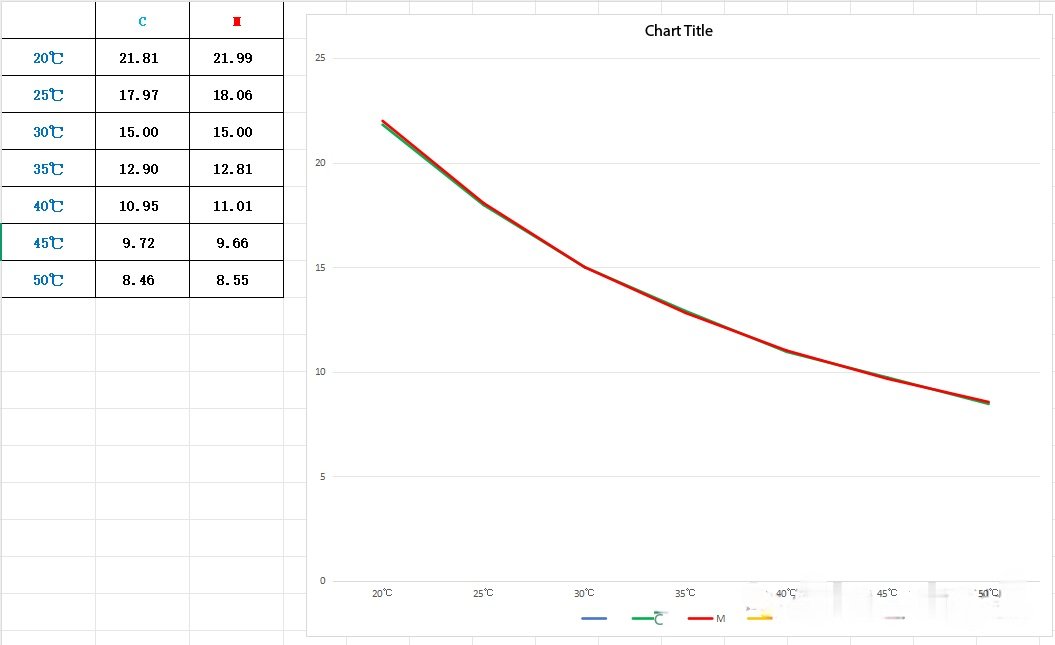
Viscosity curves of Cyan (C) and Magenta (M) inks
High-viscosity zones are prone to ink starvation, especially during fine-line printing, leading to white streaks or jagged edges.
2. Uncontrolled Resin Film Formation and Curing
Curable inks (such as UV inks) may undergo premature curing inside the nozzle, forming resin gels that clog nozzle orifices—particularly micro-nozzles with diameters below 50 μm.
Localized curing alters ink surface tension, increasing the occurrence of satellite droplets and ink splashing by approximately 15–20%.
II. Chain Reactions Triggered by Air Bubbles in the Ink Path
1. Bubble Formation and Ink Supply Interference
When air bubbles enter the ink delivery system, they create flow resistance, causing supply pressure fluctuations exceeding ±5 kPa, which disrupts droplet ejection timing.
In multi-color printing, bubbles can lead to registration misalignment, with cumulative errors reaching 0.1–0.3 mm.
2. Ink Compatibility Risks
Mixing inks from different batches may trigger chemical reactions (such as pH deviations greater than 0.5), producing precipitates that promote bubble adhesion.
Mixing water-based and solvent-based inks creates surface tension gradients; when bubbles collapse, ring-shaped stains may remain on the printed surface.
III. System Optimization Strategies
1. Ink Management
- Use sealed ink cartridge systems combined with inert gas filling, reducing solvent evaporation rates to below 1% per day.
- Add retarders (e.g., phenoxyethanol) to suppress premature curing and maintain ink activity inside the nozzle for over 72 hours.
2. Ink Path Maintenance
- Install online degassing systems (ultrasonic + centrifugal hybrid processing) to keep residual bubble volume below 0.05 mL/L.
- Use conductivity monitoring systems (accuracy ±5 μS/cm) to dynamically maintain ink composition consistency.
Conclusion
Ink stability and ink path cleanliness must be managed collaboratively. Establishing a daily system self-inspection routine is strongly recommended to maintain long-term printing accuracy and reliability.
Solving Print Ink Bleeding and Spread from the Ink Perspective
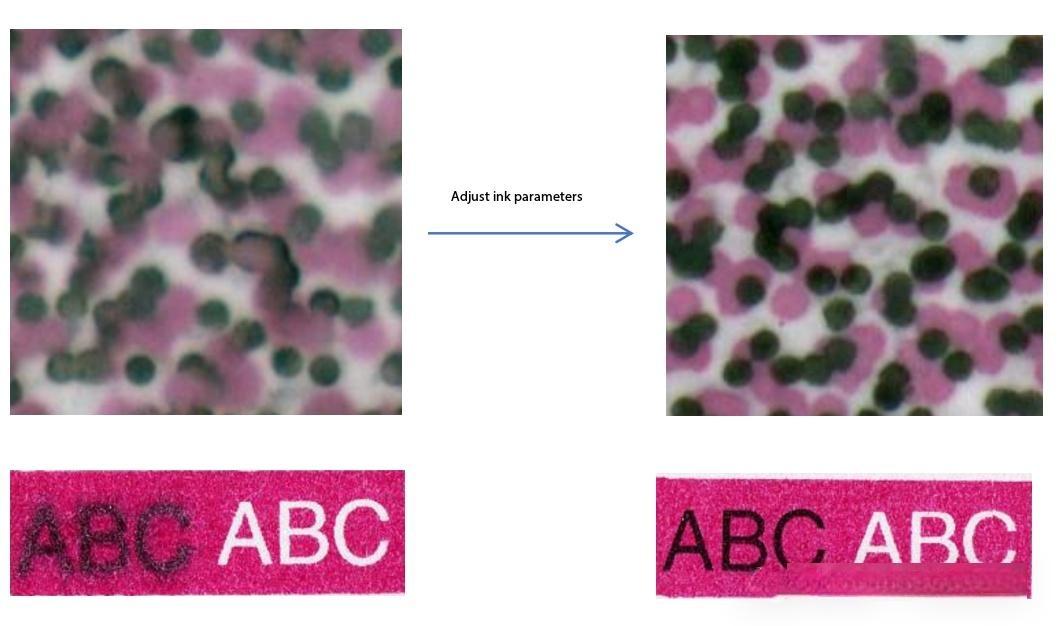
I. Ink Formulation Optimization Strategies
1. Solvent System Adjustment
- High-boiling solvent substitution:
Replacing butyl glycol (boiling point 170 °C) with diethylene glycol monobutyl ether (boiling point 230 °C) can significantly slow solvent evaporation and reduce post-ejection ink flow time. Experimental data show that the diffusion area can be reduced by up to 38%. - Mixed solvent ratio:
Using an ethanol–water mixed solvent system at a ratio of 6:4 balances evaporation rate and surface tension, maintaining surface tension within the 28–32 mN/m range.
2. Additive Application
- Nano-silica dispersion:
Adding 0.5%–1.2% nano-SiO₂ (particle size 20–50 nm) forms a three-dimensional network structure that suppresses ink flow, reducing the diffusion coefficient to 0.12 mm²/s. - Cationic polymers:
Introducing 0.3% quaternized polyethyleneimine (PEI-Q) enables electrostatic bonding with negatively charged dye molecules, accelerating ink fixation.
II. Key Parameter Control Solutions
1. Physical Property Parameters
| Parameter Type | Optimized Range | Control Method |
| Surface tension | 25–30 mN/m | Add 0.05% fluorocarbon surfactant |
| Viscosity | 5–8 mPa·s (25 °C) | Adjust PEG molecular weight (PEG 400) |
| pH value | 7.5–8.5 | Triethanolamine buffer system |
2. Printing Process Parameters
- Waveform optimization:
Using a three-stage driving waveform (pre-drive → main-drive → post-drive) and gradually reducing voltage from 30 V to 15 V can effectively suppress satellite droplet formation. Measured droplet volume deviation is kept below 5%. - Jetting frequency:
For high-viscosity inks (>10 mPa·s), it is recommended to reduce the jetting frequency from 20 kHz to 15 kHz to ensure complete chamber refill.
III. Special Application Scenarios
1. Printing on porous substrates
Adding 5% chitosan derivatives as a thickening agent, combined with a −0.5 MPa vacuum adsorption platform, can limit ink penetration depth to within 50 µm.
2. High-precision printing
Using a microemulsion formulation (water-in-oil type) with the oil phase increased to 15%, together with 1200 dpi resolution, enables line accuracy of ±0.1 mm.
IV. Verification and Testing Standards
1. Ink spread testing
According to ISO 12647-7, print a 1 cm² solid patch on 60 g/m² uncoated paper and measure edge spread after 24 hours. The acceptable limit is <0.3 mm.
2. Accelerated aging test
After storage at 85 °C / 85% RH for 72 hours, the color difference ΔE must be less than 2.0, measured using an X-Rite eXact spectrophotometer.