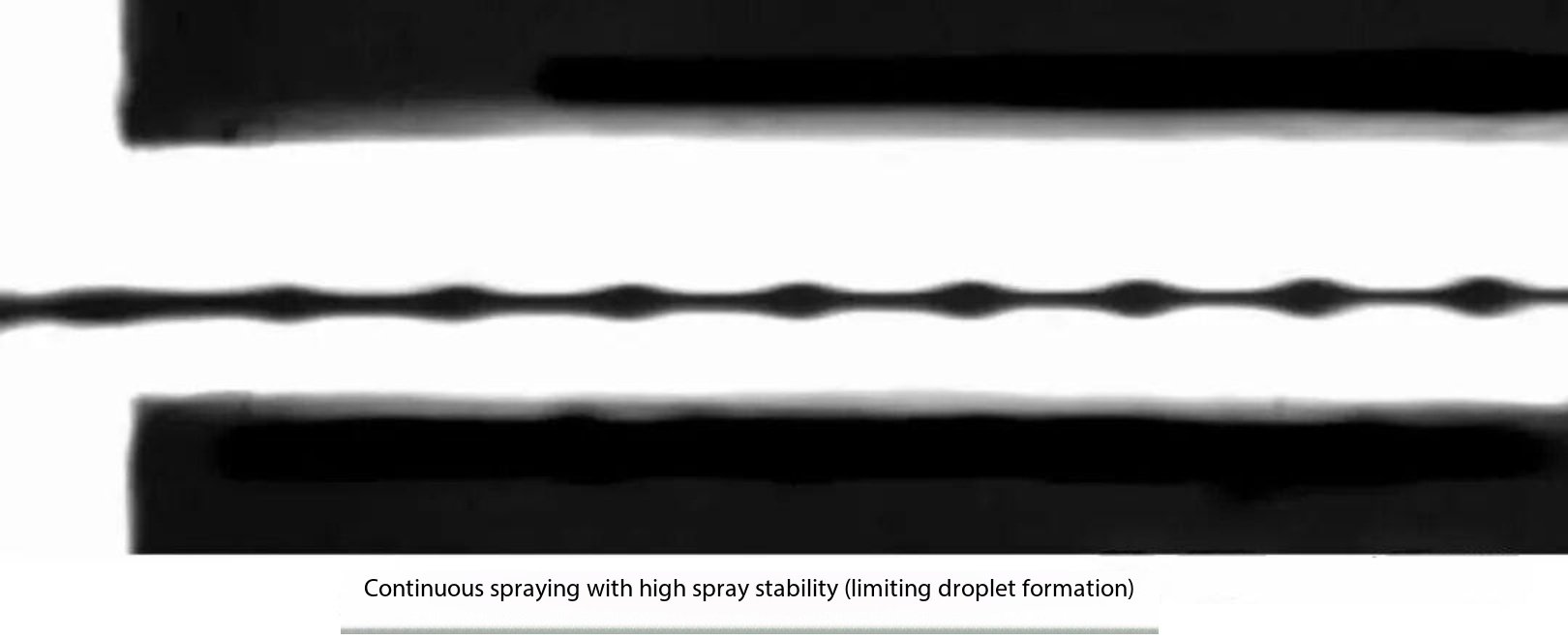
Continuous Inkjet (CIJ) is a printing technology that continuously ejects an ink stream and uses an electric field to control the trajectory of ink droplets. Its core principles and characteristics are as follows:
I. Working Principle
1. Droplet Generation and Charging
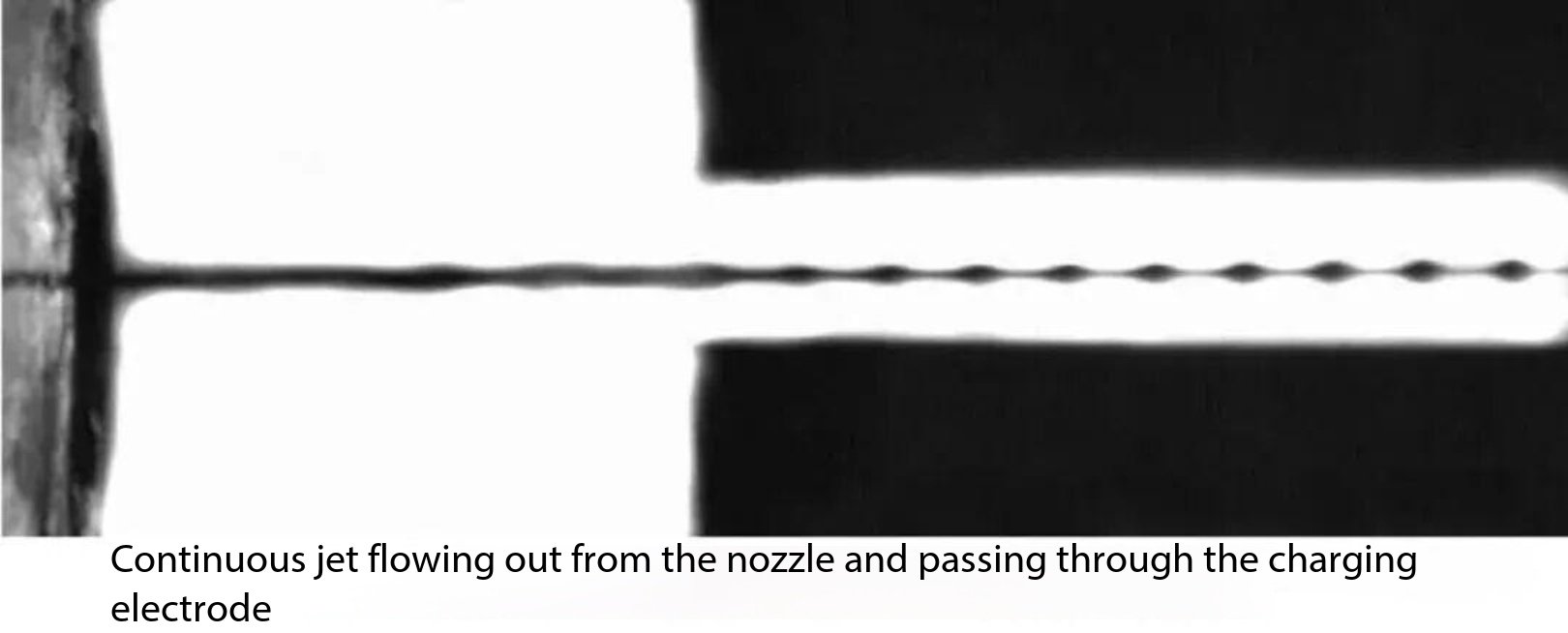
A high-pressure pump drives the ink to form a continuous ink stream, which is then broken into uniformly spaced droplets by a piezoelectric oscillator.
Charging electrodes assign different charge levels to the droplets according to the printing data.
2. Deflection and Recirculation
Charged droplets are deflected by a high-voltage electric field onto the substrate as required, while uncharged droplets are collected, filtered, and recirculated.
II. Technical Characteristics
| Feature | Description |
| Speed Advantage | Suitable for high-speed industrial applications (e.g., labeling, packaging printing). |
| Material Compatibility | Compatible with various inks (e.g., UV-curable inks, conductive inks). |
| Maintenance Requirements | Requires regular nozzle cleaning and filter replacement (e.g., 10-micron precision filters). |
III. Application Scenarios
- Industrial Applications: Product marking and packaging printing on production lines.
- Historical Application: Early telegraph recorders (as early as 1867) utilized continuous inkjet principles.
IV. Comparison with Other Inkjet Technologies
- Drop-on-Demand (DoD): Ink droplets are generated only when needed, offering higher precision but lower speed.
- Continuous Inkjet (CIJ): Ink is continuously ejected, requiring a complex recirculation system, but suitable for mass production.
V. Ink Droplet Morphology in Continuous Inkjet
In CIJ technology, droplet morphology is influenced by multiple physical factors, primarily across three stages: initial ejection, flight, and deposition. Below is a stage-based analysis:
1. Droplet Morphology in the Initial Ejection Stage
(1) Regular Spherical Droplets
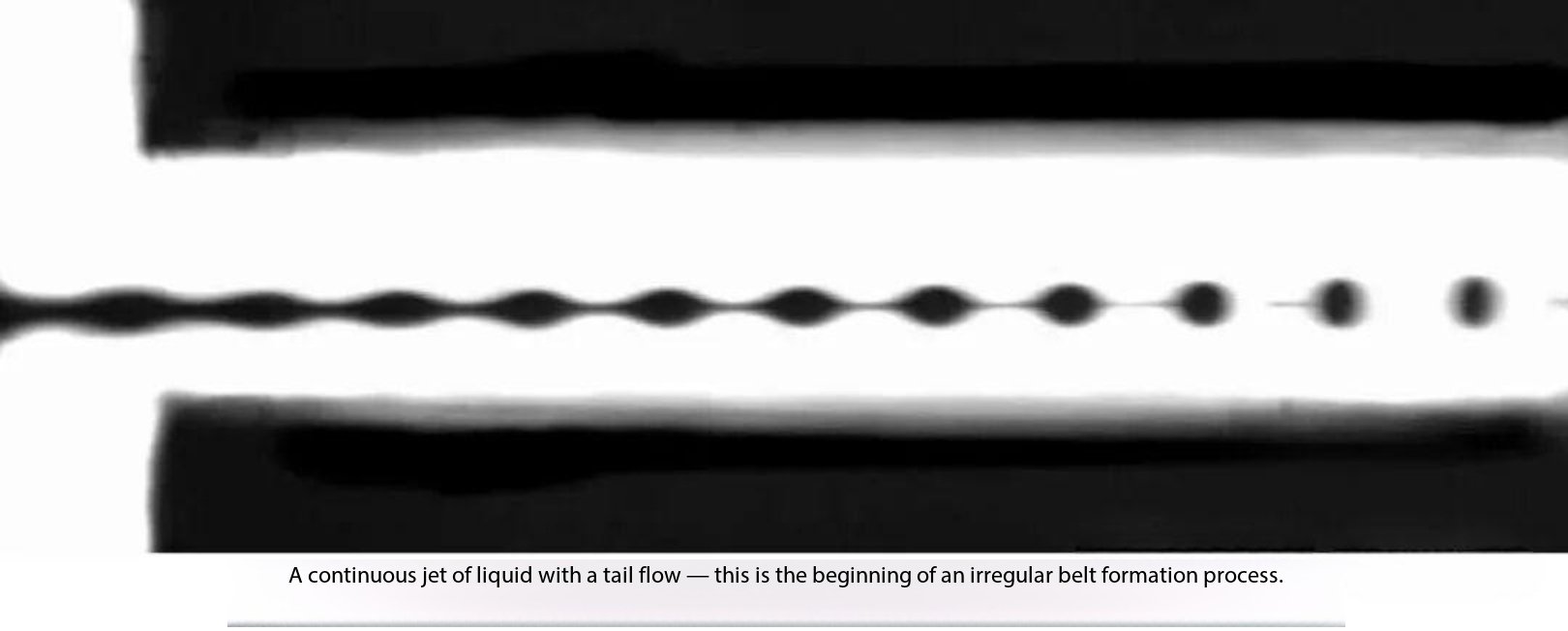
The nozzle is precisely manufactured as a circular opening (approximately 20 microns). Under surface tension, droplets initially form a near-perfect spherical shape.
(2) Deformation Caused by Meniscus Vibration
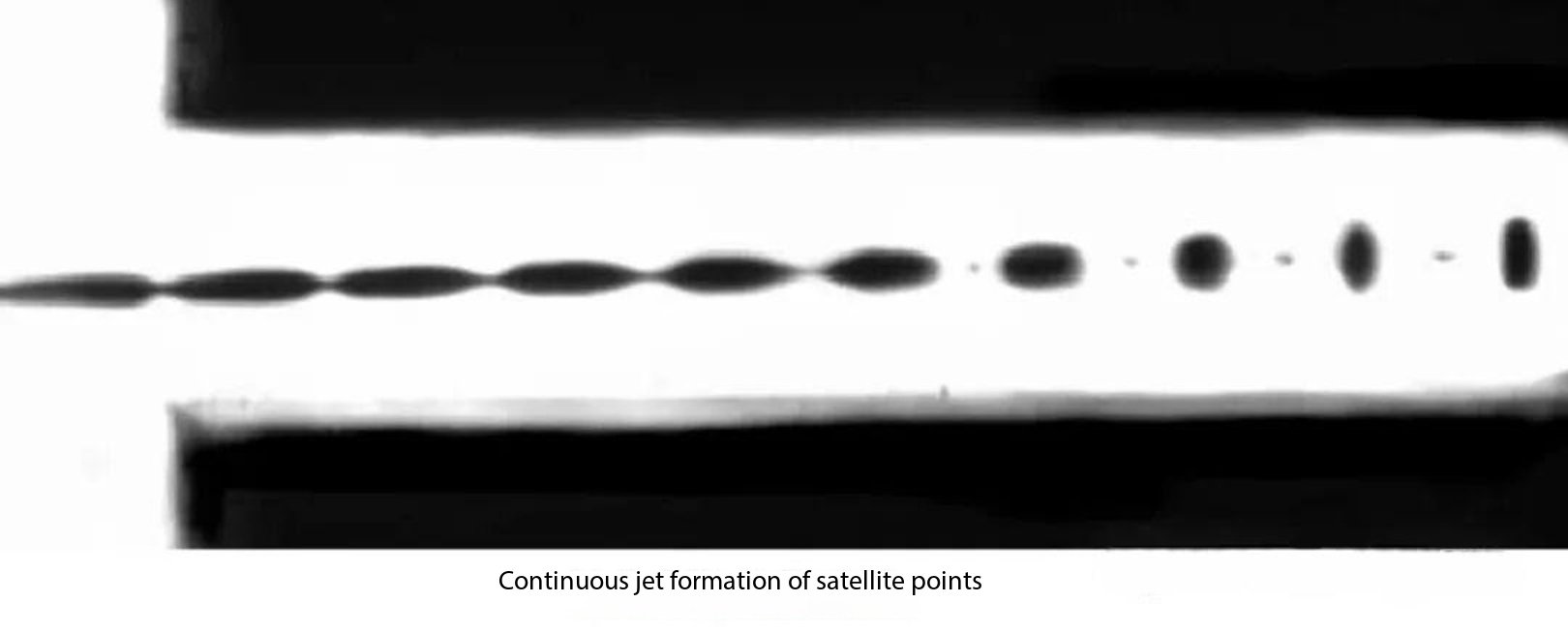
During continuous ejection, the meniscus at the nozzle tip undergoes oscillation due to traction forces, which may lead to irregular droplet shapes or the formation of satellite droplets.
2. Droplet Morphology in the Flight Stage
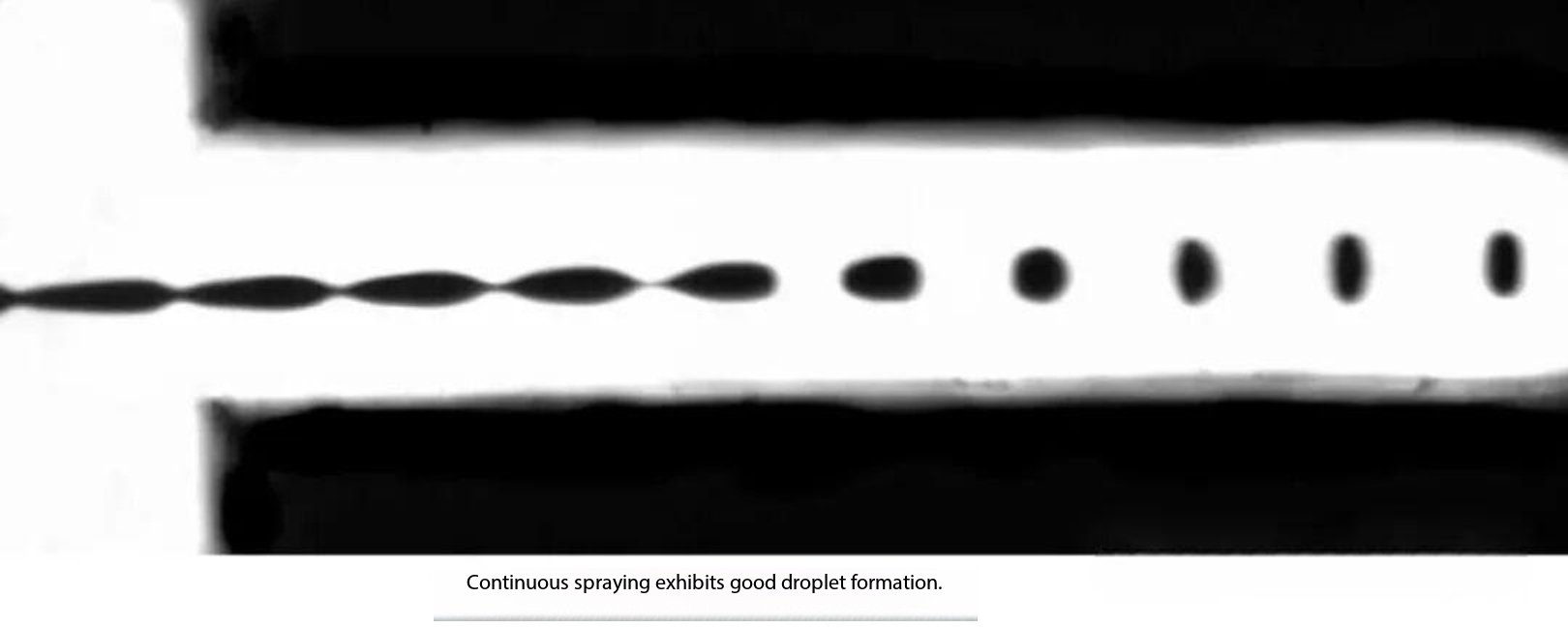
(1) Main Droplets and Satellite Droplets
- Low-viscosity inks (e.g., 9 cP) tend to produce satellite droplets due to inertial breakup, resulting in printing defects such as stray dots.
- High-viscosity inks (e.g., 12 cP) produce fewer satellite droplets but may result in uneven droplet sizes due to insufficient ejection energy.
(2) Influence of Charge Deflection
In CIJ systems, charged droplets are deflected by a high-voltage electric field, while non-deflected droplets are recovered. The deflected droplets form the printed image.
3. Droplet Morphology in the Deposition Stage
(1) Droplet Spreading and Drying
After impacting the substrate, the spreading radius of the droplet is influenced by its initial radius, contact angle, and substrate temperature.
The solvent evaporation rate and substrate treatment determine the uniformity of the final dried film.
(2) Ink Mist (Overspray) Phenomenon
Low-viscosity inks under high-speed ejection are prone to misting, which can contaminate the substrate or cause blurred images.