
Canon UVgel FullBeam Full-Beam Curing Technology Applied in Micolorprint Printers
I. Core Architecture: A “Triple-Band Synergy” Optical and Mechanical System
The essence of FullBeam technology lies in integrating three optical modules — broad-spectrum base curing, narrow-spectrum precision curing, and pulsed enhancement curing — combined with a servo-driven tracking mechanism and dynamic motion control system.
This forms a closed-loop adaptation system between:
Irradiation Energy – Motion Trajectory – Media Characteristics
It is the key technology ensuring:
- FLXture 3D texture integrity
- FLXfinish+ surface texture stability
1. Multi-Band Composite Optical System: Foundation of Uniform Energy Coverage
• Triple-Band LED Integrated Design
The system adopts a triple-band LED configuration:
- 365nm broad spectrum
- 395nm narrow spectrum
- 405nm blue light
(All using OSRAM OSLON UV series LEDs)
Through optical homogenization, energy superposition is achieved.
Broad-Spectrum Base Module
- 365nm output power: 12W/cm²
- Coverage width: 1.6m
- Honeycomb lens array homogenization
- Energy uniformity ≥95% (vs. 85% in traditional systems)
- 3–5 second rapid curing for 2D base coatings
Narrow-Spectrum Precision Module
- 395nm power: 8W/cm²
- 192 independent microlenses (8mm spacing)
- Focused φ1mm energy spot
- Edge curing precision: ±0.05mm
Pulse Enhancement Module
- 405nm blue light pulsed output
- Adjustable frequency: 100–1000Hz
- Peak power: 20W/cm²
- Designed for dark coatings and thick stacks (>3mm)
- Overcomes penetration attenuation through pulse energy stacking
• Dynamic Optical Focusing Mechanism
Integrated liquid lens group (response time <0.1s)
Automatically adjusts focal distance (5–30mm) based on laser contour sensor detection (accuracy 0.01mm):
- 0.02mm thin texture → 8mm focus, 0.8mm spot, +30% energy density
- 5mm thick stacking → 25mm focus, 2mm spot, ensuring deep resin polymerization
2. Servo Tracking Drive Module: Precision Light Following
• Dual-Axis Tracking Architecture
- Panasonic A6 servo motors (750W)
- THK precision linear guide rails (±0.01mm positioning accuracy)
- EtherCAT bus communication
Performance:
- Max tracking speed: 3m/s
- Synchronization error <0.3mm
- Real-time response to 10m/s² acceleration changes
Ensures no misalignment between curing zone and print zone.
• Multi-Zone Independent Drive Design
Curing unit divided into 8 independent 20cm zones.
Advantages:
- LED modules in unused areas automatically shut down
- 40% energy savings
- Supports motion path optimization logic
3. Energy Detection and Feedback Unit: Closed-Loop Accuracy
• Real-Time Energy Monitoring Matrix
- 32 UV energy sensors
- 500Hz sampling frequency
- ±1% precision
If energy deviation >5%:
- PWM current adjustment (0–1000mA)
- Compensation within 10ms
For curved media (e.g., 500mm radius lightbox film):
- Depressed areas receive +15% power compensation
• Temperature Protection System
- Aluminum microchannel cooling
- Heat dissipation: 150W/℃
- Temperature precision: ±0.5℃
- Above 60℃ → automatic 10% speed reduction
- Auxiliary fan activation
LED lifespan: 20,000 hours
II. Software Control Logic: Intelligent Coordination of Process – Motion – Energy
Through Prisma Guide XL 5.0 Curing Control module, FullBeam achieves digital energy regulation tightly integrated with:
- Dynamic motion control
- TRIdrive system
1. Process-Based Dynamic Energy Planning
• 80+ Preconfigured Process Profiles
Examples:
FLXfinish+ Gloss Finish (2D)
- 365nm at 60% power
- 800mJ/cm²
- Gloss >90GU
5mm FLXture 3D Stacking
- 365nm 100% + 405nm 500Hz pulse
- 1200mJ/cm² per layer
- Interlayer adhesion ≥2.0MPa
Energy parameter switching: within 100ms.
• Intelligent Energy Compensation Algorithms
Speed-Based Compensation
- Speed ×2 → Power ×2
- Energy consistency ±3%
Color-Based Compensation
- Black areas (>90% UV absorption) → +50% pulse energy
- White areas (>80% reflectivity) → -10% power
Prevents over-curing brittleness.
2. Motion and Curing Synchronization Matrix
| Process Stage | Printhead Motion | FullBeam Status | Energy Logic | Sync Delay |
| 2D Base | 2m/s uniform | 365nm 80% | Dynamic matching | <0.01ms |
| 3D Layer 1 | Pause | 365+395nm 100% | 8mm focus +20% edge | <0.02ms |
| Multi-Layer 3D | Z +0.1mm | 800Hz pulse | +12% per 1mm | 0.05ms |
| Texture Layer | 0.8m/s scan | Narrow focus | Density-based | <0.03ms |
Fault Response Integration
- Nozzle clog → faulty zone curing disabled within 15ms
- Media deviation 0.03mm → tracking system offsets synchronously
3. Environmental and Media Adaptation
• Temperature & Humidity Adjustment
- Humidity >60% → +0.5s curing time
- Temperature >35℃ → -15% power
• Media-Specific Optimization
0.01mm PP film
Low-power extended curing (50%, 4s)
2mm Canvas
High-power pulse (365+405nm, 1000Hz)
III. Technical Advantages and Motion Synergy
Four Core Breakthroughs
- Full range curing: 0.01mm–5mm stacking
- Energy control: 50–2000mJ/cm²
- 90㎡/h high-speed tracking without delay
- 30% energy reduction vs traditional systems
- 20,000-hour LED lifespan
IV. Technical Comparison
| Dimension | FullBeam | Traditional UV | Industry Multi-Band |
| Wavelength | 365+395+405 | 365 only | 365+395 |
| Uniformity | ≥95% | 75–85% | 85–90% |
| Tracking Response | <0.1ms | None | 0.5–1ms |
| Thick Curing | 5mm | <1mm | <3mm |
| Power | 120W/cm² | 150W/cm² | 140W/cm² |
Deep Integration with Motion Control
- Contour → Narrow spectrum precision
- Fill area → Broad-spectrum efficiency
- Speed-to-power linear adjustment within 50ms
- 3D texture → simultaneous Z-axis and liquid lens compensation within 0.1s
Canon UVgel TRIdrive Vacuum Conveyor Belt System Applied in Micolorprint Printers
I. Core Architecture: A “Triple-Drive Integration” Mechanical and Control System
The TRIdrive system integrates three core modules:
- Vacuum adsorption
- Tension-driven transport
- Dynamic calibration
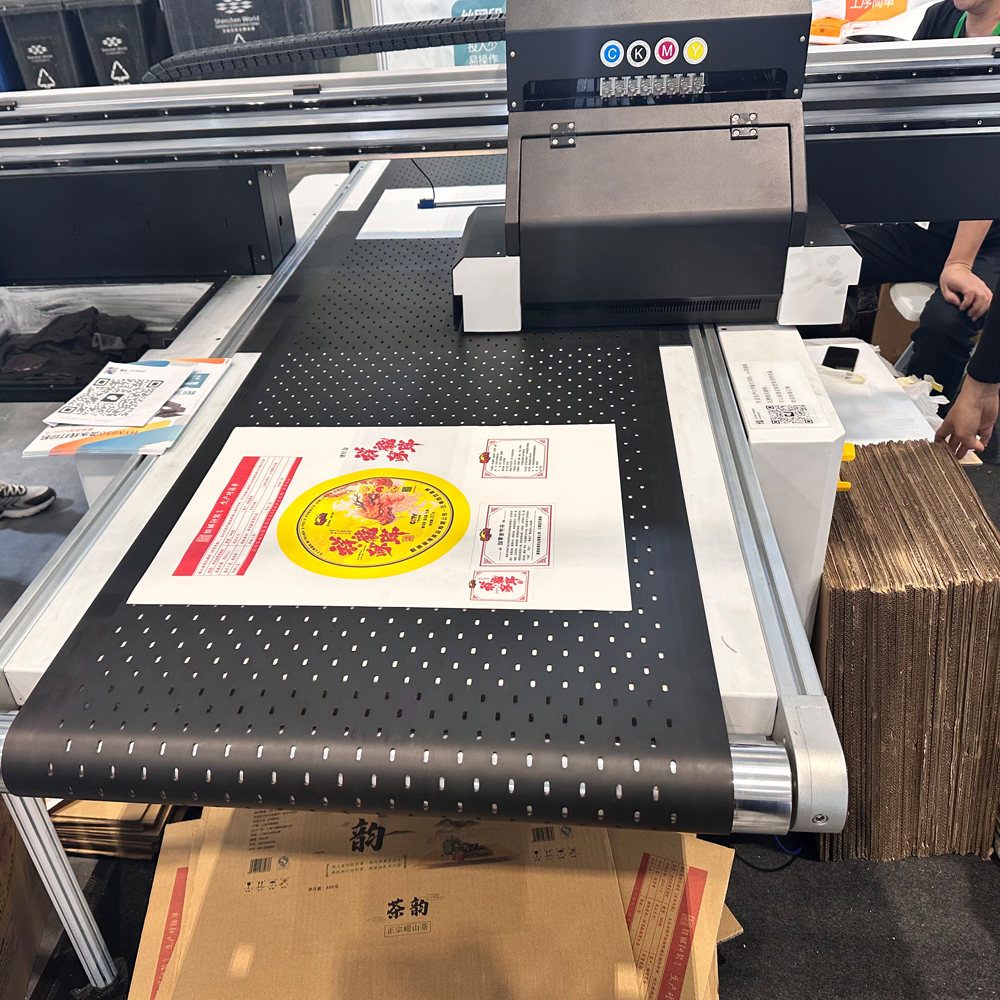
Through a centralized control unit, multi-parameter linkage is achieved. The hardware architecture is designed around transport precision and media compatibility, forming the performance foundation of the Hybrid roll-to-roll solution.
1. Vacuum Adsorption Base: Uniform Global Media Fixation
• Multi-Layer Composite Conveyor Structure
The conveyor belt adopts a three-layer composite structure:
- Polyimide base layer
- Silicone adsorption layer
- Fluorocarbon wear-resistant coating
Overall thickness: 1.2mm
Supported width: 0.6–1.6m
Base Layer
- Polyimide material
- Tensile strength ≥250MPa
- No deformation during operation
- Service life up to 100,000 hours (3× longer than conventional rubber belts)
Adsorption Layer
- Silicone hardness: 55 Shore A (more flexible than standard Hybrid model at 60 Shore A)
- Surface micro-holes: φ0.3mm diameter
- Hole spacing: 1.5mm
- 440,000 holes per m²
Using a “micro-hole array + intermolecular force enhancement” design, it enables mark-free adsorption of smooth PET films (surface tension 38 dyn/cm).
Wear-Resistant Layer
- Fluorocarbon coating thickness: 5μm
- Friction coefficient ≤0.12
- UV aging resistance Grade 4
- Prevents surface cracking under long-term curing exposure
• Zoned Independent Vacuum System
The conveyor integrates 32 independent vacuum chambers (33% more than the base Hybrid model).
Each chamber corresponds to a 15cm × 15cm adsorption area with continuously adjustable vacuum pressure (0–100kPa).
Ultra-Thin Media (0.01mm PP Film)
- Low negative pressure mode: 20–30kPa
- Prevents stretching deformation
Heavy Flexible Media (2mm Canvas)
- High negative pressure mode: 80–100kPa
- Prevents slippage (position deviation <0.02mm)
Vacuum response time: <0.05s
Chambers activate 0.2s before media enters new zones for seamless transition.

2. Triple-Motor Tension Drive Module: High-Speed Transport Core
• Three-Stage Servo Drive System
- Unwind motor
- Transport motor
- Rewind motor
All motors: Panasonic MSMF series, 1.5kW
Communication: CANopen bus
Unwind Motor
- Magnetic powder brake (0.5–5N·m adjustable torque)
- Reel diameter compensation (50–300mm range)
- Prevents slack or overstretching
Transport Motor
- Direct drive of main roller
- Speed range: 0.5–5m/s
- Speed fluctuation <0.1%
- Matches printhead firing frequency precisely
Rewind Motor
- Integrated tension sensor (±0.1N accuracy)
- Film tension preset: 5–15N
- Fabric tension preset: 20–50N
- Fluctuation within ±1N
• Floating Roller Tension Buffer
Pneumatic floating roller installed between unwind and transport units.
- Travel range: 0–200mm
- Response time: <0.1s
If tension fluctuation exceeds 5%, automatic compensation occurs.
Example:
If unwind tension suddenly increases by 10N → floating roller lowers 100mm to release tension.
Adaptability for ultra-thin media (<20N breaking strength) improved by 60%.
3. Dynamic Calibration & Detection: Closed-Loop Precision Control
• Laser Positioning and Surface Detection Matrix
Edge Position Sensors
- Two laser displacement sensors per side
- Accuracy: ±0.01mm
- Deviation >0.05mm → automatic rewind motor angle correction (0.1° precision)
Surface Flatness Detection
- Line-scan camera (2048px, 500fps)
- Detects ±1mm surface variation
- Adjusts local vacuum pressure (+10kPa for raised areas)
Dual-Point Tension Monitoring
- Two tension sensors
- 1000Hz sampling
- 99.5% global tension consistency
• Active Vibration Suppression
- Air bearings + rubber damping
- Vibration <0.005mm (80% reduction vs traditional bearings)
- Prevents droplet misplacement
Automatic belt tension adjustment via worm gear system (50–150N adjustable).
Automatic recalibration every 8 hours.
Belt deflection <0.5mm/m.
II. Intelligent Software Control Logic
Through Prisma Guide XL 5.0 TRIdrive module, digital control is achieved based on:
- Precision matching
- Dynamic compensation
- Predictive maintenance
1. Intelligent Media Matching Database
Built-in 150+ flexible media presets categorized by:
- Media type
- Thickness
- Surface characteristics
Examples:
0.05mm PET Transparent Film
- 30kPa vacuum
- 8N tension
- Fine mode (15㎡/h)
1mm Lightbox Fabric
- 70kPa vacuum
- 35N tension
- Standard mode (40㎡/h)
Media recognition accuracy: 99.8%
Configuration time: <1 second
Supports cloud-based parameter synchronization via Canon Cloud account.
2. Multi-Parameter Dynamic Compensation
Tension-Speed Compensation
When switching from fine to high-efficiency mode:
15㎡/h → 90㎡/h
Tension increases proportional to speed² to prevent deviation.
Temperature & Humidity Adaptation
Humidity >60% → +10% vacuum
Temperature >35℃ → -5% tension
Print Load Feedback
When FLXture 3D stacking >5mm:
- Transport speed reduced 10%
- Interlayer curing extended 0.5s
- Prevents scraping of uncured texture
3. Predictive Maintenance
Real-time monitoring:
- Belt wear level
- Vacuum sealing integrity
- Motor temperature
Wear >80% → warning alert with remaining service hours prediction.
Integrated 200+ fault codes:
- Insufficient vacuum
- Abnormal tension fluctuation
Automatic module identification and visual repair guidance.
Troubleshooting time reduced by 70%.
III. Technical Advantages & Hybrid System Synergy
Four Core Breakthroughs
- Media compatibility: 0.01mm–2mm
- High-speed precision:
- Lateral deviation <0.05mm
- Longitudinal stretch <0.1%
- MTBF: 2000 hours (50% improvement)
- Roll-to-roll and flatbed mode switching in <3 minutes
Typical Application Scenarios
High-End Shrink Film Packaging
Media: 0.03mm PETG shrink film
Process: Full color + FLXfinish + matte + 0.3mm FLXture security emboss
Key TRIdrive features:
- 25kPa low vacuum
- 8N low tension
- <0.03mm deviation compensation
Results:
- 100 LPI texture resolution
- 98% texture integrity after shrink
- FDA compliant
Wide Lightbox Fabric Production
Media: 1.5m width, 1mm PVC
Process: Full color + gloss + 1mm 3D border
Key features:
- 90kPa high vacuum
- 45N tension
- Floating roller compensation
Results:
- 60㎡/h speed
- Straightness <0.1mm/m
- 500-cycle weather test (-30℃ to 60℃) without failure
IV. Technical Comparison
| Dimension | UVgel TRIdrive | Hybrid Base | Traditional Roll-to-Roll |
| Vacuum Zones | 32 independent | 24 | 8–12 |
| Tension Range | 5–50N continuous | 10–40N stepped | 15–35N fixed |
| High-Speed Accuracy | <0.05mm lateral | <0.1mm | <0.3mm |
| Media Thickness | 0.01–2mm | 0.05–1mm | 0.1–0.8mm |
| MTBF | 2000h | 1300h | 800h |