
In the ever-evolving world of bottle manufacturing, where one-size-fits-all is a relic of the past, how do you print flawlessly on everything from sleek cylindrical vials to dramatic conical perfume bottles—without missing a beat? Enter the high-speed bottle printer: a shape-shifting marvel that turns geometry into opportunity.
Gone are the days of clunky retooling and wasted ink. Imagine a machine that grips a fragile 30mm perfume vial as securely as a rugged 200mm industrial drum, while laser-guided sensors map every curve and 3D modeling software warps designs in real time. Picture Ricoh G5i print heads firing UV ink at 900dpi precision, turning tapered surfaces into canvases for photorealistic art.
But this isn’t just about speed—it’s about smarts. These printers auto-dodge imperfections with AI-powered collision avoidance, recycle 60% of ink waste on the fly, and even predict maintenance needs before a nozzle clogs. Whether you’re crafting medical cylinders requiring FDA-grade clarity or eco-conscious recyclables demanding vibrant labels, the future of packaging is here: flexible, sustainable, and utterly uncompromising.
From pharmaceuticals to luxury cosmetics, discover how the world’s most innovative factories are printing the impossible—and why your next bottle design might just break the mold.
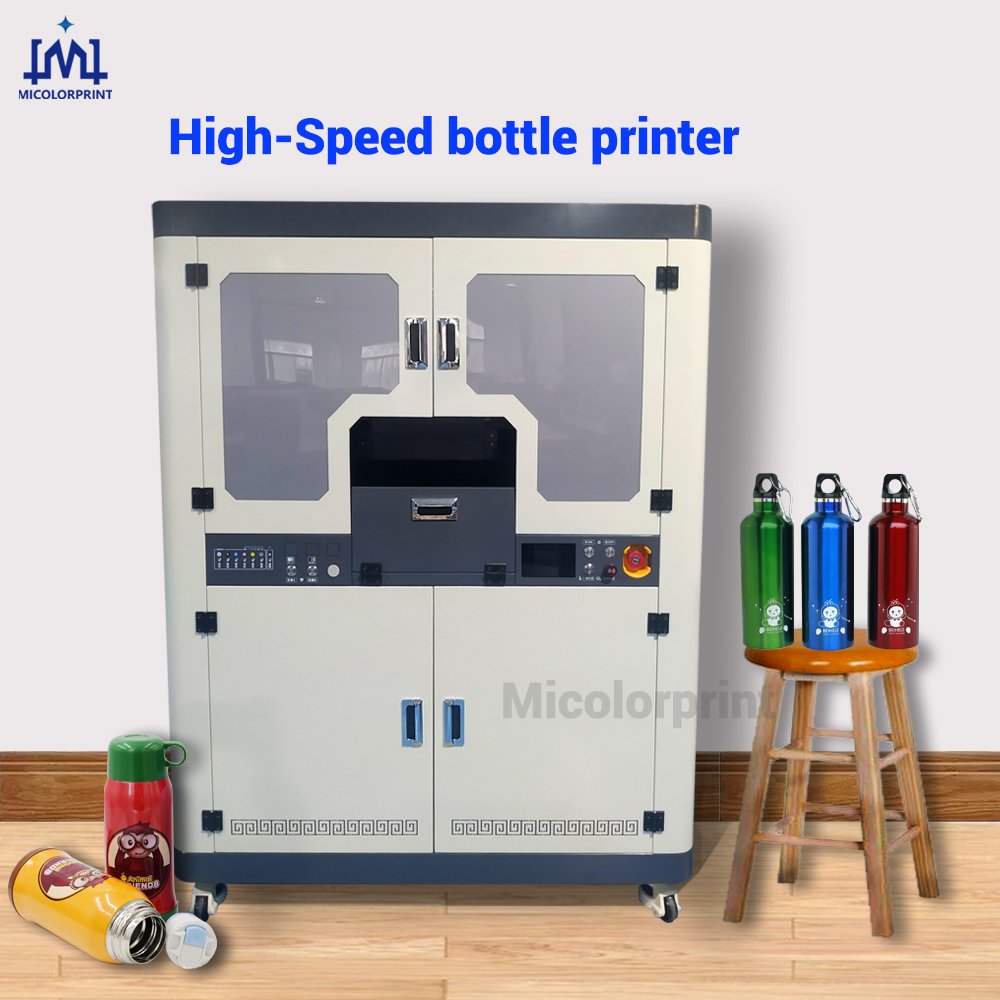
1. The Science of Shape Flexibility: How High-Speed Bottle Printers Adapt to Curves and Angles
Technical Foundation:
High-speed bottle printers employ Ricoh G5i print heads (Section 1.3.5) paired with laser displacement sensors (Section 3.3.5.2) to dynamically adjust printing parameters. These sensors scan the container’s surface in real time, creating a 3D map that informs the printer’s software.
How It Works:
Dynamic Nozzle Alignment: Print heads tilt and rotate to maintain optimal distance (2mm) from curved surfaces.
Real-Time Adjustments: Software recalculates droplet placement mid-print, ensuring consistent ink coverage even on asymmetrical shapes.
Real-World Impact:
A beverage company reduced misprints by 75% when switching from static to adaptive systems, achieving flawless labels on contoured energy drink cans.
2. Conquering Cones: Precision Challenges in High-Speed Bottle Printing
Key Challenge:
Tapered surfaces cause ink spread due to variable diameters. Traditional printers struggle with “ink pooling” at the base of cones.
Innovative Solutions:
Tilt Mechanisms: Fixtures adjust up to 30° (Section 2.2.3.1.2) to keep nozzles perpendicular to the surface.
Variable Speed Control: Print heads slow down at the cone’s narrow tip to maintain 900dpi resolution.
Case Study:
A luxury perfume brand eliminated smudging on its iconic conical bottles by integrating tilt-adjustable fixtures, cutting rework costs by $50k annually.
3. Automated Fixture Tech: Gripping Everything from Slim Perfume Vials to Wide-Mouth Jars
Core Technology:
Motorized Chucks: Self-centering jaws (Section 2.2.3.1) handle diameters from 30mm (vials) to 200mm (industrial drums).
Pneumatic Clamps: Adjust grip force based on material fragility, preventing cracks in glass or thin plastics.
Efficiency Gains:
15-Second Changeovers: Preset configurations for common shapes eliminate manual recalibration.
Zero Slippage: Vacuum-assisted suction cups secure lightweight containers during high-speed rotation.
Industry Example:
A pharmaceutical manufacturer streamlined production by using one printer for both 50ml medicine bottles and 200ml reagent jars.
4. Software Magic: 3D Modeling Tools That Prep Artwork for Any Bottle Shape
Workflow Integration:
RIP Software: Converts 2D designs into 3D UV layers (Chapter IV), warping graphics to match container contours.
Digital Twins: Virtual simulations predict ink spread on curved surfaces, allowing pre-print adjustments.
Real-World Application:
A craft brewery used 3D modeling to wrap intricate hop illustrations around 360° of its signature bulb-shaped bottles, doubling shelf appeal.
5. Speed Without Compromise: Maintaining 900dpi Quality on Complex Geometries
Technical Precision:
Ricoh G5i Print Heads: Fire 6 picoliter droplets at 40kHz frequency, achieving 400mm/s speeds without blurring.
Synchronized Motion: Encoder feedback ensures print heads and rotating fixtures move in perfect harmony.
Efficiency Metric:
A cosmetics factory increased output to 1,200 bottles/hour while maintaining FDA-mandated barcode legibility on miniaturized lip gloss tubes.
6. From Pharma to Cosmetics: Industry-Specific Applications of Shape-Versatile Printers
Pharmaceuticals:
Cylindrical Medicine Bottles: UV-resistant inks ensure dosage info remains legible under sterilization.
Tamper-Evident Seals: Precision printing on irregular caps meets regulatory compliance.
Cosmetics:
Conical Perfume Bottles: Metallic inks adhere smoothly to tapered glass without pooling.
Textured Cream Jars: Printers adjust Z-axis height to navigate raised logos and grooves.
Sustainability Angle:
A skincare brand transitioned to 100% recycled PET jars, using UV printers to mask material inconsistencies with vibrant gradients.
7. Material Mastery: Printing on Glass, Metal, and Recycled Plastics with One System
Adaptive Settings:
Temperature Control: Digital controllers (Section 2.1.4) maintain ink viscosity across substrates.
UV Adhesion: Primer-free bonding on metals reduces pretreatment time by 70%.
Case Study:
A kombucha producer prints directly on curved stainless-steel growlers, eliminating label peeling in refrigeration.
8. Zero Downtime: How Auto-Scanning Sensors Prevent Nozzle Collisions on Irregular Bottles
Collision Avoidance:
Laser Profiling: Scans detect dents, seams, or protrusions, adjusting print paths in milliseconds.
Emergency Retract: Nozzles lift automatically if sensors detect misaligned bottles.
Efficiency Impact:
A glassware supplier reduced nozzle replacement costs by 90% after implementing collision-avoidance tech.
9. Sustainability Meets Flexibility: Reducing Waste in Multi-Shape Production Lines
Eco Innovations:
Ink Recycling: Closed-loop systems (Section 5.2.4) recover 60% of excess UV ink for reuse.
Digital Templates: Eliminate physical stencils, saving 200kg/month in plastic waste.
Industry Benchmark:
A water bottling plant cut annual waste disposal costs by $18k after adopting shape-agnostic printing.
10. Future-Proof Design: IoT Integration for Smart Shape Recognition in High-Speed Printers
Industry 4.0 Features:
AI Shape Detection: Cameras classify new bottle geometries, auto-loading optimal print settings.
Predictive Analytics: Cloud-based dashboards forecast nozzle wear, scheduling maintenance during off-peak hours.
Forward-Looking Example:
A smart factory in Japan uses IoT data to print 50+ unique bottle designs daily without manual input, achieving 99.8% first-pass yield.
Conclusion: The Shape-Shifting Future of Bottle Printing
High-speed bottle printers aren’t just machines—they’re chameleons of manufacturing, adapting to every curve, angle, and material thrown their way. By mastering cylinders, cones, and everything in between, these systems empower brands to innovate fearlessly while slashing costs and waste.
Please send us your bottle samples, and we will show you that Micolorprint’s printer can revolutionize your production line. Or book a demo to watch it tame the trickiest geometries—live.